| Credit: Mohawk Nation News THE RULE OF WHAT LAW? CANADA’S OBSCENE PART IN GAZA ATROCITIES – WEAPONS NEED TO BE BURIED MNN. Jan 7, 2008. How many Palestinian infants, toddlers, children and schools have been bombed by the criminals in charge of Israeli forces in the last few days? What law are they following? An eye for an eye! A tooth for a tooth! This is primitive barbarity. The Israelis claim if they kill enough Palestinians, Hamas will stop sending in rockets. Conveniently overlooked is the fact that Israelis have built a wall around Gaza to control every Palestinian and everything that comes in and out of the ghetto to deliberately force the people into desperation. Also forgotten is that parts of the new smart bomb, GBU 39, designed for urban warfare, is made in Canadian facilities with the help of government tax breaks and Canada Pension Plan investments. This is obscene! Gaza is occupied Palestinian territory. The Israelis and Americans toppled the democratically elected Hamas government because it couldn’t control them. The war is being waged on civilians who have no arms nor anywhere to hide. How noble is it for heavily armed Israelis to shoot fish in a rain barrel? The Palestinians have a right to live. They can only lob their homemade rockets into Israel. The Israelis attack them with illegal weapons. All weapons are illegal. Manufacturers should be prosecuted. The weapons collected and buried. The United Nations is looking more like a bogus organization that serves the interests of a handful of war mongers who are trying to profit by setting up a New World Order. This is where the bankers and war mongers are the bosses and we are supposed to be their slaves. We fear the UN is setting up an “international department of Indian affairs” to control all indigenous peoples and resources worldwide. Obviously the U.S. cannot broker the peace agreement when they are supporting Israel’s attack and supplying the weapons. We Indigenous went through the same plot. To stop the invading Europeans from killing us all off, we were forced to give up our possessions and territories. We resisted. 115 million of our people died in the biggest holocaust in all humanity. The survivors had to live in concentration camps called “reserves”. Today the Israelis and their backers are carrying out the same sequence of events in the Middle East. The UN, US, Canada and Europe are part of this. The majority of the people in the world are appalled by Israel’s atrocities. They have killed over 500, mostly civilians. Over 2000 have been cruelly injured by illegal weapons made from depleted uranium and phosphorous. Palestinians have reached out to their Arab brothers and sisters whose governments are controlled by the West. Iran could be nuked by the U.S. if they helped their Palestinian family. We know how hard it is to unify. The colonists constantly work at dividing us. We too were starved and abused so they could grab our territories and wreak environmental havoc. Just follow the “blood money”. Canada helps craft and support this cynical conspiracy. 10% of income tax goes to the military. The Canada Pension Plan contributions are invested in Carlyle Group and such weapons makers as NG [Northrop Grundman], L3Com, BAESystems, Bombardier, Raytheon, DRS Technologies, Boeing and many more. How many people get their pay check directly or indirectly from the military industry? Mineral resources to make these deadly bombs and destroy the world are being stolen from our territories that have been left polluted in the process. We constantly object and are threatened and subjected to impoverishment. Our social programs, health care, education and infra structure are cut back or stopped altogether to shut us up. For example, the dissidents of the Algonquins of Barriere Lake Quebec have moved out of their communities and into the bush. They are unwanted because they are trying to stop deforestation, demineralization and water diversion of their territory. The guys trying to control our territories are finding the biggest obstacles are the sovereign legal resistance of the Indigenous people. A huge intelligence network has been set up to undermine and control our people and put out misinformation to us and about us to the public. Survival is natural. To murder babies, women, men and elders is not natural. The Palestinians are struggling to survive. Those who follow this natural instinct are labeled “terrorist”. In fact we are defenders of our people, land, nation, very existence and Mother Earth. Every living creature has a right to carry out the natural instinct for self-preservation. Creation put that in us. The war mongers tell us we have no right to self preservation. The Palestinians are being forced to live under the apartheid “Indian Act” system of Gaza which is being rammed down their throats. The same apartheid system was imposed on us and continues here. They pulled out papers on us. What are these papers? Why does their paper have more authority than human rights and our lives? Is it because they have a big gun and can constantly threaten us? This is thuggery! The idea that peace can be bought at the end of a gun has been proven false time after time. Fanaticism has never solved anything. Truly impartial people must be found to form a body that can broker a true peace. Peace will come if people learn how to stop being greedy. There has to be a real willingness to assert equality and a voice for everybody. There will never be peace of mind on the terms of the war mongers and their cohorts that want control over us, our land, culture and resources. According to the Kaianereh:kowa, the Great law of Peace, the grievances felt by people on both sides has to be acknowledged. We, the Rotinoshonni:onwe [Iroquois] have a ceremony called the “small condolence” which we perform before any negotiations. It is all symbolic. The eyes are wiped with the softest skin of the deer so that we may see the issue clearly; the ear is cleared with an eagle feather so that we may listen and hear what is being said; and a glass of clear water is drunk to clear our throats so that only those words that have no jagged edges will come forth. Unfortunately, it looks unlikely that these few war mongers will look for methodologies that can bring true peace. They are making too much money. If we choose we can organize an economy so that people can be rich without obscene torture, death and famine. First the arms have to be buried. True peace requires work. These war mongers have to be dealt with. The people have to stop listening to their propaganda. These greedy war mongers don’t have borders and no loyalty to anybody but their bank accounts and their lust for the power of life and death over us. This 3% of the population are multi national corporations, their governments, their military and their agents. They own the banks and try to control everything. They fix the economy to hold us hostage. The Palestinians will not die quietly in the Gaza ghetto from starvation, thirst, bombs or anonymity. Iakoha’ko:wa, Eagle Watch near Sharbot Lake of Haudenosaunee Territory, MNN Mohawk Nation News www.mohawknationnews.com; iakohakowa@yahoo.ca; katenies20@yahoo.com; kahentinetha2@yahoo.com; Your financial help is needed and appreciated. Please send your donations to PayPal at www.mohawknationnews.com, or by check or money order to “MNN Mohawk Nation News”, Box 991, Kahnawake [Quebec, Canada] J0L 1B0. Nia:wen, thank you very much. Got to MNN “Canada” category for more stories; New MNN books for sale; purchase T-shirts, mugs and more at our CafePressStore http://www.cafepress.com/mohawknews; sign up and subscribe to MNN for breaking news updates at http://mohawknationnews.com/news/subscription.php; and sign Women Title Holders petition at http:/www.ipetitions.com/petition/Iroquois; NOTES: GBU stands for Guided Bomb Unit. The GBU 39 is the newest small bomb which weighs 250 lbs. known for its accuracy and huge explosive power built into it. A plane can carry 4 and drop them separately. Used in Iraq and Afganistan in urban warfare. The Gaza is really a refugee camp. Northrop Grunman mades instruments for these units, other warheads, bomber planes and helicopters. The Canada Pension Plan contributions are invested in Carlyle group and companies like NG, L3Com, BAESystems, Bombardier, Raytheon, DRS Technologies and many more. GBU-39 are made in the U.S. by Boeing, Lockheed Martin and Harris Corp. with Viasat Inc. with offices in Canada. The #1 bomb for the “war of terror” because they are small, accurate and very deadly. Excerpts from http://www.globalsecurity.org/military/systems/munitions/sdb.htm Photo: http://www.globalsecurity.org/military/systems/munitions/sdb-pics.htm http://www.boeing.com/defense-space/missiles/sdb/index.html http://www.boeing.com/defense-space/missiles/sdb/news/2007/q2/070613b_nr.html http://www.boeing.com/defense-space/missiles/sdb/news/2001/q4/nr_011003b.html At just 5.9 feet long the bomb increases number of weapons an aircraft can carry, therefore raising the amount of people it can kill in one sortie. Complementing the weapon is a smart miniature munitions carriage system. The munition, with a smart fuze, has been extensively tested against multi-layered targets by Wright Laboratory under the Hard Target Ordnance Program and Miniature Munitions Technology Program. The goal is genocide to wipe out people and make their territory unlivable. Yaakov Katz wrote an article in the Jerusalem Post on December 29th 2008 that the Israeli Air Force is using new U.S. supplied smart bombs. [http://www.jpost.com/servlet/Satellite?] “a new bunker-buster missile made by [and 1000 bought from] the U.S. to strike Hamas targets in the Gaza Strip. The GBU-39 missile is a small-diameter bomb for low-cost, high-precision and low collateral damage. [They] … arrived in December 2008. They penetrate underground Kassam launchers during the heavy aerial bombardment of Hamas infrastructure… It was used in Sunday's bombing of tunnels in Rafah [where civilians are taking shelter]. This 113-kg. bomb can penetrate like a normal 900-kg. bomb, although it has only 22.7 kg. of explosives. It is 1.75 meters long. … It can penetrate at least 90 cm. of steel-reinforced concrete… used in any weather and has a standoff range of more than 110 km. due to pop-out wings”. “Military Intelligence's Psychological Warfare Department broke into radio broadcasts in Gaza and warned Palestinian civilians not to cooperate with Hamas terrorist activity”. Palestinians received recorded messages on their cell and land phones from the IDF ordering them to immediately leave their homes that IDF purported were next to Hamas infrastructure or being used by the “terrorist” organization. Defense officials said Israel will not hesitate to target civilian homes who they feel might protect Hamas terrorists. Could this be the reason behind the killing of infants, children and civilians? [www.montrealmuslimnews.net newslist: montrealmuslimnews-subscribe@lists.riseup.net montrealnews@gmail.com] Harris Canada Incorporated [of Harris Corporation], 1710-130 Albert Street, Ottawa, Ontario, CANADA, K1P 5G4 phone: 613-567-2912 Fax: 613-567-2920 255 Albert Street, Suite 500 Ottawa, Ontario Canada K1P 6A9 Phone: 613-567-2912 Fax: 613-567-2920 Contacts: Pierre Blais, pblais@harris.com, 613-567-2912 http://www.govcomm.harris.com/harris-canada/ Dollard-des-Ormeaux Quebec plant provides wireless, broadcast, government systems, and network support. Calgary, Alberta plant designs, manufactures and distributes microwave radio systems for wireless communications. Home of Consolidated Automatic Test Equipment Facility (CATEF) of Government Communications Systems Canada (GCSC). Provides avionics and logistics support to the Department of National Defence CF-18 Program. GCSC. Also manages the Canadian Forces Contractor Augmentation Program (CANCAP) which is communication hardware and satellite communications services for the Canadian Forces. Harris Canada Inc. has annual sales that exceed $200M. Has business development offices in Ottawa, Ontario representing Government and Defense Communications Systems and RF Communications groups. Calgary Alberta - 6727 - 9th Street N.E. Canada T2E 8R9 Telephone: 403-295-4770 Fax: 403-295-4765 Bob Fehr, rfehr@harris.com, 403-295-4750 | ||
| poster: katenies | ||
Showing posts with label Transnational Corporations. Show all posts
Showing posts with label Transnational Corporations. Show all posts
1/10/09
Canada's obscene part in Gaza atrocities


3/22/08
BP in West Papua
Shattered illusions
When BP set out to build a £3.5bn natural gas plant in remote West Papua, local villagers hoped for a bright future. But all is not well.
About this article
This article appeared in the Guardian on Wednesday March 19 2008 on p8 of the Society news & features section. It was last updated at 00:10 on March 19 2008.
Recently, with hundreds of Indonesian troops just out of sight in scenes of intense security, Prince Andrew, the government's official business envoy, dropped in on Bintuni Bay, one of Indonesia's mots remote corners. The plan was to inspect BP's new £3.5bn natural gas plant. What the Duke of York probably did not know was that he had walked straight into a row between the giant oil company and local villagers.
The British firm had promised its new neighbours, who live on the edge of the pristine Papuan rainforest, better homes, long-term jobs and full environmental protection when it started several years ago to build its giant plant to extract 14 trillion cubic metres of gas. But with the gas about to flow, village leaders have now complained bitterly that the company has reneged on its agreements.
In a long letter sent to the Guardian and in telephone conversations, Papuan leaders requesting anonymity have complained that the company has blocked off their fishing grounds, attracted a flood of migrants to the villages, provided very few jobs for local people and is now siding with the Indonesian authorities against native Papuans who are engaged in a long struggle for independence.
"Everything we feared when BP came to the area has come true," claims one community leader. "People are not allowed to catch any fish or shrimps in the exclusive zone established by BP. More and more migrants are coming because of the plant. There is very high inflation because there is lots of money around. The number of local people from Bintuni Bay who work in the project is very low. Local Papuans are never recruited as full-time members of staff."
BP has been desperately keen to avoid the experiences that it, Shell and other oil companies, have had in Africa and Latin America, where oil and gas extraction has left a trail of pollution, human rights abuses and distressed people with no share in the wealth extracted from their land. The company pledged from the start to set new social and environmental standards, and to be a model of corporate social responsibility. It hired some of the best development NGOs to offer advice.
Papuan leaders say they were initially impressed when BP completely rebuilt one fishing village, poured money into the nearby communities, and employed leading environment, human rights and health groups to advise them on how to avoid conflict and bring prosperity to the villages. But as the project has come closer to opening, people have flooded into the area. "Conflicts between local communities and migrants have begun," says the leader. "The migrants [from all over Indonesia] have come here to look for jobs, and are staying. There are about 1,500 in the village of Babo and 1,200 in Bintuni. They are the majority now in all the villages," he says.
The Tangguh gas field, believed to be eventually worth more than £100bn to BP and the Indonesian government, is one of the largest in the world. Known as a "super giant", it is contracted to provide gas for China, Mexico and the US, and should last 30 years.
But the Papuan leaders, who have long been pressing for independence from Indonesia, say they fear that BP is taking sides with the Indonesian government, as they are bypassed from all the lasting benefits. According to documents seen by the Guardian, less than £30m was budgeted for the Tangguh social programme over six years, including money for resettlement and security; nearly £15m was earmarked for "consultants" and administration. The nine most affected villages in the area are being given £15,000 a year for five years, and others in the area £5,500 a year.
"BP has built 100 houses for 100 heads of families. All looks wonderful," another village leader says. "But the people actually suffer mentally from their new settlement. Their access to the sea is limited because of the company's exclusion zone, and they cannot expand their gardens. They do not have enough [space] to expand their families."
Criticism of BP's employment policy was levelled at the company last year and the Tangguh Independent Advisory Panel, chaired by Lord [David] Hannay, to monitor the project, encouraged BP to employ more Papuans and to educate the local population about the "demobilisation" process when the construction work is complete.
Although nearly 6,000 people have been employed in constructing the plant, fewer than 500 will be employed by the company after the building is complete later this year. Of these, only around 50 are expected to be Papuan.
"People's dependency on BP is very high. There will be problems when the work ends. There will be economic and psychological degradation," say Papuan leaders in their letter to the Guardian.
"We predicted that BP and Indonesia would not care about the very survival of the Papuans on their land and their nation. We expected that BP and Indonesia would continuously destroy our forests and our trees and pollute the rivers and seas," they says. "And we feared that BP and Indonesia would bring misfortune for the Papuans by employing skilled workers from outside West Papua, claiming that we Papuans are not 'skilled workers'. I have to tell you that our worst predictions and fears have come true."
BP denies that it is causing environmental damage, or that it is favouring non-Papuans. The company said it is bound by strict guidelines about how many Papuans should be employed. A spokesman says: "We think about 30% of the construction workforce is Papuan. The intention is that there will be long-term employment for Papuans. We are prioritising the most affected villages," says a BP spokesman.
But he also concedes that Papua is large and that it has been difficult to identify who is an original inhabitant of these villages. On the fishing situation, he points out that BP has provided outboard motors to some people so they can travel further to fishing grounds. "We believe we have set new standards for the BP group. There has been a lot of progress but there is no complacency," he says.11/1/07
Protests and a Strike Precede Barrick Gold’s 3rd quarter shareholders meeting
On one side of the world in Chile, over a thousand people went into the streets with costumes, music, and dancing to protest the proposed Pascua Lama gold project – a multi-billion dollar project that Barrick has been boasting the late 90’s – which threatens the fertile Huasco Valley. Meanwhile, almost the same number of strikers at Barrick’s Bulyanhulu mine in Tanzania refused to work after negotiations with Barrick management brokedown over salaries, working conditions, medical care and other contentious issues. Within four days, Barrick fired every striking worker. This article provides background to these conflicts.
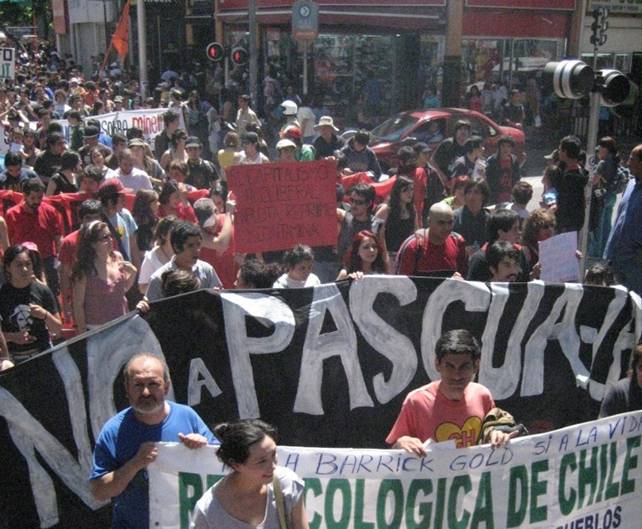
On one side of the world in Chile, over a thousand people went into the streets with costumes, music, and dancing to protest the proposed Pascua Lama gold project – a multi-billion dollar project that Barrick has been boasting the late 90’s – which threatens the fertile Huasco Valley. Meanwhile, almost the same number of strikers at Barrick’s Bulyanhulu mine in Tanzania refused to work after negotiations with Barrick management brokedown over salaries, working conditions, medical care and other contentious issues. Within four days, Barrick fired every striking worker.
While Barrick projects an image free from political controversy, these latest flares of organized resistance represent on-going struggles, discontent, and anger aimed at this mining giant.
When Opposing Pascua Lama was politically mainstream
For people outside Chile, it might be easy to forget that anti-gold mining sentiments aimed at protecting the environment dominated both President Bachelet and her erstwhile opponent, Sebastián Piñera’s election platforms last year. Both assured their constituents that the glaciers – which are situated right in the middle of a UNESCO biosphere reserve – would not be touched.
Then, in move that mine opponents believe was planned from the start, Barrick abandoned their first proposal to relocate the glaciers and the project was approved, with conditions meant to preserve the environmental integrity of the area’s sensitive ecosystem.
The mine’s opponents, including the Diaguita Huascoaltinos Indigenous group and Alto del Carmen councilperson Luís Faura Cortes, remained undeterred by what they see as paper assurances and politicking. What’s more, Barrick’s exploration activities have since been publicly revealed to be linked to a 56 to 70 percent depletion in the glaciers near the mine site, contradicting assurances in their environmental assessment reports.
Last weekend’s protest was just the latest in a series of protests against this mining project, and it represents that the resistance is still alive, and that folks on the ground in Chile are not deceived by Barrick’s political maneuverings.
Firing the Opposition will only make it burn Stronger
In Tanzania, it has been almost ten years since an estimated 30,000-400,000 small-scale miners were forced off the Buyanhulu mine site to make way for corporate mining. But this week’s decision to fire the thousand striking miners will no doubt rekindle this historic resentment. The deal to take this mining concession away from these small-scale miners was brokered by Sutton Resources’ CEO James Sinclair, who was a friend of the president of Tanzania and several senior ministers, as was his daughter.
Accusations of high-level nepotism have since plagued the Bulyanhulu operations, with allegations of millions in tax evasion surfacing last year. Additionally, just this July the Tanzanian government was criticized for signing a mining agreement with Barrick prematurely, and selling it’s 15 percent stake in the Bulyanhulu mine for too little money.
Beneath the political veneer, it appears that Barrick must appease growing movements of discontent. For more information on resistance to Barrick Gold in Nevada, Chile, Argentina, Tanzania, Australia, Peru, visit protestbarrick.net.
While Barrick projects an image free from political controversy, these latest flares of organized resistance represent on-going struggles, discontent, and anger aimed at this mining giant.
When Opposing Pascua Lama was politically mainstream
For people outside Chile, it might be easy to forget that anti-gold mining sentiments aimed at protecting the environment dominated both President Bachelet and her erstwhile opponent, Sebastián Piñera’s election platforms last year. Both assured their constituents that the glaciers – which are situated right in the middle of a UNESCO biosphere reserve – would not be touched.
Then, in move that mine opponents believe was planned from the start, Barrick abandoned their first proposal to relocate the glaciers and the project was approved, with conditions meant to preserve the environmental integrity of the area’s sensitive ecosystem.
The mine’s opponents, including the Diaguita Huascoaltinos Indigenous group and Alto del Carmen councilperson Luís Faura Cortes, remained undeterred by what they see as paper assurances and politicking. What’s more, Barrick’s exploration activities have since been publicly revealed to be linked to a 56 to 70 percent depletion in the glaciers near the mine site, contradicting assurances in their environmental assessment reports.
Last weekend’s protest was just the latest in a series of protests against this mining project, and it represents that the resistance is still alive, and that folks on the ground in Chile are not deceived by Barrick’s political maneuverings.
Firing the Opposition will only make it burn Stronger
In Tanzania, it has been almost ten years since an estimated 30,000-400,000 small-scale miners were forced off the Buyanhulu mine site to make way for corporate mining. But this week’s decision to fire the thousand striking miners will no doubt rekindle this historic resentment. The deal to take this mining concession away from these small-scale miners was brokered by Sutton Resources’ CEO James Sinclair, who was a friend of the president of Tanzania and several senior ministers, as was his daughter.
Accusations of high-level nepotism have since plagued the Bulyanhulu operations, with allegations of millions in tax evasion surfacing last year. Additionally, just this July the Tanzanian government was criticized for signing a mining agreement with Barrick prematurely, and selling it’s 15 percent stake in the Bulyanhulu mine for too little money.
Beneath the political veneer, it appears that Barrick must appease growing movements of discontent. For more information on resistance to Barrick Gold in Nevada, Chile, Argentina, Tanzania, Australia, Peru, visit protestbarrick.net.

10/10/07
Rainforest Warriors
tahi
This is an excellent and rare TV documentary about West Papua. A year on from its original UK screening it still has not been broadcast in any other country.
In 2006 reporter Evan Williams gained access, on a tourist visa, to West Papua - a country to which journalists and foreign observers are flatly refused entry by the Indonesian government. After three weeks dodging Indonesian officials and police to gather interviews and information, he filed this report for Channel 4's "Unreported World" series.
• We meet a group of tribal elders, some of whom have travelled for days, who congregate especially to tell the world media about widespread incidents of Indonesian killing and brutality in their native villages.
• The pretext for Evan Williams' visit to West Papua is the Wamena Festival, at which the local governor's speech proclaims Indonesia as "the ultimate in diversity". But for the locals, overrun by Indonesian oppression and largely outnumbered by subsidised Indonesian immigrants, is it diversity or occupation?
• Williams meets a man whose parents and friends were killed by the Indonesians and who has been fleeing the army, hiding out, for five years. He is led to a village in which the locals are mourning the deaths of relatives killed or missing since the March 2006 protests.
Channel 4
Original broadcast - October 20 2006
rua
toru
This is an excellent and rare TV documentary about West Papua. A year on from its original UK screening it still has not been broadcast in any other country.
In 2006 reporter Evan Williams gained access, on a tourist visa, to West Papua - a country to which journalists and foreign observers are flatly refused entry by the Indonesian government. After three weeks dodging Indonesian officials and police to gather interviews and information, he filed this report for Channel 4's "Unreported World" series.
• We meet a group of tribal elders, some of whom have travelled for days, who congregate especially to tell the world media about widespread incidents of Indonesian killing and brutality in their native villages.
• The pretext for Evan Williams' visit to West Papua is the Wamena Festival, at which the local governor's speech proclaims Indonesia as "the ultimate in diversity". But for the locals, overrun by Indonesian oppression and largely outnumbered by subsidised Indonesian immigrants, is it diversity or occupation?
• Williams meets a man whose parents and friends were killed by the Indonesians and who has been fleeing the army, hiding out, for five years. He is led to a village in which the locals are mourning the deaths of relatives killed or missing since the March 2006 protests.
Channel 4
Original broadcast - October 20 2006
rua
toru
Pacific Islands close to agreement on trade deal with European Union
Tonga and four other pacific countries are about to agree on an interim trade deal with the European Union (EU).
The Pacific Network on Globalisation (PANG) says that in a joint declaration after a ministerial-level meeting in Brussels, the EU and the Pacific countries said they have agreed to move on to some agreement.
“In view of the short time available until the deadline of 31 December 2007, it was necessary to conclude a World Trade Organisation (WTO)-compatible interim agreement as a stepping stone to a comprehensive EPA,” said PANG.
The Pacific countries involved in the talks include, Fiji, Samoa, Tonga, Tuvalu and Vanuatu.
Tonga was represented by the Hon. Minister for Labour, Commerce and Industries Lisiate ‘Akolo and Secretary for the Ministry Paulo Kautoke.
Interim agreement would include timetables for cutting tariffs on goods, rules of origin, and safeguard mechanisms for slowing sudden surges of imports plus possibly fisheries, competition and development issues.
The interim deal would enter into force on 01January and the two sides would seek a final EPA by the end of 2008.
PANG’s Director Roshni Sami said the Pacific had previously outlined their minimum negotiating position that no one facet of the deal is agreed on until the whole deal was agreed on.
“What we can see by this interim agreement is that actually that red line has been broken because they will be concluding negotiations on some sectors by December 31st 2007, according to this joint statement, and then the rest of the sectors will be negotiated and concluded by 2008. So you can see the Pacific’s arm has been twisted and the way they’ve done that is by including sugar in the EPAs.”
Tonga's delegation to the meeting returned yesterday.
8/25/07
Colorado AIM Call To Action: Newmont Mining Protest
Most of you know that Newmont Mining is the second largest mining
corporation in the world, and is based in Denver. Newmont operates on
every continent, except Antarctica, and almost every one of its
operations has negative impacts on First Nations people. In Peru,
indigenous activists have been beaten, imprisoned and killed in the
course of opposing Newmont's practices. The same can be said in Ghana
and Indonesia. In the U.S., Newmont, in collusion with the U.S.
government, is invading the territory of the Western Shoshone Nation
-- in violation of the Treaty of Ruby Valley of 1863. Next week, the
University of Denver, Graduate School of International Studies,
intends to honor Newmont in expectation of a huge corporate
contribution to the school.
The protest will be joined by Carrie Dann and Julie Fishel of the
Western Shoshone Defense Project. At the protest, the " Real
International Bridge-Builder Human Rights Award" will be awarded to
Carrie Dann, who will accept it on behalf of the Western Shoshone,
other indigenous communities, and all communities who have suffered,
but continue to resist, Newmont's policies and actions.
WHO: American Indian Movement (AIM) of Colorado, Global Response,
Rocky Mtn Peace and Justice Center, Stop Newmont Coalition, CU
Indigenous Support Network, and the Denver Justice and Peace
Commission are all protesting an award to be given by the U of Denver
to Wayne Murdy, CEO of Newmont Mining Company. Please join us!
WHAT: On Aug 30, at the black-tie Korbel Dinner, DU will be wining and
dining Denver's elite. This is a top-tier fund raiser for the Graduate
School of International Studies (GSIS), which touts its program on
International Human Rights. Newmont CEO Wayne Murdy will be presented
the "International Bridge Builder's Award." Former Secreatry of State
Madeleine Albright will be the keynote speaker.
WHY: To educate the public about Newmont Mining Corporation's myriad
human rights and environmental abuses in Indonesia, Ghana, Peru, San
Luis Valley in Colorado, Western Shoshone territory ( U.S.),
Australia, Romania and Mexico, and to let the University of Denver
know how inappropriate it is for Newmont to be receiving this award.
WHERE: The Denver Marriot on 17th and California, downtown Denver.
WHEN: Thursday, August 30th at 6pm
http://angryindian.blogspot.com/2007/08/fire-witch-rising-colorado-aim-call-to.html
Fire Witch Rising:
http://firewitchrising.blogspot.com/2007/08/colorado-aim-call-to-action-newmont.html
corporation in the world, and is based in Denver. Newmont operates on
every continent, except Antarctica, and almost every one of its
operations has negative impacts on First Nations people. In Peru,
indigenous activists have been beaten, imprisoned and killed in the
course of opposing Newmont's practices. The same can be said in Ghana
and Indonesia. In the U.S., Newmont, in collusion with the U.S.
government, is invading the territory of the Western Shoshone Nation
-- in violation of the Treaty of Ruby Valley of 1863. Next week, the
University of Denver, Graduate School of International Studies,
intends to honor Newmont in expectation of a huge corporate
contribution to the school.
The protest will be joined by Carrie Dann and Julie Fishel of the
Western Shoshone Defense Project. At the protest, the " Real
International Bridge-Builder Human Rights Award" will be awarded to
Carrie Dann, who will accept it on behalf of the Western Shoshone,
other indigenous communities, and all communities who have suffered,
but continue to resist, Newmont's policies and actions.
WHO: American Indian Movement (AIM) of Colorado, Global Response,
Rocky Mtn Peace and Justice Center, Stop Newmont Coalition, CU
Indigenous Support Network, and the Denver Justice and Peace
Commission are all protesting an award to be given by the U of Denver
to Wayne Murdy, CEO of Newmont Mining Company. Please join us!
WHAT: On Aug 30, at the black-tie Korbel Dinner, DU will be wining and
dining Denver's elite. This is a top-tier fund raiser for the Graduate
School of International Studies (GSIS), which touts its program on
International Human Rights. Newmont CEO Wayne Murdy will be presented
the "International Bridge Builder's Award." Former Secreatry of State
Madeleine Albright will be the keynote speaker.
WHY: To educate the public about Newmont Mining Corporation's myriad
human rights and environmental abuses in Indonesia, Ghana, Peru, San
Luis Valley in Colorado, Western Shoshone territory ( U.S.),
Australia, Romania and Mexico, and to let the University of Denver
know how inappropriate it is for Newmont to be receiving this award.
WHERE: The Denver Marriot on 17th and California, downtown Denver.
WHEN: Thursday, August 30th at 6pm
http://angryindian.blogspot.com/2007/08/fire-witch-rising-colorado-aim-call-to.html
Fire Witch Rising:
http://firewitchrising.blogspot.com/2007/08/colorado-aim-call-to-action-newmont.html
8/15/07
MNCs biggest foes of indigenous peoples’ rights
By Desiree Caluza
Inquirer
Posted date: August 13, 2007
BAGUIO CITY. The chair of the United Nations Permanent Forum on
Indigenous Issues said the biggest stumbling block to the adoption of
a UN document recognizing the rights of indigenous peoples is the
lobby started by multinational companies engaged in large businesses
around the world.
Victoria Tauli-Corpuz, UNPFII chair, said multinational companies from
Canada, New Zealand, Australia and the United States engaged in mining
and logging have been pressuring other countries to vote against the
UN Declaration on the Rights of Indigenous Peoples.
“[These firms] were against the declaration because they would like
[to keep] their business interests in countries where indigenous
peoples wanted to assert sovereign rights on their territories. They
were afraid that the declaration would stop them from extracting the
resources in indigenous peoples’ communities,” she said.
Corpuz, also executive director of the Baguio-based Tebtebba
Foundation (Indigenous Peoples’ International Center for Policy
Research and Education), said the Philippines, however, has started
gathering support from other countries to adopt the document.
The Declaration on the Rights of the Indigenous Peoples establishes
the rights of indigenous peoples to maintain and strengthen their own
institutions, cultures and traditions.
It addresses both individual and collective rights and protects their
cultural property and identity, and rights to education, health,
employment and language, among other things.
Corpuz said UN member-countries would vote to approve the declaration
on Sept. 17 in New York.
She said 67 countries have pledged to vote to approve the declaration
but votes from more than 20 countries are still needed to ensure its
adoption.
She said they are talking to representatives of African countries to
gather their support for the declaration.
African governments last year were apprehensive about supporting the
declaration, fearing African tribes might use the document as an
instrument for cessation, she said.
“We are confident that the declaration will be adopted to address the
hundreds of years of injustices to indigenous peoples,” she told a
regional consultation on the Second International Decade of the
World’s Indigenous Peoples here.
The consultation was attended by at least 100 representatives of
various tribes and organizations in the Cordillera.
http://newsinfo.inquirer.net/breakingnews/regions/view_article.php?article_id=82\333
Inquirer
Posted date: August 13, 2007
BAGUIO CITY. The chair of the United Nations Permanent Forum on
Indigenous Issues said the biggest stumbling block to the adoption of
a UN document recognizing the rights of indigenous peoples is the
lobby started by multinational companies engaged in large businesses
around the world.
Victoria Tauli-Corpuz, UNPFII chair, said multinational companies from
Canada, New Zealand, Australia and the United States engaged in mining
and logging have been pressuring other countries to vote against the
UN Declaration on the Rights of Indigenous Peoples.
“[These firms] were against the declaration because they would like
[to keep] their business interests in countries where indigenous
peoples wanted to assert sovereign rights on their territories. They
were afraid that the declaration would stop them from extracting the
resources in indigenous peoples’ communities,” she said.
Corpuz, also executive director of the Baguio-based Tebtebba
Foundation (Indigenous Peoples’ International Center for Policy
Research and Education), said the Philippines, however, has started
gathering support from other countries to adopt the document.
The Declaration on the Rights of the Indigenous Peoples establishes
the rights of indigenous peoples to maintain and strengthen their own
institutions, cultures and traditions.
It addresses both individual and collective rights and protects their
cultural property and identity, and rights to education, health,
employment and language, among other things.
Corpuz said UN member-countries would vote to approve the declaration
on Sept. 17 in New York.
She said 67 countries have pledged to vote to approve the declaration
but votes from more than 20 countries are still needed to ensure its
adoption.
She said they are talking to representatives of African countries to
gather their support for the declaration.
African governments last year were apprehensive about supporting the
declaration, fearing African tribes might use the document as an
instrument for cessation, she said.
“We are confident that the declaration will be adopted to address the
hundreds of years of injustices to indigenous peoples,” she told a
regional consultation on the Second International Decade of the
World’s Indigenous Peoples here.
The consultation was attended by at least 100 representatives of
various tribes and organizations in the Cordillera.
http://newsinfo.inquirer.net/breakingnews/regions/view_article.php?article_id=82\333
8/8/07
THE WORLD BANK AND IMF - ENFORCING A SYSTEM OF GLOBAL APARTHEID
·Global Apartheid refers to a system by which mostly white wealthy elites exploit and maintain control over poor people, predominately people of color, throughout the world. Similar to the former apartheid government in South Africa, it follows the legacies of colonialism, slavery, and genocide of indigenous peoples.
·The IMF and World Bank are controlled by wealthy, mainly Northern countries. The decision-making process at the IMF and World Bank is dominated by wealthy countries - many of the very same countries which formerly colonized large parts of Africa, Asia, and Latin America. This is because voting power is assigned through a one-dollar one-vote system, in which the voting power of a country is proportional to the size of its financial contribution to the Bank and IMF. The Group of 7 (G-7) countries of U.S., Canada, Britain, France, Germany, Japan, and Italy alone control about 50% of the decision-making power in the IMF and World Bank, and the U.S., with more than 17% of the vote, has effective veto power over some key decisions that require a supermajority of 85%. The vast majority of the world's people are people of color, living in the Global South; yet, they have a very limited voice in these supposedly global multilateral institutions which affect their lives so profoundly.
·The World Bank and IMF push policies on the Global South without any accountability. The IMF and World Bank use the debt of impoverished countries to impose all sorts of conditions, effectively micromanaging their economies. These conditions corrupt political systems and corrode self-determination, making governments accountable to foreign creditors rather than their own people. For example, when the parliament of Ghana decided to protect small farmers by imposing import duties on chickens and rice, the IMF retaliated by threatening Ghana's credit rating. They bullied the government to change its policy without regard to popular will in Ghana. When it comes to key economic policy issues, the countries of the South remain colonized!
·IMF and World Bank policies impoverish - and kill - people in the Global South. The IMF and World Bank consistently impose policies such as "labor market flexibility," trade liberalization, privatization, user fees, and budget caps on social services. These policies impoverish people in the global South by taking away their livelihoods while at the same time pricing essential services such as water and health care out of their reach, and crippling the ability of governments to provide those services. These policies cost lives, particularly in the context of serious public health crises, including the HIV/AIDS pandemic in Africa, which is threatening the future of an entire continent. By imposing user fees for health care on communities with widespread poverty and unemployment, these policies make the deaths of poor people from treatable diseases inevitable. The people who are being made poor, and who are dying, are people of color from the global South. And the people who get to make decisions that cost other people's lives in the name of economic efficiency (which usually means more profits for people like themselves), are wealthy, mainly white, people from Northern countries.
·World Bank projects disproportionately hurt indigenous peoples. The World Bank pours billions into environmentally destructive projects such as large dams, oil and gas, mining, and logging, which in a large number of cases affect indigenous communities. Indigenous peoples are displaced from their homes, farmlands, and traditional fisheries - which they have used for centuries - to make room for these projects. They almost never receive adequate compensation, and end up significantly poorer than before. Sometimes, as happened to the Maya people displaced by the Chixoy dam in Guatemala, they are subject to massacre or other violent repression if they try to resist.
·IMF and World Bank policies displace people and force them to migrate. People whose livelihoods are destroyed by the policies of the World Bank and IMF often have no choice but to migrate to wealthy Northern countries in search of work. The racist immigration systems of Northern countries are highly unlikely to give them travel documents, so they make the journey without documents, sometimes at great risk to their lives. Once in the North, undocumented immigrants usually work the lowest paying jobs, with long hours, hazardous working conditions, and no legal protections. Employers take advantage of their undocumented status to exploit them, and they remain in perpetual fear of discovery and deportation - a feeling reinforced by periodic immigration raids, which also serve to ensure that the workers are afraid to organize. Whether Latino immigrants in the US, or African immigrants in Europe, or Filipino immigrants in Japan, undocumented immigrants face the same kinds of oppression everywhere.
http://www.globalizethis.org/content/view/68/68/
·The IMF and World Bank are controlled by wealthy, mainly Northern countries. The decision-making process at the IMF and World Bank is dominated by wealthy countries - many of the very same countries which formerly colonized large parts of Africa, Asia, and Latin America. This is because voting power is assigned through a one-dollar one-vote system, in which the voting power of a country is proportional to the size of its financial contribution to the Bank and IMF. The Group of 7 (G-7) countries of U.S., Canada, Britain, France, Germany, Japan, and Italy alone control about 50% of the decision-making power in the IMF and World Bank, and the U.S., with more than 17% of the vote, has effective veto power over some key decisions that require a supermajority of 85%. The vast majority of the world's people are people of color, living in the Global South; yet, they have a very limited voice in these supposedly global multilateral institutions which affect their lives so profoundly.
·The World Bank and IMF push policies on the Global South without any accountability. The IMF and World Bank use the debt of impoverished countries to impose all sorts of conditions, effectively micromanaging their economies. These conditions corrupt political systems and corrode self-determination, making governments accountable to foreign creditors rather than their own people. For example, when the parliament of Ghana decided to protect small farmers by imposing import duties on chickens and rice, the IMF retaliated by threatening Ghana's credit rating. They bullied the government to change its policy without regard to popular will in Ghana. When it comes to key economic policy issues, the countries of the South remain colonized!
·IMF and World Bank policies impoverish - and kill - people in the Global South. The IMF and World Bank consistently impose policies such as "labor market flexibility," trade liberalization, privatization, user fees, and budget caps on social services. These policies impoverish people in the global South by taking away their livelihoods while at the same time pricing essential services such as water and health care out of their reach, and crippling the ability of governments to provide those services. These policies cost lives, particularly in the context of serious public health crises, including the HIV/AIDS pandemic in Africa, which is threatening the future of an entire continent. By imposing user fees for health care on communities with widespread poverty and unemployment, these policies make the deaths of poor people from treatable diseases inevitable. The people who are being made poor, and who are dying, are people of color from the global South. And the people who get to make decisions that cost other people's lives in the name of economic efficiency (which usually means more profits for people like themselves), are wealthy, mainly white, people from Northern countries.
·World Bank projects disproportionately hurt indigenous peoples. The World Bank pours billions into environmentally destructive projects such as large dams, oil and gas, mining, and logging, which in a large number of cases affect indigenous communities. Indigenous peoples are displaced from their homes, farmlands, and traditional fisheries - which they have used for centuries - to make room for these projects. They almost never receive adequate compensation, and end up significantly poorer than before. Sometimes, as happened to the Maya people displaced by the Chixoy dam in Guatemala, they are subject to massacre or other violent repression if they try to resist.
·IMF and World Bank policies displace people and force them to migrate. People whose livelihoods are destroyed by the policies of the World Bank and IMF often have no choice but to migrate to wealthy Northern countries in search of work. The racist immigration systems of Northern countries are highly unlikely to give them travel documents, so they make the journey without documents, sometimes at great risk to their lives. Once in the North, undocumented immigrants usually work the lowest paying jobs, with long hours, hazardous working conditions, and no legal protections. Employers take advantage of their undocumented status to exploit them, and they remain in perpetual fear of discovery and deportation - a feeling reinforced by periodic immigration raids, which also serve to ensure that the workers are afraid to organize. Whether Latino immigrants in the US, or African immigrants in Europe, or Filipino immigrants in Japan, undocumented immigrants face the same kinds of oppression everywhere.
http://www.globalizethis.org/content/view/68/68/
8/7/07
British Columbia: Nigeria North?
A video concerning Royal Dutch Shell, of Niger Delta infamy, and their coal bed methane plans in the Sacred Headwaters Basin, Mount Klappan, British Columbia.
Contact Shell! questions@shell.com
The five-minute documentary by the Victoria-based Dogwood Initiative focuses on Royal Dutch Shell's poor human rights track record in Nigeria. It draws parallels to Shell's proposed coalbed methane project in northern BC, which has been opposed by indigenous elders of the Tahltan First Nation.
8/5/07
Scrap the SPP
Resist the Security and Prosperity Partnership Agreement. Continental Day of Action August 20th
==> LEARN ABOUT THE CORPORATE LOBBY BEHIND THE SPP:
The North American Competitiveness Council (NACC) was launched as part of
the Security and Prosperity Partnership (SPP) in June 2006. It is the only
formal advisory board to the SPP and is made up of 30 corporate leaders
from Canada, the U.S. and Mexico with ten advisors from each of the SPP
signatory states. A September 13, 2006 story in Maclean’s magazine
describes NACC as a “cherrypicked group of executives who were whisked to
Cancun in March by the leaders of Canada, the U.S. and Mexico, and asked
to come up with a plan for taking North American integration beyond
NAFTA.”
Read more at: http://noii-van.resist.ca/?p=438
==> WHAT IS THE SPP?
The Security and Prosperity Partnership of North America (SPP) was founded
in March 2005 at a summit of the Heads of State of Canada, the US, and
Mexico. SPP is not an official treaty; it is not an official law;
therefore it has been able to escape any public scrutiny. The major drive
behind the SPP is a CEO-based organization, which is the only official
advisory group to governments on the SPP.
The real face of SPP is to further an agenda of corporate free trade,
border militarization, criminalization of migration, privatization and
theft of indigenous land and resources, repression in the name of national
security, impoverishment and displacement, and cooperation in war and
occupation.
The SPP is a NAFTA-plus-Homeland-Security model and will involve the
harmonization of over 300 areas of regulations, including: integration of
the military and police, expansion of temporary worker programs as a means
of ensuring low wages, coordination of no-fly lists, expedited resource
extraction particularly oil and water on unceded indigenous territories,
and harmonization of health and environmental regulations to lower
standards and development of a North American alternative to the Kyoto
Protocol.
Read more at: http://noii-van.resist.ca/?page_id=102*
Please check http://noii-van.resist.ca frequently for updates or contact
the Scrap SPP Campaign at scrapspp@gmail.com or call 778 885 0040
======================================
* No One Is Ilegal Vancover is an antiauthoritarian anticapitalist initiative
6/18/07
Rio Tinto rape the Tai Tokerau

I've been putting off putting this stuff up. I have been gutted to know that Rio Tino are surveying for mining some of our families ancestral lands. Some elders from the NT are talking in Melbourne tonight. (7pm Old Council Chambers Trades Hall)we will be sure to welcome and support their struggles against earth raping Mining companies.
Rio Tinto to acquire Iron Ore NZ interest in Prospecting Permit
The renewal documents for the prospecting permit #39287 include the
immediate acqisition of a 60% interest the the permit previously held
by John Rutherford owned Iron Ore NZ Ltd. The permit renewal also
indicates a future total transfer of the interest to Rio Tinto Mining
and Exploration Ltd - a newly formed company #1918541 reg 16 March 2007
Rio Tinto (parent and subsiduary companies) have the attention of
environmental watchdogs in Indonesia WALHI ,in Madagascar Friends of
the Earthand the Jabiluka Uranium Friends of the Earth lease in the
Northern Territory of Australia
While still raising the ire of the conservation and environmental
lobby, Rio Tinto has developed policy to address the environmental
effects of their mining operations. Rio Tinto Environmental Policy.
The proof of the adequacy will be in the historical audit of the
mining operations when compared with the policy.
Let us hope there is no white wash.
http://www.blacksands.org.nz/new/home.htm
Closeup looks at the issues of the anti seabed mining lobby KASM and
questions representitives from Iron Ore NZ, Crown Minerals and
Taranaki Regional Council
http://www.blacksands.org.nz/new/media/sandmining_241105_128k.wmv
Northland region may have valuable untapped mineral resources.
> 5:00AM Thursday June 14, 2007
> By Wayne Thompson
>
> One of the world's largest mining companies has begun an airborne
> survey of 1200sq km of mineral-rich ironsand deposits along the west
> coast of the North Island.
>
> The Rio Tinto company is managing the hunt for iron and other metals
> in a joint-venture with Iron Ore New Zealand, which won the
> prospecting permit from the Crown Minerals Group in the Ministry of
> Energy.
>
> As the survey aircraft yesterday flew low and slow over the permit
> area - at Mokau, north Taranaki and the west coast of south Auckland -
> iwi and environmental groups and the Auckland Regional Council
> scrambled for more information about the venture.
>
> Fears were expressed for the impact of any dredging on the maui's
> dolphin, a species considered critically endangered, found only off
> the west coast from Northland to New Plymouth.
>
> Ngati Te Ata environment manager Karl Flavell said he had scant
> information about the prospecting.
>
> "We have not been consulted although we are the tribal authority for
> the area from Manukau Heads to Maioro, the north side of Port Waikato
> Heads."
>
>
> ARC environment chairman Dianne Glenn said she raised three chief
> concerns about the prospecting at this week's council meeting. "As a
> result the ARC will write to the Government's conservation, economic
> development and fisheries ministers.
>
> "One of our concerns is that the maui's dolphin has a particularly
> strong presence in the permit area - the Waikato River mouth to
> Manukau Harbour.
>
> "We are also concerned at extra erosion of the coast if there is
> extraction of sand."
>
> Mrs Glenn said another concern was any mining interference with the
> build up of the Auckland construction industry's future sand supplies
> in the Kaipara Harbour. A further concern was the effect of sand
> extraction on Franklin's surf beaches - Sunset Beach, at Port Waikato
> and Karioitahi.
>
> Kiwis Against Sand Mining spokesman (Kasm) Bill McNatty said he felt
> the Rio Tinto joint venture was more "ominous" than previous seabed
> prospecting bids on the west coast because of the powerful company's
> environmental record in its operations internationally.
>
> Kasm raised 15,000 signatures for a petition calling for a blanket ban
> on ironsand mining of the seabed. The petition was presented to
> Parliament in February and is being considered by the Local Government
> and Environment Committee.
>
> Mr McNatty said Kasm had sought information from Rio Tinto and it
> would make strong representations to Crown Minerals if the prospecting
> advanced to the next stage - applying for an exploration permit.
>
> ARC coastal project leader Andrew Benson said the site within the
> Auckland Coastal Marine Area was about 480sq km, extending from the
> northern side of the Waikato River mouth along the Awhitu Peninsula to
> the South Head of Manukau Harbour.
>
> The landward boundary of the prospecting area was the line of mean
> high-water mark. The offshore boundary was a line more or less
> parallel to the Awhitu Peninsula, 15km off shore.
>
> Mr Benson said that the Auckland Regional Coastal Plan allowed
> prospecting that involved the taking of a small quantity of material,
> subject to conditions.
>
> Coastal permits - a resource consent allowing prospecting activity -
> had not been sought.
>
> However, the company advised they might take physical samples early
> next year and would then assess their need for coastal permits to
> provide for prospecting.
>
> A spokeswoman for Rio Tinto Iron ore, Joanna McKenzie, said last night
> from Perth that the aircraft was conducting aeromagnetic surveys over
> sites in the permit area.
>
> The company owns Comalco, which has the aluminium smelter at Bluff, in
> the South Island.
>
> The survey conducted by Auckland-based Kiwi Air and Perth-based UTS
> Geophysics will take a fortnight and the survey plane will fly at a
> minimum of 20m above the sea and follows grid lines 200m apart
> >
> > Qui Bono - Who Profits ?
> > by Corporate Plunder Watcher Saturday June 09, 2007 at 12:38 PM
> > Whoever gets elected at local Council, State Government or
> > Commonwealth Federal level they follow the profit hungry Corporations
> > like in theis case the world's largest mining/earth rape racketeers.
> > Like the Barrick Gold protests if you want to fight and even land a
> > few blows on these parasites then you have to
> > globalise/internationalise extend whatever you want to call the
> > campaign beyond Oz to bring in other indiegnous people and their
> > supporters...
> >
> > http://www.sea-us.org.au/corpfilez/riverofblood.html
> >
> > Rio Tinto PLC / Ltd - The Merger of CRA & RTZ
> >
> > The multinational mining giant, Rio Tinto, has grown out of the
> > former Australian and United Kingdom mining conglomerates, CRA and
> > RTZ, respectively. They have been actively involved in uranium mining
> > since the dawn of the nuclear industry for over 50 years. In the
> > 1950's, CRA managed the disastrous Rum Jungle uranium mine south of
> > Darwin, NT (although it was owned by the Commonwealth Government),
> > while RTZ controlled and operated the controversial Mary Kathleen
> > uranium mine in the Mt Isa region of Queensland. Both mines shut down
> > in the late and early 1960's, respectively, although Mary Kathleen was
> > re-opened in the late 1970's for a further 6 years.
"Marakita_Mehme wrote:
> > >
> > > Caution urged over mining potential
> > > The Bay Chronicle | Thursday, 7 June 2007
> > >
> > >
> > > The announcement of Northland's billion dollar mining potential has
> > > drawn a guarded response from Far North Environment Centre
coordinator
> > > John Kenderdine.
> > > He says extra economic activity is always welcome if it will add to
> > > the well-being of a community but he fears any movement toward
> > > weakening the Resource Management Act to accommodate exploration and
> > > mining companies.
> > > "The environment is the life support system for all life on this
> > > planet so we have to ensure that additions to our economy, on
which we
> > > base our welfare, is good for everyone in the long term."
> > > Mr Kenderdine said he spent three summers working for exploration
> > > companies in British Columbia, where he heard exaggerated reports on
> > > what had been found: "This was to jack up the share price to suck in
> > > more punters looking for a quick buck, but it was only ever the
> > > manipulators who made the money. While I have no doubt there are
many
> > > reputable exploration companies around, I doubt that our local
> > > councils have the expertise to recognise the cowboys before they do
> > > irreparable damage."
> > > Last week's announcement, based on a study by GNS Science and the NZ
> > > Institute of Economic Research, said $28 billion of non-metallic and
> > > $5.2 billion of metallic mineral deposits were potentially
present in
> > > Northland.
> > > The Foundation of Research Science and Technology funded the
> > > assessment, while the study of the economic effects was supported by
> > > the Crown Minerals Group of the Ministry of Economic Development and
> > > the Far North and Whangarei District Councils, with Enterprise
> > > Northland facilitating the process.
> > > GNS Science and NZIER identifies potential for aluminium, coal,
> > > copper, gold, lead, mercury, nickel, peat, phosphate and zinc
and says
> > > Northland?s mineral revenue could increase from about $100 million a
> > > year to $354 million.
4/19/07
Transnational Capitalism An Interview with William Robinson
| |
|
Professor of Sociology, Global and International Studies, and Latin American and Iberian Studies, University of California at Santa Barbara
Interviewed by the Greek newspaper Eleftherotypia
1. You argue that we are witnessing a world historical transition into a new phase of capitalism, with new forms of power and new forms of resistance. First, what’s new about capitalism today?
The key characteristic of this new epoch is the rise of truly transnational capital and a new globally integrated production and financial system. Production has become fragmented into countless and constantly changing phases that are decentralized and dispersed across the planet. In turn, the distinct segments are functionally integrated into vast global chains of production and distribution. Each autonomous national economy has been restructured and externally integrated, so that each “national” economy because a constituent part of the larger global production system.
We also now have a truly global financial system. There is no longer any such thing as a national financial system. In fact, finance capital is the most mobile and the most transnationalized fraction of capital. This has major implications. Money capital exists in cyberspace, where it recognizes no borders and faces few, if any, state controls. Money capital subordinates fixed capital. Those who control money capital can appropriate values anywhere in the world by financial manipulation and relocate them on an ongoing basis to anywhere else in the world.
This globally-integrated production and financial system underscores the increasing interpenetration of capital in all parts of the world, organized around the giant transnational corporations that drive the global economy.
There are important new mechanisms that facilitate this transnationalization of capital. The spread of stock markets, for instance, from the principal centers of the world economy to many if not most capital cities around the world, combined with 24 hour trading, facilitates an ever greater global trading and hence transnational ownership of shares. The global integration of national financial systems and new forms of money capital, including secondary derivative markets, has also made it easier for capital ownership to transnationalize.
Other mechanisms of integration are the sharp rise in foreign direct investment and the spread of TNC affiliates, the phenomenal increase in cross-border mergers and acquisitions, the growth of transnational interlocking of boards of directorates, the spread of cross-border strategic alliances of all sorts, and the mounting influence of transnational peak business associations.
In this way, a transnational capitalist class has come into existence as the manifest agent of capitalist globalization.
2. You are not saying that national or regional capitals no longer exist, are you?
No, I am not saying that. But there is a new type of class fractionation between local and national fractions of capital, on the one hand, and transnational fractions on the other. Transnational capital is now the hegemonic fraction of capital on a world scale. Trasnationally-oriented capitalist groups and elites are present now in all countries around the world, including in the state. These fractions, or their bureaucratic allies, exercise considerable influence if not outright control within most of the state apparatuses around the world. They often dictate policy.
We need to see here how capitalism has been reorganized into a new network structure, so that the system functions through interconnected webs that stretch across the globe. This is important because the old corporate dinosaur vertical structures are extinct. Now capital functions through vast networks of subcontracting and outsourcing, through numerous forms of alliance between different capitalist groups and other economic agents.
I am pointing this out because it is transnational capital that stands at the pinnacle of these global networks. This means that there still may be local and national capitals but they cannot compete with transnationally mobile capital. If they want to remain competitive, if they want to continue playing the game, they must link up with transnational capital, and they must do so, structurally, in a way that subordinates them to transnational capital.
3. Can we also speak of a global working class?
Yes. There is a global working class that runs the factories, farms, and offices of the global economy. Their ranks can be found in the maquiladoras, in the agro-industrial complexes around the world, among the armies of service workers in global cities. However, the global working class is internally stratified. It is divided along national - as well as racial, ethnic, and gender - lines. The continued existence of the nation-state serves to distort the consciousness and subjective experience of the global working class.
In distinction, the transnational capitalist class is a class group with a subjective consciousness of itself and its interests. Its members increasingly socialize together in their private institutions such as the World Economic Forum in Davos and develop a transnational class consciousness. In this sense it is a class-for-itself, to use Marx’s language on this matter, whereas the global working class is a class-in-itself but not yet for-itself.
3. Where does actual political power rest in this new form of global capitalism that you describe?
There is a new transnational configuration of power. In part, this is where a transnational state comes into play, which is another novel aspect of the new epoch. The question is how can the transnational capitalist class exercise its political authority? Well, one way is through utilizing existing state apparatus in each country, and we have seen plenty of that. Another is through the transformation of existing international institutions, such as the old Bretton Woods institutions or the agencies of the United Nations system, and the creation of entirely new ones, such as the World Trade Organization. Transnational capital attempts to convert the structural power of the global economy over individual countries and over working classes in each nation-state into direct political authority or influence through this transnational state apparatus.
Transnational institutions attempt to coordinate global capitalism and imposing capitalist domination beyond national borders. The IMF, for instance, by imposing a structural adjustment program that opens up a given country to the penetration of transnational capital, the subordination of local labor, and the extraction of wealth by transnational capitalists, is operating as a transnational state institution to facilitate the exploitation of local labor by global capital.
Although it is true that nation-state power and autonomy has declined in relation to transnational power structures, this image is somewhat misleading since these transnational power structures are localized within each nation by concrete social forces that are materially and politically part of the emergent transnational power bloc.
4. In this context, how should we interpret America’s struggle for hegemony and global expansion?
Your question assumes that U.S. foreign policy must be interpreted as a struggle for U.S. national hegemony. I don’t believe we can understand global hegemony, or the role of the U.S. state in the world, from such a nation-state/interstate framework. Nation-state centric analyses of inter- and transnational relations fail to appreciate the integrative character of global capitalism.
If by imperialism, we mean relentless pressures for outward expansion of capitalism and distinct political, military and cultural mechanisms that facilitate that expansion, then, yes, we are obviously seeing ongoing imperialism in 21st century. But there is nothing in this “new” imperialism to suggest it is a U.S. drive for empire in competition with other nation-state capitalists. Those who make this argument have frozen their historical analysis in an earlier moment. They are trapped in world of late 19th and early 20th century. They see world capitalism as still in its national “monopoly” stage of Lenin’s and Hilferding’s day, so that U.S. interv
ntionism can only be a drive for “U.S.” hegemony over other states.
Recent U.S. policies such as the imposition of neo-liberal structural adjustment programs and sponsorship of free trade agreements have served to further pry open regions and sectors around world to global capitalism, to transnational capital. The IMF and other transnational state agencies have not acted as simple instruments of “U.S.” imperialism. I know of no single IMF structural adjustment program that creates conditions in intervened country that favors “U.S.” capital in any special way, rather than opening up the intervened country, its labor and resources, to capitalists from any corner of world. The first thing the U.S. occupation forces did after the invasion of Iraq was not to seal off country to all but its own capital but to decree a foreign investment law that invited capitals from any corner of the world to invest.
The U.S. state has attempted to play a leadership role on behalf of transnational capitalist interests. That it is increasingly unable to do so points not to heightened national rivalry but to the impossibility of the task at hand given the crisis of global capitalism. In this sense, interventionism and militarized globalization are less a campaign for U.S. hegemony than a contradictory response to the crisis of global capitalism – to economic stagnation, legitimation problems, and rise of counter-hegemonic forces.
5. What specific, new problems does the new globalism produce?
The system is in chaos; its contradictions are explosive and, frankly, humanity is in grave danger. The global crisis is one of social polarization and social reproduction, reflecting the deeper structural problem of over-accumulation. The crisis is also of sustainability. An ecological holocaust has already begun. If we do not pull back from the precipice, and very soon, we could well be facing catastrophic consequences.
Let’s step back and see the big picture. The 1980s saw a recovery of profits following the decline of the 1970s. There was a massive wave of transnational investment in the 1980s and the 1990s, leading to overcapacity and overproduction. Capital began increasingly to seek an investment outlet through financial speculation – the notorious “casino capitalism.” The volatility of financial speculation in the face of over-accumulation led to the 1995 Mexico peso crisis and its “tequila effect” elsewhere, followed by the 1997-98 Asian financial meltdown, the Russian, Turkish, and Brazilian crises, and worldwide recession in 2001-02.
It is at this point that structural and political pressures building up in the system lead towards a militarization of global accumulation. The U.S. state as the guarantor of the system sought to open up new outlets for the global surplus through a military Keynesianism and a war mobilization, through the “creative destruction” of war. From the 1990s to date we seen a shift in the axis of accumulation, from computer and information technology as the cutting edge, along with financial speculation in stocks, real estate, and so forth, to a military-industrial-petroleum-construction-engineering complex.
States are responsive to the demands of transnational capital yet are unable to capture and redistribute surpluses, to regulate the circuits of accumulation, and therefore to fulfill social functions. States cannot absorb popular demands and resolve contradictions. All this leads to crises of legitimacy and governability, to chronic instability, to waves of crime, social decomposition, spreading anomie.
The problem of social control in the global capitalist order becomes primordial. This was symbolized in the late 2005 insurrection of the excluded in Paris. We are seeing a transition from social welfare to social control states, the rise of police states that manage prison-industrial complexes to contain the excluded population, new forms of social and spatial apartheid, social cleansing, Katrina-type militarized control responses to disasters and other stresses. We may be heading more generally towards a global police state.
6. Hasn’t globalization also led many nations out from underdevelopment?
Your question is phrased within a misleading nation-state framework of analysis, as if what “develops” or what is “underdeveloped” is a nation-state. This ignores class polarization, power relations, and social inequality within each nation-state. Globalization has turned many people in the South into participants – consumers - in the global marketplace – and spread the culture of global capitalism, with its individualism, consumerism, escapism and banality. But it has generated downward mobility, marginality and immiseration for many more.
Inequalities worldwide have reached unprecedented proportions. The pattern is a polarization between 20 percent of the population that is advancing, on the one hand, and 80 percent that is falling behind, on the other. There are new transnational class inequalities that cannot be understood within the North-South divide. The global South is increasingly dispersed across the planet so too is the global North. India now has 200 million middle class consumers who participate in the global market, as does China, even while majorities in those countries sink into destitution. Global social polarization is cutting across national lines in new ways.
7. What viable strategies do you see for challenging transnational capitalism?
Social justice requires a measure of transnational social governance over this global production and financial system as a necessary first step in a radical redistribution of wealth and power to poor majorities. What would such a new redistributive component involve and how would it come about? Certainly it would require a reversal of neo-liberal policies at the nation-state level. But redistribution is not enough. It must be linked to the transformation of class and property relations. Local class and property relations have global implications. Webs of interdependence link the local to the global.
Pockets of counter-hegemony are now emerging more clearly, for example, in the rise of an anti-neo-liberal power bloc in Latin America centered around Venezuela. Nonetheless, the challenge is how to convert a reactive global resistance into a proactive global program. The recent experiences of Venezuela, Brazil, South Africa, and Haiti, among others, make clear the limitations to reintroduction of a redistributive project at nation-state level alone.
Any challenge to capitalist state power must involve a major transnational component. Struggles at nation-state level are far from futile. They remain central to the prospects for social justice and progressive social change. But any such struggles must be part of a more expansive transnational counterhegemonic project and a program to rein in on the global market and the power of global capital. An alternative to global capitalism must be a transnational project, involving transnational trade unionism, transnational social movements, transnational political organizations, and so on.http://www.zmag.org/content/showarticle.cfm?SectionID=13&ItemID=12582
Subscribe to:
Posts (Atom)