Showing posts with label police oppression. Show all posts

10/27/08

Free Lex Wotton NOW

Lex Wotton.jpg
Last Friday an all white jury found Lex Wotton, an Aboriginal man from Palm Island, guilty of 'rioting with destruction' for his involvement in the 2004 Palm Island uprising. On November 26th 2004 the people of Palm Island set fire to the local police station, court house and police barracks after a pathologist's report claimed that the death of Mulrunji Doomadgee, a 36 year old local, in police custody a week earlier was an 'accident'. Mulrunji died in a police cell, one hour after he had been arrested for being drunk. He suffered massive internal injuries, including a ruptured spleen, four broken ribs and a 'liver that had been 'almost cleaved in two' from a huge compressive force.'

The officer who arrested him, Senior Sergeant Chris Hurley, claimed that Mulrunji had fallen on stairs. A coroner's inquest found that Senior Sergeant Chris Hurley was responsible for Mulrunji's death, as the injuries were consistent with a beating. However, a court found Hurley not guilty for manslaughter. He has since been promoted and is an Inspector on the Gold Coast.

In comparison Lex Wotton is now facing a life sentence in prison. He is being held in prison until his next court appearance in the Townsville District Court on November 7.

9/10/08

Pascoes Waka

this is an eye witness account of the pressure and intimidation that continues on the defendants and their whanau. With the reporting of the "evidence" being suppressed, the media part of this state/police repression operation/campaign was given a major blow, so it looks like nga poaka are feeling desperate


11/09/08 around 11am Maryanne and I walked down from the court course making our way across the road to the coffee shop to purchase a bottle of pump water and a cuppa chino.

As we crossed the road several cars were parked outside the coffee shop. We walked behind 1 of the cars as it was pretty much right outside the coffee shop. We walked behind this car towards the coffee shop. Maryanne noticed marks on the silver car she pointed as we walked by look at that I starred as we carried on walking to the shop oh hell wander who owns that car. Maryanne said I think its Pascoe’s. I said oh hell someone don’t like him as we carried into the shop. We purchase a bottle of pump and waited for our cuppa chino. We then turned around to go back to the court.

Outside the coffee shop a man in a white stripped t-shirt forcefully holding our whanau members arms namely Watene. The man in the white stripe t-shirt was vicious as he was continuous yelling at Watene accusing him of damaging police property. The man in the white striped t-shirt started going red as a beetroot shaking he was very shaky his hands were shaking his face was evil. Watene’s partner was holding onto his arms saying this is my husband why are you doing this to him he hasn’t done anything your just picking on us. The man in the white striped t-shirt then whacked Bonnie in the head with his right hand. She flew back from the blow trying to balance her self from falling. She came back yelling leave my husband he’s done nothing who are you. Watene was holding onto his sausage roll it fell and someone picked it up and ate his sausage roll.


I tapped the man in the white striped t-shirt and said why he is under arrest he turned around and whacked me on the chest with his right arm. I then yelled out on the loud speaker to the audience of people who watched it all going down, did you see that people did you see that man assault me. The man yelled and told me to shut up. I continued to use the loud speaker. Within seconds 3-5 police cars showed up. They all got out of their cars some ran to the scene some walked. The man in the white striped t-shirt then pulled out from his waste area a badge showed it to the police and told them to arrest watene’s partner namely Bonnie.

They immediately grabbed her she continued yelling that’s my husband leave him alone why are you doing this we have done nothing leave us alone leave us alone. The police who grabbed Bonnie from behind grabbed her arms pulled them to the back and were pulling her towards their vehicles. I heard them saying to Bonnie your under arrest for resisting arrest. They then took her to the police vehicle and put her and drove off. They also did that to Watene. There were lots of people watching this scene there were also a couple of media I believe as I saw them taking photos.

We then proceeded to the police station taking all of Watene and Bonnie tamariki with us.

While waiting at the police station Bonny’s baby was screaming for milk as the baby is a breast fed baby. We asked if they could allow Bonnie to feed her baby. They denied our request and said not at this time she be 10min. 10min went by 20 minutes went by so we asked again could you take baby to be fed she’s a breast fed baby. They refused saying she wont be too long half and hour. 45 minutes later she was released.


8/22/08

August 30th - Day of Action - Drop the Charges!

Demonstrations and protests are being planned around the world for the global day of action to 'Drop the Charges' against the 20 people arrested in the nationwide State Terror Raids of 15 October 2007.
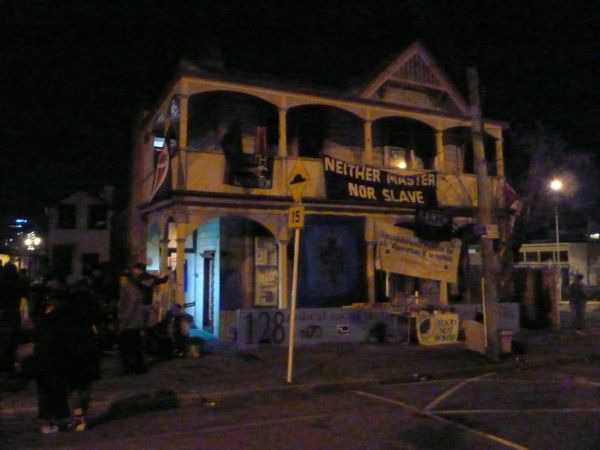
  • Wellington / Te Whanganui-a-Tara: Meet at 12noon at 128 Abel Smith Street, Te Aro. March through town - speakers and music
  • Auckland / Tāmaki-makau-rau: Meet at 12noon in Aotea Square for a rally
The deposition hearing (i.e. the pre-trial) starts in the Auckland District Court on Monday, 1 September 2008. There is a hearing in the High Court in Auckland on 22 August, too. Several defendants have filed applications regarding the police affidavits that was used to gain search and interception warrants. This is likely to be held 'in chambers' and thus not open to the public. Second, the High Court will hear an application for bail variation for Valerie Morse and Emily Bailey that would allow them to associate. As it stands, Valerie and Emily have limited association as consented to by the Crown. They are seeking a removal of any restriction on association.

Intro | Legal | Tūhoe | Solidarity | 30 August | Solidarity Statement | Fairfax | Donate | AIMC Features | Links
On Monday, October 15th 2007, more than 300 police carried out dawn raids on dozens of houses all over Aotearoa / New Zealand. Police claim the raids were in response to 'concrete terrorist threats' from indigenous activists. The reality, however, included heavily armed police terrorising an entire township. To date, no evidence of the so-called terrorist plot has been revealed.

Police arrested 17 indigenous, anarchist, environmental and anti-war activists, including people from Tūhoe, Te Atiawa, Maniapoto, Ngā Puhi and Pakeha. Police wanted to charge 12 people under the Terrorism Suppression Act (TSA), however the Solicitor-General denied the police permission to proceed. After four weeks in jail everyone was released on bail. On Tuesday, February 19th 2008, police raided further properties, arresting 3 more men. All were released on bail with strict conditions that same day. A woman was arrested on Thursday April 17th, 2008, and also faces charges under the Arms Act.

Legal update: lead up to the deposition hearing in Auckland

The deposition hearing (i.e. the pre-trial) starts in the Auckland District Court on Monday, 1 September 2008. There is a hearing in the High Court in Auckland on 22 August, too. Several defendants have filed applications regarding the police affidavits that was used to gain search and interception warrants. This is likely to be held 'in chambers' and thus not open to the public. Second, the High Court will hear an application for bail variation for Valerie Morse and Emily Bailey that would allow them to associate. As it stands, Valerie and Emily have limited association as consented to by the Crown. They are seeking a removal of any restriction on association.

The deposition hearing has been set down to start 1 September and will sit until 11 September. There will be a recess for one week. Court will resume on Monday, 22 September and run until 3 October (unless it finishes early).

All but one of the 20 defendants are due to have a depositions hearing starting on 1 September in the Auckland District Court. This hearing is effectively a preliminary step in which the Crown must prove that it has a 'prima facie' case (literally a case 'on the face of it') against each of the accused. There will be the presentation of evidence to determine whether the defendant has a case to answer before a jury. There is a low threshold to prove a 'prima facie' case - A prima facie case is one that at first glance presents sufficient evidence for the plaintiff (the Crown) to win. Following this, defendants will be committed to trial by jury. This will likely happen in mid- to late 2009. One defendant, Raunatiri Hunt, will have a deposition hearing in Tauranga on 20 November 2008.

During the depositions, the defendants can call any of the Crown's witnesses. This will be their opportunity to see the extent of the case against them and get clarification on various matters and statements. All of the arrestees have been excused from attending this hearing as long as they have legal representation. However, the October 15th Solidarity support crew is urging arrestees and whānau to attend at least the first week to get a clear idea of what is happening.

The crown has said that they will lay a whole heap more Arms Act charges. This will mean that Tame Iti for example will face 38 charges - the 20 defendants will probably face around 400 charges together! The crown has indicated that they will call 132 witnesses in their case.

Tūhoe - the struggle for Mana Motuhake

Ngāi Tūhoe entered the beehive with around 500 people in late July for the signing of the Terms of Negotiations for their historical Waitangi Tribunal claims. When entering the semi-circular banquet hall, a haka - Te Pūru - was chanted. The formal proceedings were done with Te Ati Awa kawa. Two Te Ati Awa kaumata did a whaikōrero followed by Minister of Māori Affairs, Parekura Horomia. Then a speaker of Ngāi Tūhoe responded. He talked about the colonial invasions in the 1860s and 1916 and the confiscation of land aswell as the state terror raids last October. Michael Cullen, Minister of Minister in Charge of Treaty of Waitangi Negotiations, addressed Ngāi Tūhoe. "I would also like to briefly acknowledge that less than a year ago the events at Ruatoki provided a fresh point of tension in our relationship. It would not be appropriate or helpful for me to comment on the merits of the events of last October. I know emotions are still raw and opinions strongly held. But I am very pleased that less than a year later we are able to join together to show that it is the future that is first and foremost on the minds of Ngai Tuhoe."

However, the actions of Te Weeti Tihi during the signing itself show that Ngāi Tūhoe has not forgotten the raids last year, nor the confiscation, the scorched earth campaigns and murder in previous years. Te Weeti, who was arrested on 15th October 2007 when he challenged police setting up their roadblock on the confiscation line just out of Rūātoki, refused to shake hands with Michael Cullen and instead showed him his middle finger.

Tāmati Kruger, chairperson of Te Kotahi ā Tūhoe Trust said there would be some sensitive issues in negotiations that could create "unease" for the Crown. "I think the tricky issues are around Tuhoe's desire and wish to have Te Urewera National Park regarded as part of our territory. The second one that would be difficult for the Crown would be discussions over self government, over mana motuhake and sovereignty." He said that he has recently met with Police Commissioner Howard Broad to settle out of court over last year's state terror raids. It is rumored that Broad will visit Te Urewera in October this year - or in Tame Iti's words: "Broadband is coming to Rūātoki."

Tame Iti gave Michael Cullen a taiaha during the ceremony. "Te rākau nei, kei te haere ki te minita, mo te hoki mai o te whenua, ko Te Mana Motuhake ō Tūhoe. Ae, me whakawhiti korero tātou, ko Te Mana Motuhake ō Tūhoe kia hoki mai a Te Urewera. ko te kaupapa nui inaianei, me pehea, me aha?"

Ngāi Tūhoe signs Terms of Negotiation http://indymedia.org.nz/newswire/display/75809/index.php

We did it once…Let's do it again!

The solidarity movement on the streets in October and November 2007 is probably the main reason why charges under the Terrorism Suppression Act were never laid and everybody who faces charges is currently on bail. Thousands of people marched across Aotearoa and the world to stand in solidarity with the people in prison. Over 1000 people marched to Mount Eden prison in October 2007 in Auckland to demand the immediate release of all arrestees.

Since then, the various groups have raised thousands of dollars. The Wellington October 15th Solidarity group can now pay for the use of the marae during the deposition hearing so that defendants, whanau and friends have a place to stay.

August 30th - Global Day of Action
  • Wellington / Te Whanganui-a-Tara: Meet at 12noon at 128 Abel Smith Street, Te Aro. March through town - speakers and music
  • Auckland / Tāmaki-makau-rau: Meet at 12noon in Aotea Square for a rally
  • Vancouver (Canada): Film Screening at Spartacus Books, 684 East Hastings, at 7pm. Money to support the accused!
Why have a day of action?
The day of action is a chance to educate and inform people about what is happening with the case. Many people believe that since the Terrorism charges were not successfully laid by Police, that everything is fine. We need to let people know that the case is on-going. It also is an opportunity to re-ignite involvement in the issues of Tino Rangatiratanga, Te Mana Motuhake o Tuhoe and repealing of the Terrorism Suppression Act. People can come along to express their rage, anger and sadness at the raids, and their on-going commitment to the solidarity work.

What is happening?
There are demonstrations and actions being planned around the globe. In Wellington, there will be an action starting at 12 noon at 128 Abel Smith Street. People should come along prepared for a demonstration and protest. It might include a tour of the places that were raided and a visit to the local police station. Bring along your signs, banners, placards, do some street theatre and make some noise for justice and freedom!

Statement of support: October 15th Solidarity

We demand the unconditional freedom of the people who are facing charges as a result of the state terror raids on 15 October 2007.

Attempts by the Police to lay charges under the Terrorism Suppression Act (TSA) failed but people are still facing politically motivated charges under the Arms Act. These charges are the result of a racist operation.

Police used the Terrorism Suppression Act and over $8 million to harass and punish political activists who they saw as supporting Tino Rangatiratanga.

The Police have arrested a few people but we're all targeted. The arrests of 15 October are aimed at intimidating and frightening all of our communities and cannot be tolerated.

We therefore call on everyone to stand up against this attack on our communities. We support the global day of action on 30 August 2008 and are mobilising to demand the unconditional freedom of the people facing charges as a result of the state terror raids.

Supporting organisations (21st August 2008)

"…al Qaeda had arrived" - Tim Pankhurst and Fairfax New Zealand in court

Five days have been put aside in September for the solicitor-general's case against Dominion Post editor Tim Pankhurst and Fairfax New Zealand. David Collins is taking contempt proceedings against them for publishing 'Operation 8' conversations secretly recorded by police over their two year investigation. The court hearing start on 15th September 2008 in Wellington. This decision was announced by Justice Randerson in the Supreme Court.

Two judges, Justice Randerson and someone else, will be in court for the hearing. A telephone conference will take place on 9th September to finalise the dates. Jail is a possibility, but only if it is sought by the solicitor-general. In this case, jail is not being sought and only Fairfax could face a fine. Collins has not applied to have Pankhurst fined.

On 14th November 2007, the Dominion Post and The Press published information which they obtained of the 155-pages search warrant which was used to raid over 40 homes on 15th October 2007. The Dom Post called it 'The Terrorism Files'. They printed several quotes without attributing them to anyone. "To help ensure that [revealing what police found relating to the terrorism charges will not influence those firearms cases] we removed the names from the material" wrote Pankhurst in his editorial on 14th November. David Collins said that "the articles were sensational in tone and highly memorable." He went on to say that the decision not to attribute comments to individual defendants had the effect of attributing them equally to all of those charged.

Pankhurst said that "Police needed to treat [what was happening in Te Urewera] seriously and needed to investigate. To do anything less would have been to fail in their duty to protect New Zealanders. We believe that the police were right to act. However, we also believe the public has the right to make its own judgment on the police's credibility, and to do that it needs as much information as possible, within the bounds of the law and within the bounds of fairness to all those involved. That is why we decided to publish."

Curiously, the Dominion Post did not believe that the public needed to make its own judgement about suppressed information regarding the rapist police officers Brad Shipton, Bob Schollum and Clint Rickards during their gang rape trial in 2006. The suppressed information, that two of these men were already serving prison time for a nearly identical offence and that more trials were forthcoming, might have resulted in a very different outcome had the public been made aware of it.

If the Dominion Post is in fact so interested informing the public, perhaps they could endeavour to publish the entire 25,000 pages that have so far been disclosed to the defendants (plus around 200 DVDs with video and photo material). Reading through these pages, any person will be able to see the racist nature of 'Operation 8' and what this colonial government is really scared of: indigenous sovereignty.

Struggle against capital - capital to the struggle ;-)
  • October 15th Solidarity Cheques - Please make your cheque payable to 'October 15 Solidarity', and post to October 15 Solidarity, PO Box 9263, Wellington, New Zealand.

    Wire or Transfer Details - Bank: Kiwibank, Account name: October 15 Solidarity, Account Number: 38-9007-0239672-000

    This is a Wellington based group that formed in the immediate aftermath of the raids. It does both support work and political organising. Deposits made with the code "Support" will be dedicated towards supporting all those affected by the raids, arrests and on-going court appearances.

  • Legal Defence Fund

    Cheques - Please make your cheque payable to 'Peace Action Wellington'
    and post to: 128 Abel Smith St, Wellington.

    Wire or Transfer Details - Bank: BNZ, Account name: Peace Action
    Wellington, Account number: 02 0536 0458570 00, Bank address: Bank of New Zealand, North End Branch, Pastoral House, 100 Lambton Quay, Wellington

    Money donated to this account with the tagline "Legal Defence" will go towards the legal costs of all those still facing charges under the Arms Act. The money collected for legal defence will be shared among defendants
    according to their need.

  • Te Mana Motuhake o Tuhoe fund:

    Wire or Transfer Details - Bank: BNZ Bank, Account name: Tūhoe Trust, Account number, 02-0488-0170643-00, Bank Address, BNZ Bank, Whakatāne Branch, 181 The Strand, Whakatane.

    The struggle for Te Mana Motuhake ō Tūhoe is the struggle for self-determination of Tūhoe people and sovereignty over their lands. Donations made to the Tūhoe trust support this struggle.

  • Rotorua regional fund:

    Cheques - Please make your cheque payable to 'Nga Tai o te Reinga', and post to Nga Tai o te Reinga, 61B Iles Rd, Lynmore, Rotorua.

    Wire or Transfer Details - Bank: Kiwibank, Branch: Te Ngae, Account name: Nga Tai o te Reinga, Account Number: 38-9002-0653401-00, Bank address: Kiwibank Limited, Te Ngae Branch, Te Ngae PostShop, Shop 7, 512 - 518 Te Ngae Road, Rotorua.

  • Civil Rights Defence - Auckland:

    Cheques - Please make your cheque payable to 'Global Peace and Justice Auckland', and post to GPJA, PO Box 7175, Wellesley St, Auckland.

    Wire or Transfer Details - Bank: Kiwibank, Account name: Global Peace and Justice Auckland, Account Number: 38-9000-0099726-00. Particulars/Code/Reference: Defence Fund

    Civil Rights Defence is an Auckland based group that formed in the immediate aftermath of the raids. Money donated to Civil Rights Defence goes to their campaigns and also to projects such as bringing people from Ruatoki to Auckland for court.

  • Te Kotahi a Tuhoe fund:

    Cheques - Please make your cheque payable to 'Te Kotahi a Tuhoe' and post to: Te Kotahi a Tuhoe, PO Box 47, Taneatua, Whakatane.

    Wire or Transfer Details - Bank: ASB, Account name: Te Kotahi a Tuhoe, Account Number: 12-3253-0032178-50, Bank address: ASB Bank, Whakatane Branch, 202 The Strand, Whakatane or PO Box 682, Whakatane 3158.

    Te Kotahi ā Tūhoe supports Tūhoe who were affected by the raids on October 15th. The worst actions of the police that day were taken against Tūhoe and the community of Ruatoki was terrorised.

    Te Kotahi ā Tūhoe engaged Peter Williams to investigate the police actions at Ruatoki on 15 October, and represent them in claims against the crown arising from those actions. Donations you make would support this work.

Aotearoa Indymedia Features: Police raid houses across Aotearoa under anti-terrorism legislation, at least a dozen arrests (15 Oct. 07) | 17 activists arrested, denied bail. 300+ Police raid houses across the country (15 Oct. 07) | Solidarity with the Urewera 17! Free them now! (17 Oct. 07) | Stop the Terror Laws! Free our Friends! (19 Oct. 07) | "Raise your voice before you lose your soul" - protests across Aotearoa (20 Oct. 07) | Urewera 17 Update: Bail Denied, Another Police Raid, Another Activist Named, Wellington Activists Moved (26 Oct. 07) | Across the world, people demand freedom for political prisoners! (27 Oct. 07) | Urewera 16 in court - 2 more bailed (2 Nov. 07) | 150 People Protest Labour Conference in Tamaki Makaurau (3 Nov. 07) | Two more prisoners lose name supression (7 Nov. 07) | No terrorism charges for the Urewera 16! (8 Nov. 07) | Tuhoe Hikoi Arrives at Parliament (14 Nov. 07) | The struggle continues… (19 Nov. 07) | Thousands gather in solidarity with October 15th arrestees and against the Terrorism Supression Act (1 Dec. 07) | Tame Iti back in jail for one night (11 Dec. 07) | UN to investigate New Zealand Government over conduct of the Oct 15 raids (26 Jan. 08) | Waitangi Day protests across Aotearoa (6 Feb. 08) | More Raids, 3 More Arrests in Tuhoe (19 Feb. 08) | La Lucha Sigue… Protests against raids and arrests (23 Feb. 08) | 'Operation 8' defendants back in court on March 5th (3 Mar. 2008) | Labour Party conference to be held responsible for Operation 8 (9 April 08) | Labour party humiliated by protest at election congress (12 April 08) | Further 'Operation 8' arrest in Auckland (17 April 08) | Tūhoe freedom fighter in Porirua District Court (1 May 08) | October 15th Solidarity - State Terror court update (21 May 08) | The SIG at it again (7 June 08) | Sign onto the October 15th Solidarity Statement (2 July 08) | SOUL FIRE - a night of dancing in solidarity with those affected by the police "terror raids" (30 July 08) | Ngāi Tūhoe signs Terms of Negotiation (1 Aug. 08) | Operation Eight bail variation denied (15 Aug. 08)

Links: October 15th Solidarity | Te Mana Motuhake o Tuhoe | AoCafe | Civil Rights Defence | Te Kotahi a Tuhoe | Tūhoe: History of resistance | Tu Kotahi - Freedom Fighting Anthems

7/31/07

Why Fuck the Police

thanks to http://www.crimethinc.com/police/

Criticism of opposition to the police usually falls into one of five categories. The first common argument is that the police, as our fellow workers, are also exploited members of the proletariat, and should therefore be our allies. Unfortunately, there is a vast gap between “should” and “is.” The police exist to enforce the will of the powerful; anyone who has not had a bad experience with them is likely either privileged or submissive. Today’s police officers, at least in North America, know exactly what they’re getting into when they join the force; people in uniform don’t just get cats out of trees in this country. Yes, most take the job because of what they feel to be economic necessity, but needing a paycheck is no excuse for obeying orders to evict families, harass young men of color, or pepper spray demonstrators; those whose consciences can be bought are everyone else’s enemies, not potential allies.


This argument could be more persuasive if it was couched in strategic terms, rather than Marxist abstractions: for example, “Every revolution succeeds at the moment the armed forces refuse to make war on their fellows; therefore we should focus on seducing the police to our side of the barricades.” But again, the police are not just any workers; they are the ones who have most deliberately chosen to base their livelihoods and value systems upon the prevailing order, and thus are the least likely to be sympathetic to those who struggle against hierarchy. This being the case, it makes sense to focus on opposing the police as such, not on seeking solidarity with them. So long as they serve their masters, they cannot be our allies; by publicly deriding the police as an institution, we encourage individual police officers to seek other employment, so we can find common cause with them.

The second argument is that the police can win any confrontation, so we shouldn’t invest ourselves in strategies that involve confronting them[1]. It may seem that, with all their guns and armor and equipment, the police are invincible, but this is an illusion. They are limited by all sorts of invisible constraints—bureaucracy, public opinion, their own need to avoid inconvenient escalation. This is why a motley crowd armed only with the tear gas canisters shot at them can hold off a larger, more organized, better equipped force; contests between social unrest and military might are not played out according to the rules of military engagement.

Those who have studied the police, who can predict what they are prepared for and what they can and cannot do, can usually outsmart and outmaneuver them. Such small victories can be inspiring for those who chafe under the heel of police repression, as well as instrumental in accomplishing concrete goals. In the collective unconscious of our society, the police are the ultimate bastion of reality, the force that ensures that things stay the way they are; to fight them and win, however temporarily, is to show that reality is negotiable.

The third argument is that the police are a mere distraction from the real enemy, not worth our wrath or attention. Alas, state power is not just the politicians; they would be powerless without the millions who do their bidding. When we contest their control, we are also contesting the submission of their flunkies, and we are sure sooner or later to come up against those of the latter who insist on submitting. That being said, it’s true that the police are no more integral to hierarchy than the oppressive dynamics in our own communities; they are simply the external manifestation, on a larger scale, of the same phenomena. If we are to contest hierarchy everywhere, rather than specializing in combating certain forms of it while leaving others unchallenged, we have to be prepared to take it on both in the streets and in our own bedrooms; we can’t expect to win on one front without fighting on the other. We shouldn’t fetishize confrontations with uniformed foes, we shouldn’t forget the power imbalances in our own ranks—but neither should we be content merely to manage the details of our own oppression in a non-hierarchical manner[2].

The fourth and most despicable argument is that we need police. According to this line of thinking, even if we can aspire to live in a society without police in the distant future, we need them today, for people are not ready to live with each other in peace without armed enforcers. As if the social imbalances and submissiveness maintained by the violence of the police are peace! Opponents of the police need not even answer this charge, however. It’s not as if a police-free society is suddenly going to appear overnight, for good or for ill, just because someone spraypaints “Fuck the Police” on a wall—if only it was so easy! The protracted struggle it is going to take to free our communities of police repression will probably go on as long as it takes us to learn to coexist peacefully; indeed, no community incapable of sorting out its own conflicts can expect to triumph against a more powerful occupying force. In the meantime, anti-police sentiments should be seen as objections to one of the most advanced and egregious forms of conflict between human beings, not arguments that without police there would be no conflict at all; and those who argue that the police sometimes do good things bear the burden of proving that those same good things could not be accomplished at least as well by other means.

The final and most nuanced objection to militant resistance against police oppression is the pacifist critique of violence itself. According to this account, violence is inherently a form of domination, and thus inconsistent with opposition to domination; those who engage in violence play the same game as their oppressors, thereby losing from the outset. Others hold that violence enforces unequal power dynamics in some cases, while in other cases it contests them—that is to say, there is such a thing as self-defense. For those whose value system is still descended from Christianity, keeping one’s hands clean of immoral behavior is the top priority, at whatever cost; for the rest of us, who desire to be free of superstitious prohibitions, the most important thing is what will work, in a given context, to make the world a better place. Sometimes—to name an obvious example, in the struggle against Nazi Germany—this may include violence.

To make this clear: yes, cops are people too, and deserve the same respect due all living things. The point is not that they deserve to suffer, or that we have to bring them to justice—that’s Christian morality again, dealing in currencies of superstition and resentment. The point is that, in purely pragmatic terms, in order that others not have to suffer, it may be necessary to interrupt, by militant and confrontational means, the injustices perpetrated by police officers. It can be empowering for those who have spent their lives under the heel of oppression to contemplate finally settling the score with their oppressors; however, a real liberation struggle does not focus on exacting revenge, but rather on solving problems so that all might have better lives. Therefore, while it may even sometimes be necessary to set police on fire, this should not be done out of a spirit of vengeful self-righteousness, but from a place of careful thought and compassion—if not for the police themselves, then for all those who would otherwise suffer at their hands.

One could make the argument that encouraging people to struggle against the police does more to publicize disapproval of them than to cause actual assaults. One could even argue that it thereby does a service not only for those who suffer police oppression, but also for the families of police officers and even for the officers themselves—for not only do police officers have a disproportionately high rate of domestic violence and child abuse, they also get killed, commit suicide, and become addicts with disproportionate frequency. Anything that demoralizes police officers and delegitimizes their authority, thus encouraging them to quit their posts, is in their best interest as well as the interest of their loved ones and society at large.

5/5/07

Protest, Politics and Policing


Excellent article by Victoria & Shane. We are all back in the Gubba Court this Friday .


Victoria Stead and Shane Reside

This article is in the current issue of Arena Magazine (April-May 2007)


In the aftermath of last November’s protests against the G20 summit in Melbourne, Victorian Police have conducted a massive operation against individuals allegedly involved in the three day mobilisation. Under the banner of Taskforce Salver, dozens of houses have been raided, undercover snatch squads have been used to grab people from the streets, and photos of individuals deemed ‘persons of interest’ have been published in newspapers and on Crime Stoppers. At the time of writing, over 35 people have been arrested and charged with offences including riot, affray and conduct endangering persons. Some of these charges carry sentences of up to ten years imprisonment.

The Police operation over the last few months suggests disturbing shifts in the policing of protest and dissent. Particularly, the response to the G20 mobilisation highlights the dangerous relationship between ‘community policing’ and more authoritarian tendencies within the Victorian Police force.

Compared to the policing of the demonstrations against the World Economic Forum in Melbourne in 2000, the police response to the G20 protest has been markedly different. When tens of thousands of people converged at the Crown Casino five years ago to successfully disrupt the summit of the World Economic Forum, police responded with a massive display of violent force. Unprovoked charges, overhead baton strikes and outright brutality left scores of demonstrators injured, many of them seriously. In the lead up to the G20 protest, Police Chief Commissioner Christine Nixon publicly made it clear that the policing operation this time was not going to be a repeat performance

. Instead, she employed a range of tactics including: a centrally controlled and staged increase in police force ‘appropriate’ to the context; low barriers instead of high security fences around the summit site; and the use of ‘crowd safety officers’ whose role was to circulate amongst demonstrators handing out cards recommending the suitability of alternate protest venues which were, not surprisingly, out of sight of the G20 delegates, inner-city businesses, and pretty much everyone else in Melbourne.
Nixon’s ‘softly, softly’ approach fits within the model of ‘community policing’ which has been advocated by the Victorian Police command since the early 1980s while facing ongoing resistance from the bulk of the Police rank and file. Studies conducted in the 1990s showed that community policing continued to be viewed by the majority of officers as primarily a public relations exercise.

Instead, rank and file officers have tended to support the more authoritarian approach advocated by the powerful Police Association. The tension between these two approaches – community policing and authoritarian policing – is in turn deeply rooted in the ongoing power play between the Police Association and the Victorian Police command.

The recent policing of protests such as the G20 needs to be seen within the context of this struggle within the Victorian Police force. Increasingly, the approach to the policing of political dissent is being shaped by a dangerous combination of elements from both of the tendencies within the force.

As Jude McCulloch has argued, community policing has become the ‘velvet glove that covers the iron fist’ of increasingly repressive and authoritarian policing in Victoria. While this has long been evident in over-policed Indigenous and working class communities across the state, the G20 mobilisation and its aftermath provides a case in point of the dangers of this twin-bladed approach.

Based on a community policing framework, Nixon’s ‘softly, softly’ approach hinged on containing the mobilisation. Protest was to be allowed, so long as it remained non-contentious, passive and preferably out of sight. Given these parameters, a confrontation between police and protestors was always going to be highly likely.

While there is a wide diversity of opinions amongst protestors regarding tactics, a belief in the need for direct action has long been a hallmark of progressive social movements. And the space for action offered by the community policing approach simply does not allow this.

As it happened, there were attempts by demonstrators to breach the police cordons and disrupt the G20 summit meeting on the first day of the mobilisation. Clashes with police ensued, and it quickly became clear that the Chief Commissioner’s approach did not enjoy the support of the rank and file officers who were there. Nixon had been scheduled to appear at a fundraising dinner that Saturday evening, performing a rendition of ‘It’s Raining Men’, no less. Instead, she was forced to cancel her appointment and rush to the barricades to appease her surly troops.

It would appear that in the face of rank and file unrest, a green light was given for police to utilize all the force at their disposal for both the remainder of the mobilisation and the days and months following. Certainly, there appears to have been a significant and rapid turn around in police tactics. When a small group of protestors gathered at the Melbourne Museum the next day – where G20 delegates were enjoying a little cultural respite from the hard work of summit negotiations – police launched without warning into an unprovoked baton charge. One woman was so badly injured that she required hospitalisation.

The authoritarian policing tactics have continued since. A round up of protestors began on the morning of the 18th, with snatch squads grabbing people off the streets. One man, Drasko Boljevic, was snatched by unidentified men, thrown in the back of an unmarked white van and held for hours. Not only did he have no idea who his assailants were, it later transpired that he had not even been present at the protest. Dozens more have faced intimidation and harassment, regardless of their degree of involvement in any violence. In the backlash against Nixon’s approach, the Police Association has decryied the ‘lack of appropriate resources’ given to officers, and the ‘grave OH&S dangers’ they faced. And in a style that ex-Queensland Premier Joh Bielke-Peterson would be proud of, it has even gone so far as to suggest a blanket ban on the right to protest. Unsurprisingly, mainstream media commentators and politicians have jumped into the fray, bemoaning the decay of law-and-order and going all out to demonise those involved in the mobilisation as violent thugs.

Regardless of the debate over the use of property damage, the policing of the G20 and the continuing actions of the Salver Taskforce should be a cause for concern for everyone who believes in the need for grassroots movements to organise in opposition to the neoliberal agenda being pushed by institutions such as the G20.

The twin-bladed approach of community policing and authoritarian tendencies, arising from the tensions and power struggles within the Victorian Police force, has potentially grave implications for the right of ordinary people to dissent. The space for protest is shrinking for us all. As we come up against the barrage of neoliberalism, militarism, environmental destruction, racist border controls and draconian IR legislation, the right to protest is something we all need to defend.

4/27/07

Public Forum on Anti-terror legislation and the G20 arrests

Report from ORGASN/CRD solidarity meeting

It was a big turnout – I counted a few over 70 people. Good mix of ages.

Anita from ORGASN gave a fantastic speech encompassing the history of the G20 as it developed from the G7. She reiterated the ridiculousness of the claim to representation of the G20 (cos governments don’t represent the populace) and defended the attacks on the police van as an important step in confronting the fear that people have over the police, whose role is to enforce submission to capitalist social and economic relations. Anita invited people to be part of court solidarity actions and to join us in calling for the charges to be dropped.


Marcus Banks from Austudy 5 talked about the history of diverse, militant actions in the lead-up to the Austudy 5 cases in 1992. From the AIDEX Arms Fair in 1991 (3 day demonstration involving 3,000 people, including students, the Food Preservers Union, Domestic Violence and Incest Survivor activists) at which the Defence Minister Robert Ray was forced to cancel his speech because of the tripods, demonstrations, etc. The Arms Fair organisers actually asked the government to declare a state of emergency, and activists were accused of bizarre things like hurling oranges with syringes stuck in them at police, and covering themselves in shit. The Anti-Bush (snr) demos in early 1992 followed.

Marcus put the Austudy demonstrations in the context of the ALP/Keating neo-liberal assault, and the Gulf War. He gave an entertaining description of the Melbourne National Day of Action on March 26th, which was described as a”riot” in all the dailies. 4 people were de-arrested from a police van which was surrounded, rocked, graffitied and had its tyres let down. Those in the van were released. The day before the next action, 5 members of the ISO were raided and charged with unlawful assembly, releasing people from police custody and a number of other charges. These raids were co-ordinated with the media for maximum negative exposure. Marcus passed around a newspaper article in which the police declared the establishment of a new police unit to destroy the ISO. Marcus talked about the support he got from his trade union because he had gone to the demos in his role as delegate. Police claimed that they arrested the ISO activists because they couldn’t find the people from the police van – one of these, an NUS Education officer, issued press releases informing the cops that he’d been in the van. He wasn’t arrested. At the trial by jury that eventually ensued, a deal was struck by which all charges would be dropped except lawful assembly, and all would 5 would cop a 2 year good behaviour bond. Marcus emphasisied that the language of the defence campaign was frame in terms of rights, but rights that were political, social, economic – not framed in terms of limited legal rights.

Colin Mitchell and Lisa Farrance from CRD spoke of the victimisation of Jack Thomas and the Barwon 13. Colin emphasised that the Barwon 13 are being treated as guilty before being charged. He also talked about the truly terrifying case of Faheem Lohdi. Lohdi, a Sydney architect, was convicted in June 2006 of preparing for a terrorist act, and sentenced to 20 years in prison. He was convicted on the basis of downloading photos of various “sensitive sites” some of which he had worked on as an architect, of making enquiries about obtaining chemicals that the prosecution alleged could be used to make explosives [note: for those who want an example of what kind of chemicals can be hypothesised by cops desperate for a conviction as “potential explosives” please see the cases of the Guildford Four and Maguire Seven – people might know the movie “In the Name of the Father” based on these cases…], and of having “radical” Islamic views – whatever that means…


Rob Stary – now, I don’t like lawyers as a general rule, but this guy was great. He publicly acknowledged the work of Civil Rights Defence in defending Jack Thomas, and gave us a bit of a reminder of the history of the persecution and then failed prosecution of Jack Thomas. Stary, Mark Taft and Lex Lasry are now being called as witnesses by the prosecution to prevent them from representing Jack.

Rob talked about the flimsy evidence against the Barwon 13. Basically, that they have been charged with being members of an unnamed terrorist organization, of which they are members (and which bears a striking resemblance to their prayer circle), then of financing and supporting this unnamed organization. And they have been charged with “possession of a thing”. A thing can be anything that is connected to “terror” a computer with naughty documents on it, for example. It seems unclear exactly what the “thing” that they possess is. But, they did go camping together, and this apparently seals the case against them. The trial judge is the same Public prosecutor in charge of pursuing the Austudy 5, Bernard Bongiorno. Rob reminded people of the crazy charges used against anti-Nike crew and the Austudy 5, and against forest activists, and that the new National Security Information Act means that people can be tried in their absence and the absence of any legal representation.

Rob talked about being swamped with DVDs and evidence and that this is a tactic to make the legal reps lives very difficult.

There will be a mention this week of the G20 case. But Rob indicated that the May 11 court appearance would only go ahead if people pleased guilty. So its not that likely….


Discussion centred around the desire to get unions on board, and the need to get together some simple info to spread around (i.e leaflets) so people can hand out the info at workplaces. People also talked about the importance of APEC organising, and the direct link between the intense pressure on Sydney arrestees in particular, and APEC organising.

At the pub, we talked about fun ideas for organising APEC proxies, for those who can't leave the state cos of bail conditions...


by K Flat Friday April 27, 2007 at 01:31 AM

http://melbourne.indymedia.org/news/2007/04/144091.php

Article relating to public forum at Fitzroy Town hall last night on the G20 arrests.

Last night at the Fitzroy Town Hall a crowd of around 50 people attended a public meeting organised by the G20 solidarity network and Civil Rights Defence. Speakers discussed the current political climate in regards to anti-terror legislation and the charges facing the G20 arrestees.

The first speaker, Anita Thompson, discussed the tactics used in the stop-G20 movement and the media representations of both the protests and the subsequent arrests. Forty people have now been arrested in relation to the G20 protests.

Thompson said attempts by protesters to breach police barricades were a challenge to the G20 system - a system which sustains a world order whereby "twenty percent of the world's people control eighty percent of the world wealth".

Thompson argued that protesters "embraced a diversity of tactics" and they were far from the "apolitical thugs" that the media had portrayed them to be. She stated that "capitalism is inherently violent" and the police should not be viewed as "a neutral body". Thompson further stated that the crackdown on those involved in the G20 protests should be seen as an attempt by the state to demonise protesters and delegitimise the right to demonstrate.

Marcus Banks then spoke regarding his experiences with Austudy 5. Banks said that like the G20 arrestees, these protests resulted in dawn raids by the police and a "cascade of charges". Banks said the police tended to use militant actions as "an opportunity" to arrest and repress unpopular groups and individuals. He said the affect of this was "to make people feel fearful" causing actions to become less militant. Colin Mitchell of Civil Rights Defense supported this sentiment, saying that the charges against the G20 arrestees were symptomatic of the "demonisation for political purposes" that is a characteristic of the war on terror.

Rob Starry, the lawyer who is defending some of the G20 arrestees, Jack Thomas and the Barwon 13, then gave an update on these cases and how they can be viewed in light of recent anti-terror legislation.

Starry stated that the case against Muslim convert Jack Thomas is currently being adjourned after a number of trials and retrials. Thomas is charged with possessing a falsified passport and receiving funds from a terrorist organisation. Starry also spoke of the charges against the so-called Barwon 13, who are facing multiple charges in relation to allegations that they attended terrorist training camps.

Starry said that since July 2002 the Commonwealth Government has passed forty pieces of anti-terror legislation almost unanimously. He said that the most worrying piece of legislation inducted was the National Security Information Act, which allows court proceedings to be conducted in secret, in the absence of the accused or the legal representative.

In regards to G20 arrests, Starry said that charges like riot, affray and criminal damage were "an incredible overreaction" by the police to "a bit of property damage" and they will "cost the community literally millions of dollars".

The case against the G20 protesters is listed for mention tomorrow. However, Starry told the audience rather emphatically "we're not pleading guilty."

There are meetings at Trades Hall on every second Friday (I think?) in solidarity with the G20 arrestees.

Thanks to Food not Bombs for supplying the lovely nibblies.

Indigenous advocate criticises move-on powers

Last Update: Friday, April 27, 2007. 7:32am (AEST)

The Aboriginal Justice Advocacy Committee is angry about a new Northern Territory policing strategy.

Police are being trained for what is called the new Social Order Crime Reduction Strategy.

Under the plan, officers on the beat will move people on more regularly in an attempt to avoid situations escalating into violence or anti-social behaviour.

The advocacy group's Chris Howse says the Government should be addressing the reasons people are on the street instead.

"This committee is sick and tired of hearing about such policies as so-called proactive policing in the Alice Springs area that will result in people getting locked up and families being split apart when the overall problem is neglected gravely by governments and councils," he said.

4/18/07

New Plymouth Pigs Burn Maori Woman off Property

A WOMAN at the centre of a land dispute at Urenui was devastated to discover all her belongings have perished in a suspicious blaze.
pigs.jpg


what is passed off as police in New Zealand never ceases to turn my guts, unless it's what's passed off as a judge ofcourse. Late on Sunday afternoon a series of suspicious fires destroyed all of Margaret Eriwata's possessions, including a make-shift house, two caravans and two campervans, leaving her with nothing more than the clothes on her back.

Ms Eriwata (53) has been fighting for almost four years for the right to live on her share of 20ha of farmland on Mataro Rd, Urenui, which was left to her in her grandfather's 1922 will. Police are not investigating the fires. Ms Eriwata says she is devastated by what has happened.Last year Ms Eriwata was evicted from the land after Justice Wild in the New Plymouth High Court said he was satisfied she was in contempt of court orders prohibiting her from staying on the land.

Ten cars were removed from the land and lined up along the road side but were later moved back on to the land. Ms Eriwata had not seen the damage for herself, she spent Sunday night in police custody after being arrested for breaching her totally unreasonable bail conditions by returning to her property only hours before the fires were lit. (by the police) Ms Eriwata, who is vowing to continue her fight to live onher land, says she was tipped off about the fires and tried to stop the police.

She says police did nothing and have not investigated death threats she has received. Waitara police Senior Sergeant Matt Prendergast says police treat all complaints they receive seriously while grinning ear to ear. The fires were being treated as suspicious, he said, with a chuckle.

http://indymedia.org.nz/newswire/display/72891/index.php

4/16/07

Man sues police over his arrest

Chris Evans
April 16, 2007

AN ABORIGINAL man injured in a controversial arrest in 2004, which witnesses likened to the infamous 1991 bashing of Rodney King in Los Angeles, is suing the state of Victoria and five policemen for damages.

Victorian Aboriginal Legal Service lawyers, acting for convicted car thief Raymond William Merritt, have lodged a writ for damages and costs in the County Court.

They claim Merritt suffered multiple injuries, including a burst left ear drum. Merritt's claim states he suffered a broken jaw joint, cuts to his head and swelling to his head and arm after being hit with batons. He also suffered loss of consciousness, anxiety, nightmares and emotional distress.

The first mention of the case will be heard by judge Sandra Davis in the County Court tomorrow.

A year after the arrest, the police were cleared of wrongdoing by the Ombudsman's then deputy director for police integrity, Brian Hardiman.

He found the police acted within the law when they intercepted and arrested Merritt at the wheel of a stolen Holden Calais, after they used satellite tracking equipment to stop the car by remote control in Melbourne Park on February 1, 2004.

Mr Hardiman found the police feared Merritt was armed.

"In any event, had he obeyed police instructions, opened the door and surrendered, police may not have needed to use force against Mr Merritt, who is very tall (195 centimetres), well built and powerful (90 kilograms)," Mr Hardiman found.

At least five people, including English pop musician Nitin Sawhney, told The Age at the time they saw up to 10 police drag Merritt, 27, through a smashed car window and slam his head on its roof in Batman Avenue near Rod Laver Arena.

They said police pulled him to the ground and punched and kicked him. Sawhney likened the arrest of Merritt to the bashing of African-American motorist Rodney King by Los Angeles police "but it was like 20 times worse".

In a statement of defence, the Victorian Government Solicitor denies the allegations.

Violent arrest report to get restricted release

By Jason Dowling
January 23, 2005
Constable Adam Runciman leaves court after giving evidence against Raymond Merritt, inset. A report into alleged police brutality against Mr Merritt will not be made public.

Constable Adam Runciman leaves court after giving evidence against Raymond Merritt, inset. A report into alleged police brutality against Mr Merritt will not be made public.
Photo: Andrew De La Rue

The findings of an investigation into the conduct of police during the allegedly violent arrest of a car thief in Melbourne last year will be made known this week.

But the report - by the office of police integrity, part of the office of State Ombudsman George Brouwer - will only be made available to those who complained about the man's treatment.

Witnesses complained about police who intercepted a stolen Holden Calais on the Exhibition Street extension last February and arrested Raymond William Merritt after triggering the car's immobilising system.

According to five people who witnessed the arrest, police repeatedly beat Merritt, dragged him through the car's broken passenger window and smashed his head on the roof.

The incident was likened to the notorious 1991 bashing of Rodney King in Los Angeles.

At the time, the acting Assistant Commissioner of Ethical Standards, Stephen Fontana, said police had received five complaints. He promised a thorough inquiry that could take up to three months.

Almost 12 months later, there has been no word from the ethical standards department about the outcome of that investigation.

English musician Nitin Sawhney, who witnessed the incident, said at the time that he had complained to police and the Ombudsman about the action of the officers. He said that to describe the amount of force police used as excessive "was the understatement of the century".

Merritt is in custody in NSW on charges unrelated to his arrest in Melbourne.

He is due to face the Central Local Court in Sydney on February 10.

A solicitor working for Merritt in Sydney, Thomas Russell, said last week that he would be interested in the findings of the office of police integrity investigation. He said Merritt was still considering suing police.

Mr Russell said he was surprised at the time it had taken the office of police integrity and the ethical standards department to complete their investigations.

"I attended an interview with the Ombudsman's office and Mr Merritt comparatively recently, considering the investigation apparently got under way in February last year; they have just got around to interviewing him," Mr Russell said.

He said investigators from the office of police integrity did not speak with Mr Merritt until November 24.

A spokeswoman for the Ombudsman's office said the office would provide a detailed response to complainants next week.

"Our response will be based on ESD's investigation and our own further inquiries," she said.

She said ethical standards department would provide its own reports to witnesses and others who contacted the department. No information from the office of police integrity would be made publicly available, she said.

"The director of office of police integrity can only make a matter public if he reports to Parliament, the same as in his Ombudsman's role . . . such cases are not typically reported to Parliament," the spokeswoman said.

She said she understood the department had also completed its review of the incident, but was unaware if its findings would be made public.

Victoria Police would not comment on the ethical standards investigation until police had seen a copy of the office of police integrity report, a spokeswoman said.

www.theage.com.au

4/15/07

APEC security: treating protesters like terrorists


Pip Hinman, Sydney
14 April 2007


While NSW police minister David Campbell has inspected the new APEC command in Sydney — in which the state government is wasting millions of dollars — anti-war, environmental and workers’ rights activists are preparing to send their message to US President George Bush, PM John Howard and other APEC leaders in Sydney in early September.

“Millions of dollars are being spent on this so-called ‘anti-terror’ exercise, but for what?” asked Alex Bainbridge from the Stop Bush Coalition, which is organising major protest activities at the time of the Asia Pacific Economic Cooperation summit.

“Given the amount of money being spent on anti-protest policing, it would seem that the US and Australian governments are more worried about ordinary protesters than any supposed terror threat”, said Bainbridge, adding that “over-policing peaceful protests is an assault on democratic rights”.

Referring to the “police overkill” at February protests in Sydney against visiting US Vice-President Dick Cheney, Bainbridge argued that “the whole exercise is designed to intimidate ordinary people from joining the protests”.

Protesters are expected to join the demonstrations for a variety of reasons. Bainbridge explained: “There’s widespread opposition to the sorts of policies that Bush, Howard and many of the regional leaders want to push through APEC, and large protests are expected against the wars in Iraq and Afghanistan and against the sham ‘solutions’ to global warming that will be proposed at the summit”, said Bainbridge.

“But the NSW ALP, along with Howard and the rest, don’t want that to happen. They would prefer to disrupt the demonstrations and then blame the protesters.”

Bainbridge said that so-called anti-terror and public order laws give the authorities even greater power than they previously held. “Protests can be caught under laws where a police officer can say that there is a risk of public disorder, and then lock down an area for 48 hours and demand that people give their names and addresses. This is treating ordinary protesters like suspects or terrorists.

“Professor George Williams from the University of New South Wales says that the laws relating to terrorism are so ill-defined that even a long-running industrial dispute, such as a nurses’ strike, could be deemed to be creating ‘a serious risk to the health or safety of the public’ and thereby break the terrorism laws.

“At the same time, the Oxford Research Group, a British think tank, is warning that the ‘war on terror’ is increasing the liklihood of more terrorist attacks.” According to the ORG, “treating Iraq as part of the war on terror only spawned new terror in the region and created a combat training zone for jihadists”, and the US-NATO war in Afghanistan has led to the resurgence of the Taliban.

4/1/07

APC and Downtown Eastside Resident's Association Office Raided by Police

Saturday, March 31, 2007


The following from Vancouver:
The police raided the former office of the Anti-Poverty Committee Thursday night, under the pretext of looking for the Olympic flag that was stolen by the Native Warrior Society nearly a month ago.

The office, located in a DERA building, has not been used by the APC for more than a year. The police arrived at 11:15pm with a search warrant, and left empty-handed about an hour later.

The APC believes that this search was a political maneuver - an attempt by the Vancouver Police Department to drive a wedge between APC and DERA. This strategy has been used in previous efforts by the VPD and the City to neutralize our support and isolate our organization. DERA has made it clear publicly that they have no intention of falling for the cops' bluff and selling us out.

Further, we believe that this search was an act of desperation. The police and colonial powers will do everything in their power to render invisible the Native Warrior Society and minimize all forms of indigenous struggle. The fact is that the Native Warrior Society was able to strike a significant blow by stealing the enemy''s flag. This was not a symbolic gesture but a revolutionary act and one that has got the colonial cops running scared.

We refuse to be intimidated by the cops. We will continue to stand and fight while the cops and the powers they protect scramble like fools. We laugh in their faces and say bring it on! We ally ourselves with the warriors and we say Fuck the Racist Police! Fuck 2010! No Olympics On Stolen Land!

--

The Anti-Poverty Committee is an organization of poor and working people, who fight for poor people, their rights and an end to poverty by any means necessary. For more information on the Anti-Poverty Committee's on-going campaigns, visit http://apc.resist.ca/home. Contact us by e-mailing apc@resist.ca or phoning 604-682-3276.

If you are able to donate financially to our legal defense or other campaigns, deposits can be made directly into our account at any branch of Vancity (account is listed under 'Anti-Poverty Committee). Cheques or money orders made out to the APC can be mailed to P.O. Box 1, 12 East Hastings Street, Vancouver, BC V6A 1N1.

3/31/07

baldhead palagi kaka

Ewww worst piece of baldhead palagi kaka I’ve read in a while. , obviously he didn’t eat enough taro and palusami, or drink enough Valima whilst in Samoa and this clown gives security advice and wants to polices us natives in the pacific. 45% of Samoans live in poverty.

Go figure.

Found this article in a nominally right wing pakeha view of the Pacific, blog.

Samoa a vulnerable Paradise.

Eric is a member of AIPIO (Australian Institute of Professional Intelligence Officers) and is currently studying for his Post Graduate Diploma in Policing, Intelligence and Counter Terrorism. Eric can be contacted at intellisec(@)hushmail dot com.

http://pacificempire.org.nz/?p=247

http://www.aipio.asn.au/about.html


Introduction

Samoa, like most other countries in the South Pacific region, will not face security issues posed by the militaries of neighbouring countries. Instead, the threats Samoa will face will come from various other aspects of security such as local and organized crime, especially in the areas of off shore banking and possible money laundering and drugs, illegal economies such as counterfeit goods and corruption within government among others.


In terms of drug trafficking there have been a number of drug seizures. Several were made on the ferry that runs between Samoa and American Samoa. There have also been recent arrests made in relation to methamphetamine (Samoa Observer, 2005).


There has also been an increase in the number of people using marijuana. I have witnessed the dealing in marijuana being conducted quite openly at the markets and was approached by a dealer on my first day living in Samoa.


Samoa is also very vulnerable to natural disasters and climate change. Samoa has endured two devastating cyclones in 1990 and 1991 respectively. These caused widespread devastation and a total of 32 people were killed, 16 in each cyclone.


This paper however will focus on Samoa’s economic vulnerability and Samoa’s vulnerability to pandemics such as Bird Flu, both of which are equally devastating to a small developing nation such as Samoa.


Having lived and worked in Samoa these subjects as well as the country are close to my heart and I have witnessed some of these vulnerabilities first hand.

Overview

At the outbreak of World War I, Samoa was a German protectorate occupied by New Zealand. New Zealand continued to administer Samoa as a mandate until 1962 when Samoa became the first Polynesian nation to re-establish its independence in the 21st Century.

Samoa was known formerly known as Western Samoa but dropped Western from its name in 1997.


Samoa is part of Oceania and is located in the South Pacific Ocean about half way between New Zealand and Hawaii. Samoa lies at the heart of Polynesia.


Ethnically Samoa comprises 92.6% Samoan, 7% Euronesians (people of Polynesian and European decent) and Europeans 0.4% (CIA World Fact Book, 2005). These figures however do not seem to take into account the number of Asians, particularly Japanese and Chinese that call Samoa home. This link with Japan and China will be important later on in this paper and so I wanted to highlight this fact.


Samoa has no military force of its own; it has arrangements with New Zealand under the 1962 Treaty of Friendship, which would require New Zealand to consider any military assistance requested by Samoa.


Samoa comprises two major islands and several smaller ones. Apia the capital is located on Upolu, while Savai’i is the third biggest island in Polynesia and also the more traditional of the two main islands.


A tribal system is still in place and the family unit or Aiga is represented by a Matai or chief who sit on a village fono (council) to enforce rules within the villages.

Samoa is headed by a Prime Minister, currently Tuila’epa Sailele Malielegaoi.


Economic Perspective

Samoa has a market based economy and is heavily reliant on development aid, family remittances from relatives living overseas, agriculture and fishing.


Agriculture accounts for about two thirds of the work force, it accounts for 90% of exports, such as coconut cream, coconut oil and copra. Samoa’s main natural resources are hardwood forests, fish (especially tuna) and hydropower (CIA World Fact Book, 2005).


There is a small manufacturing sector which mainly focuses around the agricultural industry. The largest manufacturing business produces electrical harnesses for the automotive industry in Australia. This plant employs approximately 3,000 people, a significant amount given the population of Samoa which at last census was about 199,000 people (Samoa - Country Reports on Human Rights Practices; US Department of State, 2003).


There is also a large number of Samoan’s living overseas, Australia, New Zealand, Hawaii and California would account for the most significant populations.


In terms of economic vulnerability one only needs to look at Samoa’s major industries, for example fishing and logging of hardwood. Neither of these are sustainable on a large scale over the long term.


Over fishing is a great concern and there has been a decline in fish stocks, especially tuna. In terms of the scale of the tuna industry in Samoa, it is not as large as the industry in American Samoa, which has several major canneries located in and around it’s capital - Pago Pago.

The majority of fishing is rather for subsistence, with catches being sold on the local market, although some are sold on the overseas market, such as Japan. A 10 kilo Yellow Fin Tuna sells at the local market for about $30.00WS (approximately $15.00 Australian).


Over fishing in Samoan waters and surrounding areas is a great concern, this would devastate the industry and the livelihood of many thousands of people, not just in Samoa and American Samoa but other island countries, such as Tonga which also has a great many people working in the tuna industry in Pago Pago.


The local fishermen are already experiencing a decline in tuna numbers, some days there are no tuna at the local markets.


This industry is also prone to environmental factors such as cyclones with even bad storms affecting the fishing industry. If there is a bad storm or cyclone the fishing boats may not be able to go out for days on end. This has a flow on effect across not just Samoa’s economy but other countries that are linked to the tuna industry in Samoa.


As with the fishing industry, logging of Samoa’s hardwood is not sustainable over the long term. The native Ifilele trees are already becoming rare when once they were abundant. While working as a Resort Manager in Savai’i we commissioned an artist to carve a sculpture for the restaurant. We invited him to the resort as we wanted the work to reflect our resorts setting. We had a number of Ifilele tree’s on the resort property. As it turned out the artist had never seen an Ifilele tree in his life. I was both surprised and sad as the Ifilele tree features heavily in Samoan culture.


If we look at bigger countries that have logging industries and the issues with sustainability they have it does not bode well for a small country like Samoa.

The tourism industry is a burgeoning sector within Samoa. With airlines now offering direct flights and money being spent on advertising there will be an increase in the numbers of tourists traveling to Samoa.


However there are several factors which could have a negative impact on the tourism sector.

Firstly, skilled labour to both manage and staff resorts for example, is very hard to come by locally. A lot of Samoa’s skilled labour leaves Samoa to work over seas such as in New Zealand and Australia as they are able to earn a higher wage. This means foreign skilled workers must be imported to fill these positions. It also means most of these foreign workers will be seeking higher salaries than that of local workers. Again, this situation is not sustainable.

The minimum hourly rate in Samoa is $1.70WS ($0.85 Australian). This low hourly rate of pay leads to other problems such as petty crimes. The theft of food and other small items is fairly prevalent, this is something I have witnessed first hand while running the resort and talking with other local business owners.


Secondly, factors outside of Samoa can impact the tourism industry in a negative fashion.

The age of terrorism and high oil prices affects the numbers that may travel overseas due to the high cost of air travel, which in turn will affect Samoa’s economy.

These are factors which could also increase the cost of living in countries where Samoan’s live and as a result this would affect the amount of money they would normally send home for relatives. As mentioned before, remittances from family members living overseas is a major part of Samoa’s economy.


In any country where there is a low income issue various types of crimes appear. These range from petty theft as mentioned previously, through to high level corruption.

There have been multi-million dollar passport scams uncovered in Samoa (Security in Oceania in the 21st Century, 2005, Asia Pacific Centre for Security Studies). The investigations went nowhere as it is seen as disrespectful to persons of high rank, for example Matai and government officials, to be accused of criminal acts.


Again, countries, especially developing nations are open to corruption and manipulation not just from within but from other countries and their governments.

Japan for example donated all the ferries that are currently used throughout Samoa. It is not known what Samoa gave to Japan, if anything, but fishing rights would top that list in my eyes. For example, in 2005 Japan awarded millions of Yen in “grant aid” to several countries, including Samoa, in an attempt to buy votes at the International Whaling Commission (McNeil, 2006). So, it would not be the first time something like this occurred.


This could have a very significant impact on fish stocks in Samoa’s territorial waters. That is having large industrialized nation fishing on a large scale in its territorial waters.

After the Tiananmen Square Massacre in Beijing, the Samoan Prime Minister was the first politician to visit China. In return, China built the new Samoa Government Building.

China is now one of the top three donors of aid to the region; it offers aid with no strings attached, or so it seems, unlike Australia and others which ask for good governance of the country. This is seen as China planting the seeds to exert greater influence in the region (Windybank, 2005).


One could argue that this is a war of influence rather than an armed conflict with the prize being greater influence when it come to natural resources.

This type of activity leads to countries or governments at least of developing nations, such as Samoa, being placed in a compromised position, both politically and economically.


Economic Perspective

Samoa has a market based economy and is heavily reliant on development aid, family remittances from relatives living overseas, agriculture and fishing.

Agriculture accounts for about two thirds of the work force, it accounts for 90% of exports, such as coconut cream, coconut oil and copra. Samoa’s main natural resources are hardwood forests, fish (especially tuna) and hydropower (CIA World Fact Book, 2005).


There is a small manufacturing sector which mainly focuses around the agricultural industry. The largest manufacturing business produces electrical harnesses for the automotive industry in Australia. This plant employs approximately 3,000 people, a significant amount given the population of Samoa which at last census was about 199,000 people (Samoa - Country Reports on Human Rights Practices; US Department of State, 2003).


There is also a large number of Samoan’s living overseas, Australia, New Zealand, Hawaii and California would account for the most significant populations.

In terms of economic vulnerability one only needs to look at Samo

a’s major industries, for example fishing and logging of hardwood. Neither of these are sustainable on a large scale over the long term.


Over fishing is a great concern and there has been a decline in fish stocks, especially tuna. In terms of the scale of the tuna industry in Samoa, it is not as large as the industry in American Samoa, which has several major canneries located in and around it’s capital - Pago Pago.

The majority of fishing is rather for subsistence, with catches being sold on the local market, although some are sold on the overseas market, such as Japan. A 10 kilo Yellow Fin Tuna sells at the local market for about $30.00WS (approximately $15.00 Australian).


Over fishing in Samoan waters and surrounding areas is a great concern, this would devastate the industry and the livelihood of many thousands of people, not just in Samoa and American Samoa but other island countries, such as Tonga which also has a great many people working in the tuna industry in Pago Pago.


The local fishermen are already experiencing a decline in tuna numbers, some days there are no tuna at the local markets.

This industry is also prone to environmental factors such as cyclones with even bad storms affecting the fishing industry. If there is a bad storm or cyclone the fishing boats may not be able to go out for days on end. This has a flow on effect across not just Samoa’s economy but other countries that are linked to the tuna industry in Samoa.


As with the fishing industry, logging of Samoa’s hardwood is not sustainable over the long term. The native Ifilele trees are already becoming rare when once they were abundant. While working as a Resort Manager in Savai’i we commissioned an artist to carve a sculpture for the restaurant. We invited him to the resort as we wanted the work to reflect our resorts setting. We had a number of Ifilele tree’s on the resort property. As it turned out the artist had never seen an Ifilele tree in his life. I was both surprised and sad as the Ifilele tree features heavily in Samoan culture.


If we look at bigger countries that have logging industries and the issues with sustainability they have it does not bode well for a small country like Samoa.

The tourism industry is a burgeoning sector within Samoa. With airlines now offering direct flights and money being spent on advertising there will be an increase in the numbers of tourists traveling to Samoa.


However there are several factors which could have a negative impact on the tourism sector.

Firstly, skilled labour to both manage and staff resorts for example, is very hard to come by locally. A lot of Samoa’s skilled labour leaves Samoa to work over seas such as in New Zealand and Australia as they are able to earn a higher wage. This means foreign skilled workers must be imported to fill these positions. It also means most of these foreign workers will be seeking higher salaries than that of local workers. Again, this situation is not sustainable.


The minimum hourly rate in Samoa is $1.70WS ($0.85 Australian). This low hourly rate of pay leads to other problems such as petty crimes. The theft of food and other small items is fairly prevalent, this is something I have witnessed first hand while running the resort and talking with other local business owners.


Secondly, factors outside of Samoa can impact the tourism industry in a negative fashion.

The age of terrorism and high oil prices affects the numbers that may travel overseas due to the high cost of air travel, which in turn will affect Samoa’s economy.


These are factors which could also increase the cost of living in countries where Samoan’s live and as a result this would affect the amount of money they would normally send home for relatives. As mentioned before, remittances from family members living overseas is a major part of Samoa’s economy.


In any country where there is a low income issue various types of crimes appear. These range from petty theft as mentioned previously, through to high level corruption.

There have been multi-million dollar passport scams uncovered in Samoa (Security in Oceania in the 21st Century, 2005, Asia Pacific Centre for Security Studies). The investigations went nowhere as it is seen as disrespectful to persons of high rank, for example Matai and government officials, to be accused of criminal acts.


Again, countries, especially developing nations are open to corruption and manipulation not just from within but from other countries and their governments.

Japan for example donated all the ferries that are currently used throughout Samoa. It is not known what Samoa gave to Japan, if anything, but fishing rights would top that list in my eyes. For example, in 2005 Japan awarded millions of Yen in “grant aid” to several countries, including Samoa, in an attempt to buy votes at the International Whaling Commission (McNeil, 2006). So, it would not be the first time something like this occurred.


This could have a very significant impact on fish stocks in Samoa’s territorial waters. That is having large industrialized nation fishing on a large scale in its territorial waters.

After the Tiananmen Square Massacre in Beijing, the Samoan Prime Minister was the first politician to visit China. In return, China built the new Samoa Government Building.


China is now one of the top three donors of aid to the region; it offers aid with no strings attached, or so it seems, unlike Australia and others which ask for good governance of the country. This is seen as China planting the seeds to exert greater influence in the region (Windybank, 2005).


One could argue that this is a war of influence rather than an armed conflict with the prize being greater influence when it come to natural resources.

This type of activity leads to countries or governments at least of developing nations, such as Samoa, being placed in a compromised position, both politically and economically.

Pandemic Vulnerability

In 1918 and 1919 the Spanish Flu had devastating affects on populations around the world. The global mortality rate is not known but it is estimated at around 2.5% to 5% of the world’s population, with 20% of the world’s population suffering from the Spanish Flu to some extent (Wikipedia, 2006).


Samoa’s population was particularly badly hit by the Spanish Flu with 22% of its population killed. Samoa’s population in 1918 and 1919 would have been significantly lower, so this loss of life would be magnified to a much greater extent if such a pandemic were to happen today. Even with a population of 199,000, 22% of the total population is a massive number.

All this leads to questions being raised about the world’s ability to cope with a pandemic of Bird Flu. Countries that have a modern medical system and the latest in both medical equipment and pharmaceutical manufacturing are in a much better position to cope with such a pandemic.
Countries such as Samoa, who are listed among the Least Developed Countries by the United Nations, would struggle to cope.


Firstly Samoa would struggle to cope with the numbers of sick and dying and secondly it would struggle to recover.


Samoa has one national hospital located at Vailima, just outside of the capital of Apia on the main island of Upolu. This hospital is the most up to date and best equipped in the country. There are regional hospitals throughout the main island of Upolu as well as Savai’i. There is also a major hospital at Tuasivi on Savai’i and although it is the most modern on Savai’i, it is not at the level of the National Hospital at Vailima.


There is also a private hospital, the Medcen, also located at Vailima which is well equipped and modern. But with this hospital costing around $300.00WS as day, it is out of reach for most Samoan’s.


Recently Samoa experienced a major health crisis, with Doctors going on strike over pay conditions. Doctors in Samoa receive about $30,000.00WS (approximately $15,000.00AU) after completing six years university. Subsequently a lot of Samoa’s Doctors and Nurses move overseas to work. This relates back to earlier points about a shortage of skilled labour within the country. And it is noticeable in the hospitals as a lot of the doctors are from other countries, and in a lot of cases are employed in Samoa through the World Health Organisation (WHO).

The doctors’ strike lasted for approximately 5 months when Samoa’s Prime Minister gave the doctors an ultimatum; return to work or be sacked. The doctors then proceeded to resign rather than return to work.


This lead to a major crisis, with hospitals around the country having no doctors. The national hospital at Vailima had two doctors working, and the Medcen private hospital was staffed. But regional hospitals were left with no doctors at all.


During this period any one who was severely ill was being flown out of the country to New Zealand. But of course this situation does not help those that need immediate medical attention, where a flight could jeopardise their life.


In terms of medications such as vaccinations for the Bird Flu, Samoa would be reliant on either New Zealand or Australia to lend assistance and supply them with the required medications.

Samoa already relies heavily on donated medications and through various funds set up to help developing nations. It is not uncommon in Samoa to find prescribed medications past the expiry date and still being sold and used.


As I touched on earlier, Samoa has a population of both Japanese and Chinese that live and or work in Samoa. This connection could potentially expose Samoa to the threat of Bird Flu spreading to Samoa. Both Japan and China have experienced cases of Bird Flu. Since 2003 China has recorded 21 cases of Bird Flu, with 14 total deaths. This is a very high mortality rate for people who contract the disease (Cumulative Number of Confirmed Human Cases of Avian Influenza, 2006, WHO).


Another aspect that poses a threat to Samoa with regards to the spread of Bird Flu is the fact the Apia harbour is one of the major shipping ports in the South Pacific. Many products in Samoa originate in places such as China and come into the country aboard ships to Apia.

An interesting point to raise here is that if we are comparing the spread of Spanish Flu to that of Bird Flu, one of the theories that has been presented is that the Spanish Flu began to spread through port cities. Apia is a perfect example of a port city. It is thought that in 1918 the Spanish Flu virus mutated and spread to three port cities, Freetown, Sierra Leone; Brest, France and Boston, Massachusetts (Lessons from the 1918 Spanish Flu – Part I, 2006, Duncan).

It is not too far a leap of the imagination to assume that Bird Flu may spread in a similar fashion.

Considering other major pandemics to hit the world spread around the globe in six to nine months, it is thought in this age of globalization it would take as little as three months.


The World Health Organization believes that once a contagious virus emerges, its global spread is inevitable in this day and age and that all countries will be affected (WHO, 2006).

Given Samoa’s loose border control and lack of medical infrastructure, it remains at great risk of a population decimating pandemic such as the Bird Flu scenario given by the World Health Organization.

somewhere_in_samoa.jpg

Future Paradise

Samoa needs to continue to develop policies that move towards economic stability. They also need to encourage local industry development to ensure economic stability. As we have seen the major industries in Samoa at present such as the tuna industry may not be sustainable over the long term. Samoa needs to plan for this and diversify its industry.


The tourism industry needs to continue to be nurtured as it is the biggest growing industry at present in Samoa. There have been steps taken to develop skilled labour within the country for the tourism sector. The Samoa Tourism Authority for example runs training days that are free of charge for resort workers. This training is in areas of customer service and food hygiene to name just two. This is a positive step to ensuring the tourism industry survives and contribute in a positive way to Samoa’s economy.


In terms of protecting itself from a major pandemic such as Bird Flu, hospitals must be fully stocked and staffed to have any chance of coping with such an outbreak of a deadly disease.
Putting in place agreements with countries such as New Zealand and Australia, supply of medications needed to treat Bird Flu, and have a stock pile of vaccines for Bird Flu is crucial.

Samoa needs to take part in regional planning to prepare itself to deal with an outbreak of Bird Flu, as well as an awareness program set up to provide the public with the knowledge needed to identify possible cases of Bird Flu and how to seek treatment.

Bibliography

  • CIA, (2006), CIA World Fact Book, Central Intelligence Agency.
  • Duncan, K (2006), “Lessons from the 1918 Spanish Flu”, PERI Symposium.
  • Malielegaoi, T.S. (2006), Statement to UN at Review of Least Developed Nations, United Nations.
  • McNeil, D (2006), “Revealed: Japans Secret Whaling ‘Shopping List’”, Independent UK.
  • Nickel-Leaupepe, J (2005) 4. District Hospitals to get doctors: PM.
  • Cabinet needs more time to look at the Commission of Enquiry’s Report, LeSamoa.
  • Shibuya, E and Rolf, J (2003) Security in Oceania in the 21st Century, Asia-Pacific Centre for Security Studies.
  • STA (2004), October Monthly Newsletter, Samoa Tourism Authority.
  • US Department of State, Samoa - Country Reports on Human Rights, (2004), Bureau of Democracy, Human Rights, and Labor.
  • Wikipedia (2006), Spanish Flu, http://en.wikipedia.org/wiki/Spanish_flu
  • Windybank (2005), “The China Syndrome”, Policy.
  • World Health Organisation (2006) Cumulative Number of Confirmed Human Cases of Avian Influenza A/(H5N1) Reported to WHO.