Showing posts with label Police Repression. Show all posts

3/31/11

OPERATION 8 - Trailer


On October 15, 2007 activists around New Zealand woke to guns in their faces. Black-clad police smashed down doors, dragging families out onto roads and detaining some without food or water. In the village of Ruatoki, helicopters hovered while locals were stopped at roadblocks. Operation 8 involved 18 months of invasive surveillance of Maori sovereignty and peace activists accused of attending terrorist training camps in the Urewera ranges -- homeland of the Tuhoe people. Operation 8 asks why and how the raids took place. How did the War on Terror become a global witch-hunt of political dissenters reaching even to the South Pacific?

Screening soon at The World Cinema Showcase


The Day the Raids Came

Stories of survival and resistance to the state terror raids


Book cover


On October 15th, 2007 an estimated 300 police raided houses all over Aotearoa New Zealand and arrested people based on warrants issued under the Terrorism Suppression Act. Lives were turned upside down as the police searched for evidence of ‘terrorism.’ This book is a collection of oral history interviews of people affected by those raids and the aftermath: defendants, friends, family, supporters and other people subject to the state’s coercive powers on that day.

The case is the first ever attempted use of the Terrorism Suppression Act, a piece of legislation enacted in response to the 9/11 events in New York and Washington DC. The terrorism charges were not brought, but the people arrested continue to face a long journey to freedom as the state seeks to punish political activists and to reinforce the status quo. http://www.rebelpress.org.nz/publications/day-raids-came


 http://www.october15thsolidarity.info/


12/21/08

Howard Broad Poaka Fraud


Video evidence collected at demonstrations in Wellington as recently as last week expose Police Commissioner Howard Broad as a bold-faced liar notes Michael Medved, spokesperson for the Justice NOW! Collective

Howard Broads precise words were that they "Were not interested in the to-ings and fro-ings of protest groups who might be wanting to stand outside a building and put placards up or do all the sorts of things you associate with lawful protest in a free and democratic society."

Watch this video and see for yourself that Howard Broad is simply not telling the truth. said Dr Medved.

A solidarity demonstration outside of the Greek Embassy in Wellington on Friday 12 December (immediately before the revelations about informant Rob Gilchrist) was heavily surveilled, videoed and photographed by police staff simply for standing outside the embassy with banners. Everyone at the picket was a target of the police photographer, uniformed police and the diplomatic protection squad. A similar demonstration outside the annual weapons conference in Wellington in October was surveilled by both police and intelligence contract agents from security firm Thompson and Clark who are working closely with police to target and exploit activists. This is the normal behaviour of police, not some exceptional circumstance.

The sole purpose of this police surveillance is to gather intelligence on political action and activity. Frankly, it smacks of a police state. The Police Commissioner should resign and the SIG should be disbanded immediately for this grotesque intrusion into legitimate political activity concluded Dr Michael Medved of Justice NOW!

11/22/08

Free Lex Wotton NOW - Solidarity on Wurundjeri Land 7.11.08


Some highlights of a rally outside the County Court, Melbourne, on the day Lex Wotton was due to be sentenced in Townsville. Speakers included representatives of Indigenous communities from around the world ...
See http://www.nit.com.au
News of the sentence - six years imprisonment with a minimum of two years without parole -arrived too late to announce during the rally .

10/2/08

Watchdog wary of terror review role

THE senior public servant earmarked as the first independent reviewer of Australia's counter-terrorism laws does not want the job.

The Inspector-General of Intelligence and Security, Ian Carnell, fears the new role could compromise the independence of his office.

"I'm not thrusting forward and saying, 'I'm the best model to take it'," Mr Carnell said.

In what is set to become amajor embarrassment for Attorney-General Robert McClelland, Mr Carnell told The Australian that given the highly contentious nature of the counter-terrorism laws, he was concerned his office could become overly politicised.

continues here

See Also

UN Observer says govts are using terror to instill fear in communities


9/18/08

Police spies caught in the act

Source

Last night (Tuesday 16th), as an October 15 Solidarity meeting was winding up at Oblong/Freedom shop, attendants were alerted to the presence of half a dozen suspected plain-clothes police positioned outside in Left Bank pedestrian mall.


raw08.jpg
At ~8:50pm last night (Tuesday 16th), as an October 15 Solidarity meeting was winding up at Oblong/Freedom shop, attendants were alerted to the presence of half a dozen suspected plain-clothes police positioned outside in Left Bank pedestrian mall. One was noticed pacing back and forth past the front door, looking in on the meeting. As other activists showed up in response to the alert some meeting attendees came outside to join in confronting the suspected police. The plain-clothes got up and started toward Cuba St together. They were asked to disclose their badge numbers, but nobody amongst the group was saying anything.

A group of us followed them. Initially they attempted to shield one man in particular (the man pictured in the white jacket) and identified to him a person in our group who had been in the meeting. As they made their way to Dixon St and then along to Taranaki St several more people joined their group from various positions. They moved down Taranaki St to Wakefeild St, and several more people joined them.

Some eventually started telling us that we had it all wrong, we making fools of ourselves, and that they were actually a group doing a teambuilding exercise, although they would not disclose any company or group name.

Some of us were using cell phones to take pictures and getting around in front of them asking them more questions about what they were doing and who they worked for. They were pushing us around. One of the women with them told one of us “we're not dangerous”.

Some of them were using cell phones sending text messages. Two of them were hanging back from their group in some kind of attempt to mingle with our group in a pseudo friendly manner (the man with the big moustache in particular), and trying to extract personal information from us.

Still following, we headed across the New World car park where one of us dashed inside to purchase a disposable camera. They then went to Chaffers Park where another group also in plain-clothes emerged to meet with them. They regrouped. Altogether there were approximately twenty five of them. They tried to tell us it was all a joke and how silly we were for being fooled.

It was made absolutely and extremely clear to these people that whoever they were, what they were doing was totally unacceptable and unwelcome.

The group left the park and we followed. We photographed them as they stood around and then moving. Some were still pretending it was a joke and denying being police while two of the men started to act more aggressively, pushing people in our group and trying to chase and intimidate individuals, one of them approaching one of the women in our group saying “I'll nut you”. When asked if this was a threat he replied “yes”. Others went on to make ill informed and juvenile jokes aimed at our group.

They went to the waterfront where the group split up. One group was followed around and around and around the boat shed. Another group was followed over the foot-bridge. We continued to follow both groups. One group split again, we followed them too.

One group proceeded back toward Left Bank, where they entered a couple of cars at the Willis Street end of the mall, one of which was a blue station wagon.

Another group stopped by the playground for a 'team talk', at which point we departed.

At approximately 10pm, two plains-clothes police cars, a blue stationwagon, a black SUV, a white car, a few other cars, and a well equipped police surveillance vehicle turned up in quick succession to the Wellington central police station, entering the internal police parking lot. Many of the people from the group/s we had followed were positively identified as passengers in and in some cases driving the vehicles. Other plain-clothes police also were present on the street near the station. Shortly after, the surveillance vehicle re-emerged from the car park, then quite a few marked vehicles were seen to enter the garage one after the other.

We found out that a person working in 'Offbeat' cafe knew of this 'exercise', however the staff member advised that they could not disclose anything to us 'for legal reasons'. When asked whether they were cops, the staff member replied in a vague manner, “did they look like cops to you”.

Some of the vehicle details are as follows:
Mid Blue stationwagon, Number plate COZ127

Could those who have other details please post them.
1_mug.jpg
Click on image for a larger version

2b.jpg
3.jpg
3a.jpg
4.jpg
5.jpg
6a.jpg
7_mug1.jpg
7_mug2.jpg
7.jpg
8.jpg
8a.jpg
9.jpg
10.jpg
10b.jpg
12.jpg
12a.jpg
More shots from last night.

8/22/08

How the Haneef affair became carry on coppers

Richard Ackland
August 22, 2008

More than a year ago, there was strong evidence that the terror case against Mohamed Haneef was a farce. Yet grimly the federal police and the top copper Mick Keelty held firm to the belief that this Indian doctor posed a threat.

Based on the word of the Australian Federal Police, Haneef was stripped of his visa. The then minister for immigration, Kevin Andrews, repeatedly said he was in possession of secret information from the police that he relied on to make that decision. It was so powerful and secret that this information could not be publicly revealed.

It has now emerged that there was no evidence of criminal behaviour in the document at all.

.....

At the moment, Mick Keelty is looking like one of the most wretched and plod-like public servants in Australia.

It's about time the Government put its foot on his neck. To allow him to continue to run a complex and massively resourced anti-terrorism agency is unthinkable.

continues here

12/4/07

Police Corruption: Cops Hit the Front Page

By: Sam Davies
Tuesday 4 December 2007

Original article here

It all started with a dead gigolo named Shane.

Who would have thought that, four years after the murder of Shane Chartres-Abbott in June 2003, an initially unrelated probe into inappropriate emailing would culminate in the resignations and suspension of several high-ranking police?

But that’s exactly what happened at the Office of Police Integrity (OPI) hearing in Melbourne over the last few weeks — the latest episode in the enduring drama of Victoria Police corruption, which, with its plot twists, secret evidence and high-profile cast, has had Victorians on the edge of their tram seats.

At the centre of the hearing were allegations that high-ranking police had leaked information that tipped off another police officer that he was under investigation by Operation Briars, a taskforce investigating the gangland murder of gigolo Shane.

As reported in The Age, the same officer, Detective Sergeant Peter Lalor, was concurrently being investigated over emails, written under the alias ‘Kit Walker,’ which discredited a rival to the Police Association leadership.

The bombshells dropped at the OPI hearings destroyed some high-profile careers — Assistant Commissioner Noel Ashby and Media and Corporate Communications Director Stephen Linnell resigned in disgrace after being found to have lied to the OPI, while Police Union President Paul Mullett and Head of the Media Unit Inspector Glenn Weir were suspended. But it has not been without collateral damage.

In the words of Counsel assisting the OPI, Dr Greg Lyon SC:

This hearing focuses on a very few. This hearing should not cast a shadow over the majority, who in reality are also betrayed by such misconduct .

Which is exactly what happened.

Apart from, perhaps, Inspector Weir, no one at the Media and Corporate Communications Department (MCCD) had the barest suspicion of the goings-on behind their Director’s door. Yet the fallout from Linnell’s public humiliation and resignation cast a pall over them all.

Labelled by news-hounds as the Police Propaganda Unit and the ‘101 members of Victoria Police’s Spin Machine,’ the mood in the MCCD plummeted, reputedly ‘like someone had died.’

And slagging off the department attained new heights. Neil Mitchell on 3AW asked:

the police are so far into media manipulation it’s obscene. This isn’t to do with helping the public, it’s to do with hiding things from them. Why do we need 101 spin doctors in the Victoria Police?

Instead of asking the MCCD, he asked the Herald Sun’s Keith Moor, who answered:

I remember before there was a Media Unit and it was certainly, in my view, a much more efficient way of members of the public finding out exactly what was happening … The old Chinese whispers happens if you’ve got to deal with somebody other than the detective who pulled the knife out of the back, then you get a slightly different story…

Andrew Bolt’s post on the issue in his Herald Sun blog elicited dozens of responses from all the usual conspiracy theorists:

‘They probably need [the 101 people in the department] to keep all of the Vic Govt’s information suppression orders in line,’ wrote ‘Larry of Canberra.’

‘MartinX’ of Springfield Lakes was on the right track: ‘Some of those 101 would be involved in internal communications, possibly AV work, intranet support, etc.’

But a salient point was made by ‘K Walker of Melbourne,’ who suggested: ‘Before the boring slagging off most should get some facts right.’

As the Media Department later informed Mitchell, the MCCD actually comprises 102 people (OK, make that 101 now) across several divisions, only one of which, Inspector Weir’s Media Unit, is involved in day-to-day media campaigns and response — accounting for 22 people. The remainder work in areas such as Strategic Communications, the Film and TV Office, the Police Museum and, largest of all, 50, in the Police Bands.

But the Herald Sun’s Roger Franklin wasn’t letting the facts get in the way of a good rant. On 16 November, he wrote:

at a time when police are thin on the ground, so stretched that some officers responding to a recent riot in Noble Park had to be summoned from 40km away, why did disgraced PR man Steve Linnell need 101 staff in his spin machine? Residents in areas plagued by hoons, drugs and increasing numbers of knife crimes will be particularly interested in that one.

Fair enough, the next time there is a riot in Noble Park, perhaps Victoria Police can redeploy its pipe band.

The MCCD was enraged. But worse was to come with the very public humiliation of their boss. If the cringing transcriptions of secretly taped conversations weren’t enough to destroy Linnell’s career, there was no shortage of journalists willing to add an extra sentence or two.

Linnell’s locker-room language was a particular shock for some: Paul Austin editorialised in The Age about the ’foul-mouthed’ Linnell — as if newsrooms aren’t equally as colourful.

Roger Franklin wrote: ‘[Linnell] talks the lingo like a man born to the blue and he shoots the poison darts of gossip and slander … as if he was himself in the running for the top job.’

Nor was there a shortage of people willing to say ‘I told you so.’ At The Age, John Silvester wrote:

One senior officer was warned that Linnell was a ’wild card’ who lacked the experience for the job and could be manipulated. Before he left The Age he was warned to be wary of cut-throat police politics because it could be career-ending and to try to temper his locker-room language because it could be used against him. He chose to ignore the advice. Former media director Bruce Tobin offered to provide a background briefing on the job and the key players in the force. Linnell declined, preferring to wander into the minefield without a map.

At least the Herald Sun’s senior police reporter Geoff Wilkinson speaks from personal experience, having been Victoria Police Media Director 1981-89.

Linnell failed one of the most basic tenets of journalism and his job — the need to be right and assume nothing. He also ignored the fact that the first test of the credibility of a police media director … is the number and nature of the secrets you can keep.

By their very nature, relations between police media units and the news media are strained. Stereotypically, journalists perceive media units as providing too little information too late, while police place the imperatives of their own investigative inquiries above those of journalists.

In a time when both police and news media are equally skeptical of each other, media units are caught in the middle trying to facilitate the timely exchange of information. In reality, it works quite well. Police news, particularly crime and arrests, sell newspapers, while police rely on the media to promote campaigns, improve the public perceptions of police, and call for information.

It is not foolproof, as past president of Liberty Victoria Brian Walters wrote:

Instead of informing the public, the [police] media unit can be used to spin a line that is deceptive, or even use their position to trade influence.

Compared to the rest of the world, Victoria Police charts the middle ground with its media relations. In Sweden, at the overarching National Police Administrative Board (Rikspolisstyrelsen), the desire to be seen as transparent means the official police magazine has beaten the news media in breaking controversial policing stories. Any police can proffer personal comments on policing issues without fear of retribution from their superiors, and following media conferences, journalists may even be granted one-on-one interviews with relevant police to ensure they get different grabs from their rivals.

The New York Police Department, meanwhile, is strict with its media control; reporters have office space within the media bureau which facilitates all media comment. The NYPD utilises technology such as podcasts to promote public messages — with the added bonus that journalists can write off iPods as a tax expense.

But perhaps the most generous police media relations exist in Cambodia. Following the January 2004 assassination of Trade Union leader Chea Vichea, whose death was the seventh political murder in a year, the police surprised everybody with the speed in which they apprehended the two murderers. A media conference was hastily convened around a large table at the police station, and the ‘culprits’ were paraded in for journalists to photograph, touch and question.

So what if the lowly small-time crooks protested, tears streaming down their cheeks, that their confessions had been beaten out of them, or that the Phnom Penh Post later found that one had been four hours away at the time of the murder? The pressure was off the police to solve those dastardly political murders, and the media had a great front page.

About the author:
Sam Davies worked in the Victoria Police Media Department between 2004-2006 as a journalist on Police Life magazine and as the Internet Content Editor, also undertaking a research trip to the Swedish National Police Board and the NYPD. He worked with the Phnom Penh Post in January 2004 and is now a freelance journalist based in France

Spin Cycle

This appeared in the embedded 'jurno' wipe ya Herald Sun, Victorian police officers in limbo after G20 protests

What complete pig spin, are the press aware that they are the Police Associations PR? Because their reputation is being trashed at the moment, rotting from the inside with corruption, racist policing of the African communities in Flemington, looks like the only positive pr they can get in this climate is to have another go at us mob and hide the fact that they brutally bashed people outside the museum.

Tactical and orchestrated on their part for sure. Check this out :

CASE STUDY: Victoria Police at G20

Situation: Victoria Police are involved in crowd control at
major events and protests. The aim of these events is to keep
the crowd peaceful and act quickly if things escalate.

Challenge: During an event, on-site officers move amongst
the crowd reporting activities and crowd behaviour to the
Police Operations Centre (POC) and/or Forward Command.
Traditional approaches to crowd management involve officers
patrolling in-the-field and then relaying information via radio.
Incidents can often only be dealt with in a reactive manner
once they are occurring.

The G20 meetings, held all over the world, often result in
protests and demonstrations. In anticipation of Melbourne
hosting the G20 Victoria Police wanted to investigate the
how live video streaming could assist with more accurate
information gathering and quicker decision-making.

Solution: Officers moving around in the field used the
fully mobile m-View GoPack, allowing experts at Command
and Control to watch the action as it happened. Police
captured and streamed video from the protest live to POC and
Forward Command. Many high-quality snapshots were taken,
recording crowd behavior and evidence.
http://momentumgroup.com.au/


Police attack G20 protesters at Melbourne Museum

Sunday afternoon a group of 50 demonstrators were beaten and trampled by police during a peaceful anti-G20 protest inside the foyer of the Melbourne museum. A woman was severely injured after police used batons and fists to disperse the small group of singing, dancing demonstrators. Several hundred police, including two divisions of riot police, were deployed in the incident.

Police attack G20 pr...
click to enlarge


Sunday afternoon a group of 50 demonstrators were beaten and trampled by police during a peaceful anti-G20 protest inside the foyer of the Melbourne museum.

A woman was severely injured after police used batons and fists to disperse the small group of singing, dancing demonstrators. Several hundred police, including two divisions of riot police, were deployed in the incident.

The group consisted mostly of women and included musicians and children. “We were given no warning and were not asked to leave before police charged.” Said one of the demonstrators. Members of the group were badly shaken after the event, and the severely injured woman was hospitalised with suspected broken ribs.

“We were singing and dancing at the front of the Melbourne Museum, as a non-violent way of publicly raising our concerns about the G20”, said one of the demonstrators. “Without warning we were baton-charged by heaps of cops. It was frightening, especially when a couple of busloads of riot police turned up afterwards.”

Police only called an ambulance to attend to the injured woman 10 minutes after the incident, despite repeated requests from members of the group.

Protesters afterwards attempted to disperse peacefully, but were followed for twenty minutes by a large police contingent.

Today's incident follows on from two days of protesting against the G20, a gathering of finance ministers, reserve bank governors and the heads of the IMF and World Bank.

police at door...
click to enlarge


police baton hit...
click to enlarge


poice baton hit 2...

police baton hit 3...
click to enlarge


police charge...
click to enlarge


police charge...
click to enlarge


woman being carried...
click to enlarge


injured women on gro...

11/15/07

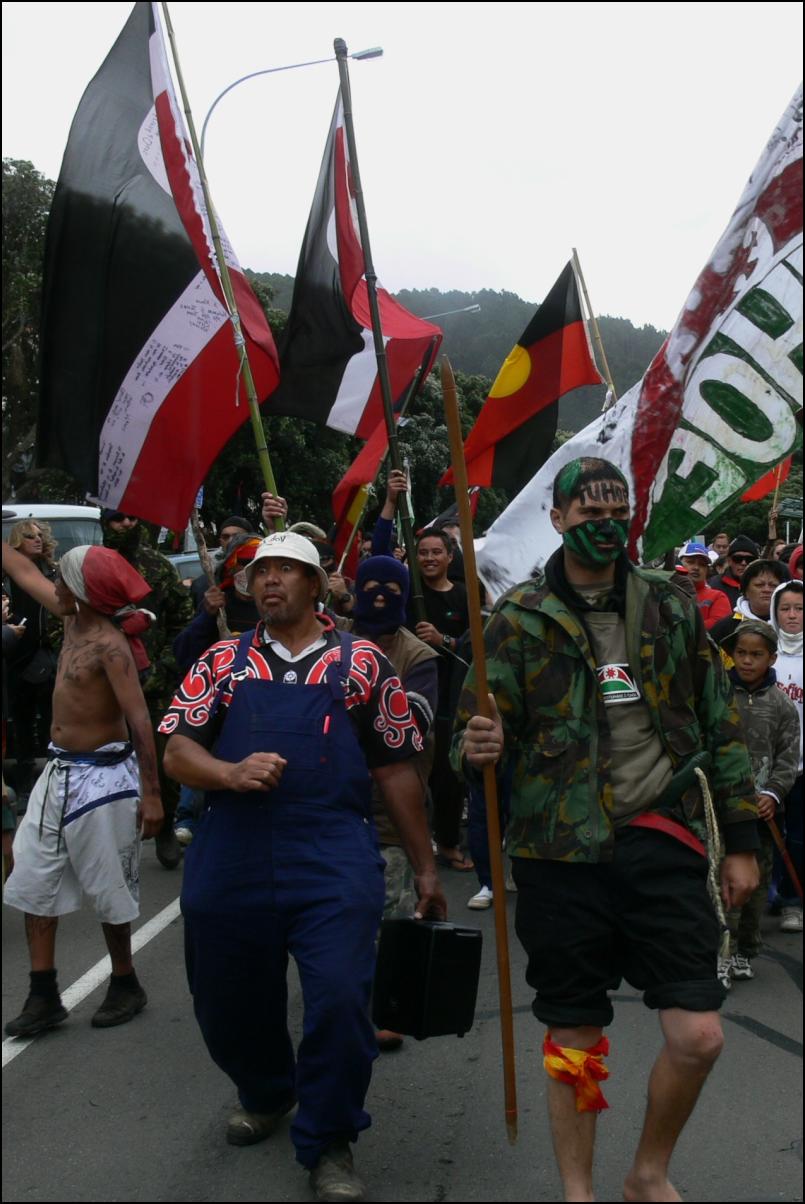
Tuhoe Anger Loud And Clear Over Police Raids And Terror Laws


Story And Images By Spike Mountjoy

Click for big version

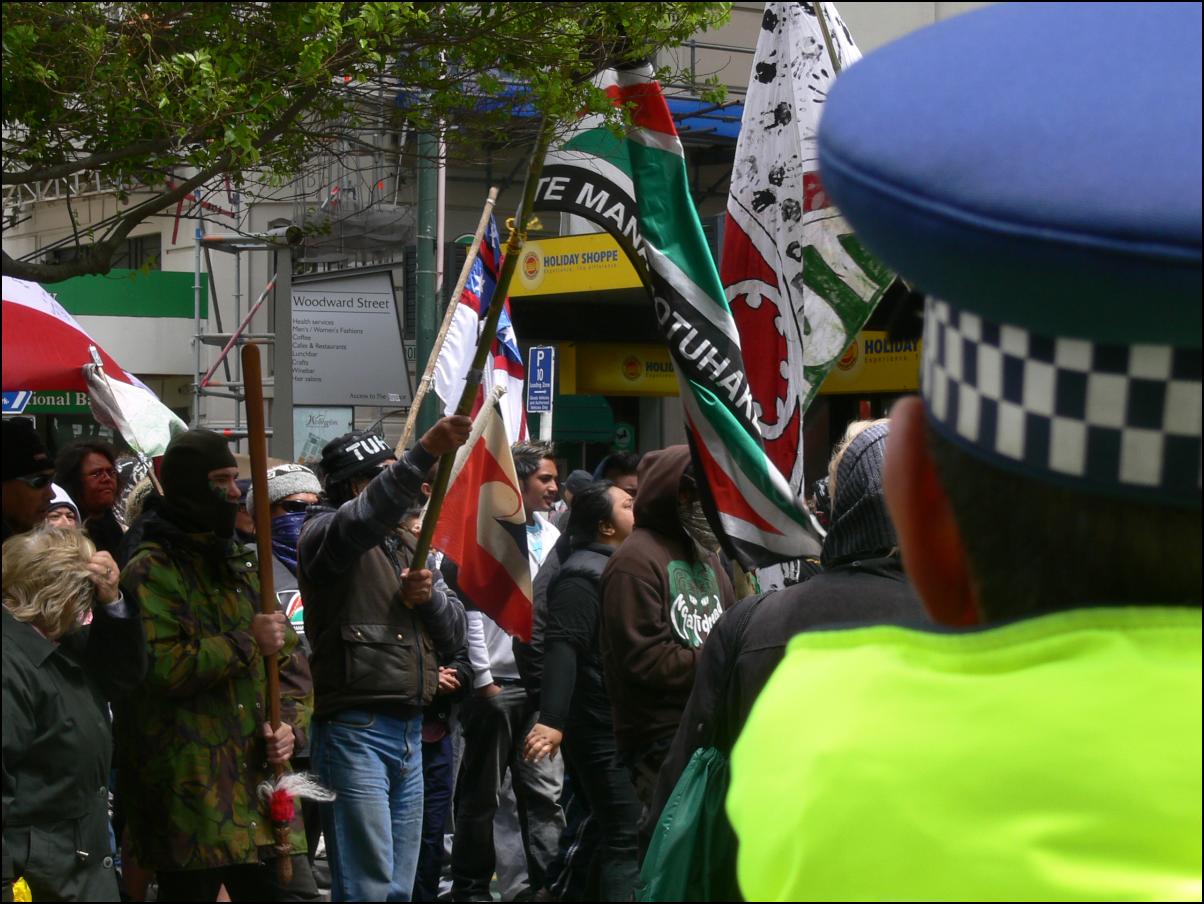
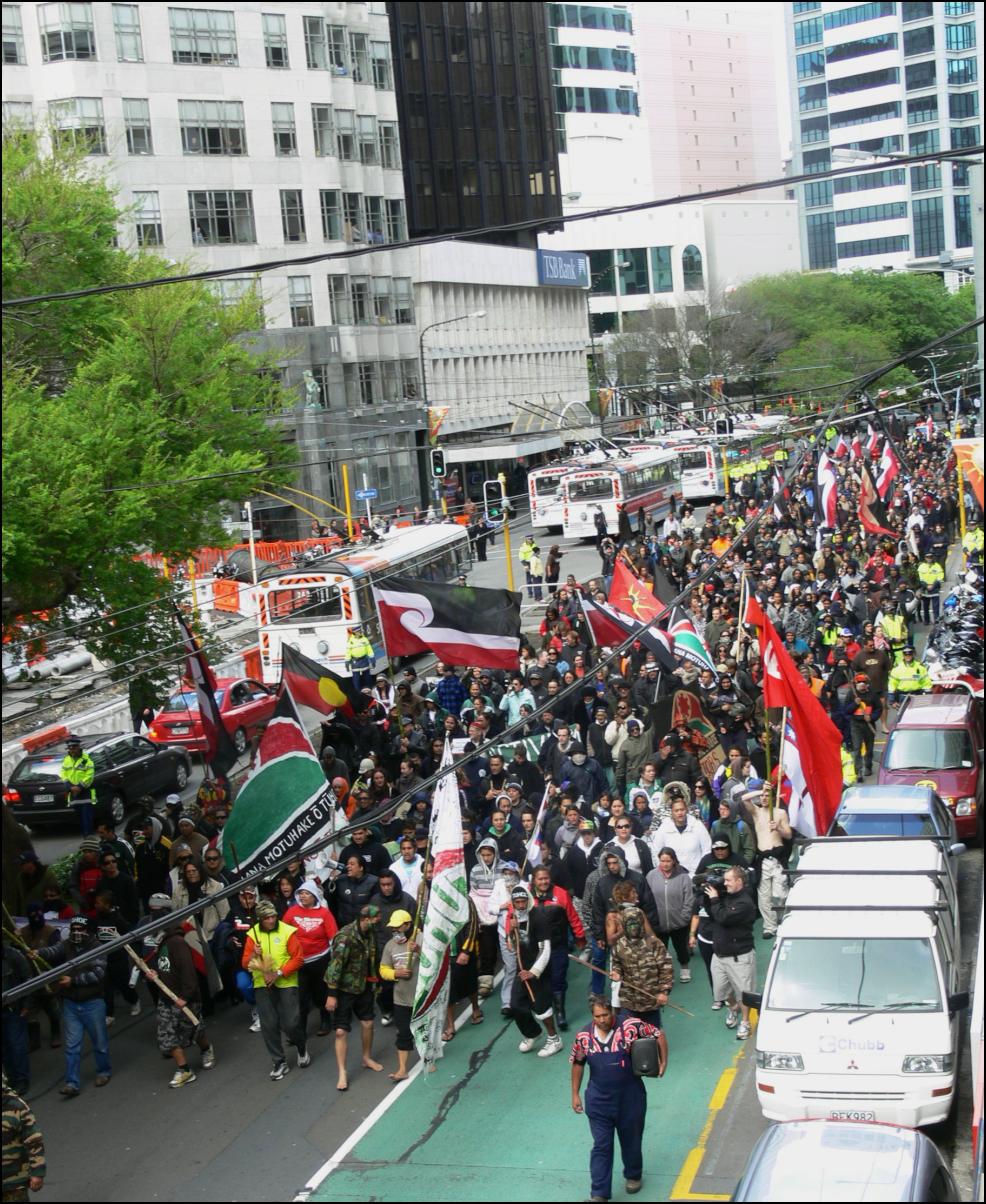
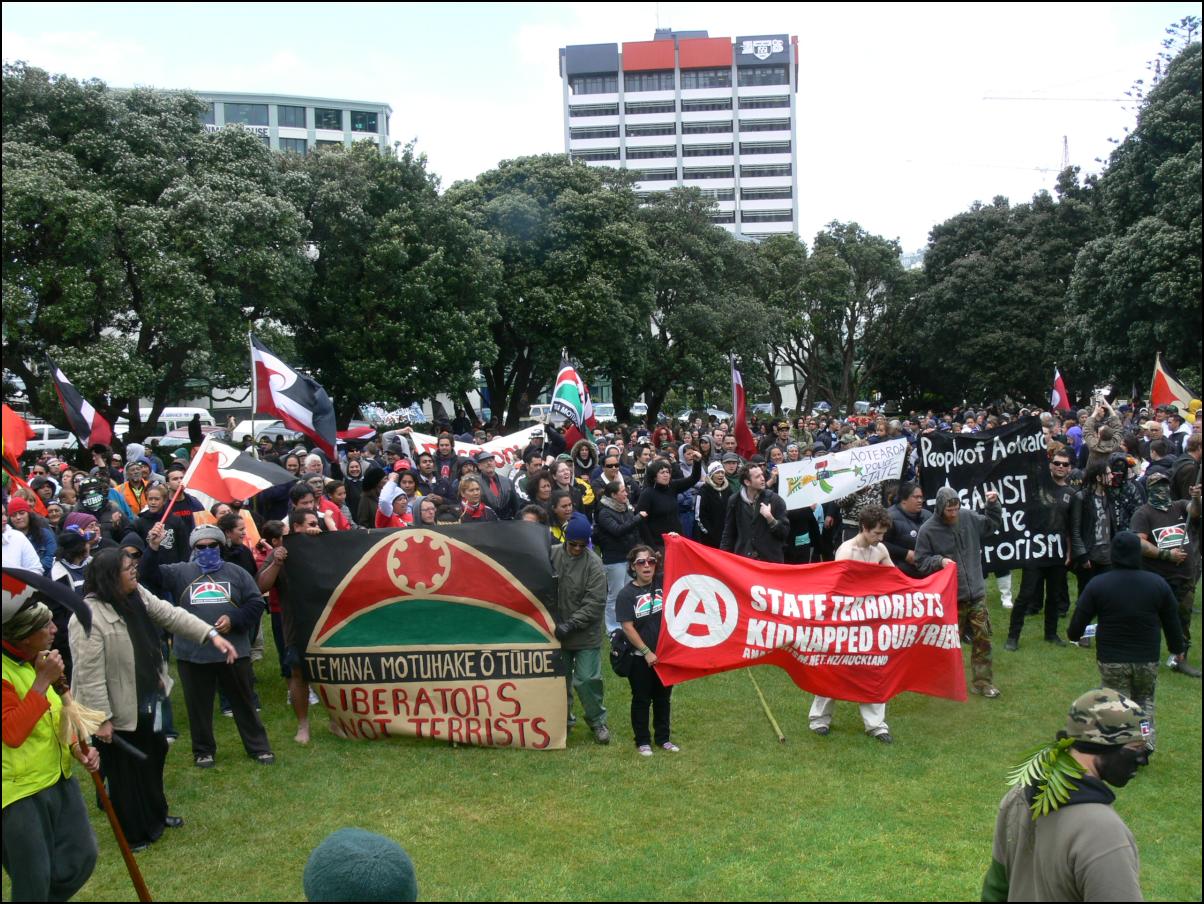
Maori Labour MP’s were shouted down as they tried to address a Hikoi of more than 800 Tuhoe iwi, activists, and supporters outside parliament yesterday.

Many were there to demonstrate their opposition to October’s police raids, and recent changes to New Zealand terror legislation.


Click for big version

Members of the hikoi - which left Ruatoki on Monday - drowned out speeches by Nanaia Mahuta and Parekura Horomia, with cries of “Kupapa”, which translates to traitor, or Maori soldier fighting for the government.

Some members of the crowd questioned loudly why Mahuta and Horomia had not stood up against the Terrorism Suppression Amendment Act during its 3rd and final reading on Tuesday.

Taito Phillip Field, who voted against the amendment, was applauded, as were Keith Locke and members of the Maori Party.

But the majority of yesterday’s speeches focused on police behavior during the October arrests.


Click for big version

Peti Nohotima, a grandmother originally from Ruatoki who had traveled from Palmerston North, said she was there because of the violation against her friends and family during the raids.

“I’m here to say to Helen Clark ‘how would you like it if we held a gun to your head’.

“You come to the Marae and talk to us Kanohi ki te Kanohi – eye to eye.”

Later as the protestors marched up Molesworth Street they chanted “Helen is a racist coward”.

One of those arrested in the raids, Wellingtonian Valerie Morse, arrived with about 25 activists from 128 Able Smith Street, a house searched in the October raids.

Morse said she was there to support Tuhoe and the people of Ruatoki.

“There is a deep seated fear within the police and intelligence services of Maori, and the potential for Maori political action – there is a real cultural divide, a culture of racism that’s institutionalised.”

Yesterday also saw the Dominion Post publish police prosecution evidence consisting of intercepted conversations recorded in the lead-up to the arrests.

Although that evidence can no longer be used in court since Terrorism Suppression Act charges are not being laid, the paper could face contempt of court prosecution over its decision.

Morse, who has photo suppression, said she is angry about the publication.

“I think it’s a ridiculous assertion that they [the Dominion Post] are allowing the public to ‘draw their own conclusions’, it is completely and utterly one sided and out of context.”

“The Solicitor General looked at all the evidence and said it was insufficient – it’s totally ludicrous.”

Morse said several others arrested in the raids were at the protest, and they had to be careful to keep separated from one another so as not to breech their bail conditions which prohibit them from associating with one another.


Click for big version

For most of the day police kept a low profile, with often only 20 or so visible, mostly without batons or handcuffs.

No-one was arrested in what appeared a consciously reserved approach by the police.

But police with batons stood four-deep outside their national headquarters on Molesworth Street – where Police Commissioner Howard Broad has his office.

This final stop on the march provided an opportunity for the protestors to express their displeasure with the police directly.

They chanted, “Who are the terrorist? Pirimana [the police]!”, and members of the crowd called for Commissioner Broad’s resignation.

Tuhoe elder Te Weeti Tihi told the crowd that, “the police will be your friends today and arrest you tomorrow.

“We will be telling our children, and our children’s children, to never forget what they have done to Tuhoe.”


Click for big version
ENDS

http://www.scoop.co.nz/stories/HL0711/S00259.htm

10/17/07

Why Thursdays' anti-terrorism bill is bad for New Zealand

17 October 2007

Media Release:

Since 2001 our government has passed three pieces of legislation to
"suppress terrorism" with the fourth now due in parliament tomorrow.
This latest piece is the Suppression of Terrorism Bill 2007.

There will be many more such bills to follow in the future.

The government says it is just doing its part supporting international
moves to isolate and control terrorism. In reality it's part of the US
leadership's drive to have American foreign policy objectives adopted
by governments around the world.

So what are the latest changes and why are they dangerous?

Change 1:
Under the proposed law the definition of a terrorist changes to
someone who, for political reasons, causes "serious disruption to an
infrastructure facility, if likely to endanger human life"

Effect: There are many examples of protest activity and civil
disobedience from past events such as the 1981 Springbok tour which
could now be classified as terrorist. (A better definition would be
the UN definition of "criminal acts, including those against
civilians, committed with the intent to cause death or serious bodily
injury, or taking of hostages, with the purpose to provoke a state of
terror in the general public")

Change 2:
Under this legislation New Zealand would automatically adopt the UN
list of terrorists and terrorist organisations. It is the US which
dominates the compilation of these lists.

Effect: New Zealanders working to support liberation struggles,
democracy and human rights overseas would now face the prospect of
being charged with supporting terrorist organisations. Under the new
proposal it would have been illegal to provide support for the African
National Congress in the fight against apartheid or for campaigns to
have Nelson Mandela released from jail. It could easily also be used
against New Zealanders supporting Palestinian groups such as Hamas
despite Hamas being democratically elected to power in the occupied
territory of Palestine. (Previous legislation allowed support and
assistance to organisations provided it was "for the purpose of
advocating democratic government or the protection of human rights".
This wording is to be removed)

Change 3:
New Zealand would give up its right to make its own independent
assessments of terrorists and terrorist designations.

Effect:
Without the ability to make our own independent assessments we become
captive to shonky, prejudiced, politically motivated overseas
assessments such as those relating to Ahmed Zaoui. (Previously New
Zealand adopted UN designations "in the absence of evidence to the
contrary". This safeguard would be removed)

Change 4:
The courts are removed from considering designations of terrorist or
terrorist organisations. (At the moment if the Prime Minister
designates a terrorist organisation then this is reviewable by the
High court after three years)

Effect: Independent scrutiny of cases will no longer be available. The
PM will be judge and jury. The US wants this because governments are
then more open to international pressure. At least with the courts
there is the semblance of independent scrutiny.

This assumption of power by politicians over court processes is
demonstrated most clearly by the US with its treatment of Guantanemo
Bay detainees and the CIA's "rendition" programme whereby suspected
terrorists have been clandestinely transferred around the world for
torture. In both cases the courts have been sidelined. It would be a
disgrace for New Zealand to follow.

Monday's arrests
Monday's police action in arresting 17 people on gun charges and
raising the spectre of terrorism charges to follow is an attempt to
soften the public up to the idea we have terrorism in New Zealand.

This creates a climate of fear and makes it easier to pass
anti-terrorism laws which inevitably undermine the civil rights of New
Zealanders and our relations with organisations overseas.

The government should withdraw this grubby piece of legislation.

John Minto
Spokesperson
Ph (09) 8463173 (H)
(09) 8452132 (W)

http://www.gpja.org.nz/newsletter/why-thursdays%E2%80%99-anti-terrorism-bill-bad-new-zealand

10/15/07

Against State Repression of Activists in Aotearoa

Early this morning there were simultaneous raids across the North Island, in Auckland, Whakatane, Wellington, Ruatoki, and Hamilton. Later in the morning, Police came to at least four houses in Christchurch. Around a dozen people have been arrested so far, and reports are that up to 60 are being sought for questioning.

The raids were under the Suppression Of Terrorism Act and the Firearms Act. They have been targeted at people involved in the Tino Rangatiratanga, Peace and Environmental movements.

This is a full on criminalisation of dissent, it is deplorable and a disgusting attack on Tino Rangatiratanga, Environmental & Peace activists, This is a very convenient way for the police to arrest every activist in the country, and smear them with terrorism, in the style of a cointelpro programme.

Come and demonstrate your solidarity with our brother & sister activists in Aotearoa, and show your disgust at state repression and the criminalisation of dissent.

Consulate-General of New Zealand

Suite 2, North Level 3 350 Collins Street
Melbourne VIC 3001

11am Tuesday the 16th of October

Tautoko atu a wairua, a hinengaro, a tinana hoki

Ka Whawhai tonu matou ake ake ake !!!!!

10/4/07

Racist cash to fund pig pens


Queensland Premier Anna Bligh says the State Government has secured $12 million from the Commonwealth to build extra police housing in seven Indigenous communities.

The funding was part of a deal that saw 11 Queensland police officers sent to the Northern Territory as part of the Federal Government's intervention in Aboriginal communities.

Three more police houses will now be built at Woorabinda in central Queensland and two more at Mornington Island in the Gulf.

The five Cape communities of Aurukun, Pormpuraaw, Lockhart River, Doomadgee and Hope Vale will also each have an extra house built.

9/21/07

Shawn Brant: Another Case of Kkkanada's Political Persecution of Indigenous People


Take note, Australian, Kkkanadian, New Zealand and the United States couldn't give a rats arse about Indigenous rights,so they not only share a minority racist attitude, but also share all the ways they have perfected oppressing us. Treating an Indigenous father and activist Shawn Bryant as some internal threat is the thin edge of the wedge and denies the legitimacy & justice of his and his peoples history, present and future.Thats State Sanctioned Genocide.

Much Aroha & Tautoko Shawn, Kia Kaha brother, Respect, Regards & Love to our Relations defending their ancestral rights for your generations to come.

by Justin Podur; September 19, 2007 - Znet

http://www.zmag.org/content/showarticle.cfm?SectionID=30&ItemID=13830

On August 30, about two weeks before Canada became one of only four countries to vote against a UN declaration on indigenous rights, Tyendinaga Mohawk father and activist, Shawn Brant was released from Quinte Detention Centre on bail. Bail had been denied him twice before, when he first turned himself in on July 5th and again after a bail-review hearing on August 10th. The conditions of his bail were restrictive: $50,000 cash bond with another $50,000 surety, 30-day house arrest, curfew, no protests, and above all, no returning to the struggle for the Mohawk territory the government hoped to disrupt by putting him in jail in the first place. His trial will take place some time in 2008. He is to stand trial on 9 charges having to do with two blockades, one that occurred in April 2007 and the other in June 2007, including 6 charges of indictable mischief (for which the maximum penalty is 10 years in prison), and 3 charges of breach of bail. His actual crime, for which he is being persecuted, is being an articulate and militant spokesperson for his community and indigenous struggles in Canada more generally.

The bail hearing also featured massive, militarized security, all for a community activist who had been involved in activities no more violent than blockades of roads and reclamations of sites, and who had turned himself in. It was a disgraceful display by the state, an attempt to generate fear of violence as a diversion from the substantive issues.

Exclusion and Environmental Destruction

The Mohawks of Tyendinaga, and community members from sister Mohawk territories Kahnawake, Akwesasne, and Kanehsatake, are no strangers to repression and persecution by governments. Indeed, with borders transecting Quebec, Canada, and the US, the Mohawks have known three different flavors of violence. The variations, however, are less striking than the similarities. In the 1990s, these communities faced a military occupation, with thousands of Canadian troops besieging the Mohawks, who were protesting that their sacred sites were slated to become condominium developments and golf courses. An all-out invasion was planned for these communities in 1994, called off at the last minute because of concerns that the political fallout from the bloodshed would be too high. More recently, Kanehsatake, for example, has faced tense standoffs with Canada’s federal police and Quebec’s provincial police, including the creation of a privatized police force to invade the community in 2004 (1). Before that, the Canadian police and military presented these sieges of communities as “law-and-order” activities, using force to stamp out the crimes of Canada’s indigenous people. But the massive, ongoing crime is one committed against indigenous people, and the law-and-order posturing, to which we will return, is intended to present an inversion of reality.

The Canadian state and corporations view the country’s economic development in terms of extracting resources from the land and selling them off, mainly to the United States, for profit. In this model, indigenous people, who live on the land and have their own ideas about how to treat it, are an obstacle, and have been treated that way historically. Even though rights to exploit the land were as often won by negotiation and treaties that included mutual obligations by Canada and indigenous nations as by force, Canada has treated indigenous people as a colonizer treats its victim, disrespecting agreements with them, dispossessing and excluding them, and using force with impunity. “Development” on indigenous lands, whether of resources or, in more densely populated areas, of suburban housing construction projects, is a sort of development that provides no benefit at all to them. While indigenous people from the Six Nations of the Grand River Territory neighbouring Caledonia in Ontario watched their historic lands turned into suburban developments, and Mohawks in Tyendinaga watched trucks carting tons of gravel out of their lands, the majority of indigenous communities in Canada (75% in 2001) have substandard, dangerous water quality and inadequate housing.

Beyond merely excluding the indigenous, Canada has destroyed the very basis of their survival through environmental destruction. The Mohawk territory on the Ontario/Quebec/New York border has been thoroughly poisoned. Canadian authorities have been destroying Mohawk fishing grounds since they started manipulating the flow of the St.Lawrence River in the 1830s. When Canada opened the St. Lawrence Seaway in the 1950s, it offered cheap hydro power to industrial investors, and heavy industry, from General Motors to Alcoa and Reynolds, responded, contaminating the rivers and lakes of the region and the groundwater table with PCBs, DDT, mercury, Mirex, and more. Poisoned water killed both the wildlife and the traditional economy. With no more hunting or fishing, there was no more traditional diet and, consequently, a whole set of new health problems (2).

Environmental destruction and exclusion from the economic benefits of their own territories has led to poverty and unemployment in indigenous communities. This has provided the state with another lever of control over the communities – small amounts of money distributed through the welfare system and through institutions of “self-government” that were imposed on indigenous communities, often at gunpoint. These meager and humiliating funds have an additional value to the state besides control: they also enable the state to sow racism by claiming that indigenous people are “lazy” and “don’t work”, living off of “handouts” from the state.

Adaptation of Tobacco


But the indigenous were never excluded quietly or easily, and the Mohawks found a way to adapt even to this narrowing of their options. Taking advantage of their position on the border, they created businesses selling a traditional sacred plant – tobacco cigarettes. Canada’s establishment treated the “native cigarette” trade as a major crime, alleging associations with organized crime and threatening brutal action. Indeed, from 2004-2006, the government threatened the Mohawk communities, repeatedly, on the basis of the tobacco trade. In an interview with the CBC in April 2006, Shawn Brant explained some of what the tobacco trade had meant for Tyendinaga:

“We have approximately 6 to 7 million dollars a month which comes into the community as new revenue from the outside, that we’ve been able to establish infrastructure within our community. We’ve been able to put forward our first institution of government, as we call it, the longhouse. We showed them that we were going to use the proceeds from tobacco in order to recreate ourselves within the society, that we would allow for something greater to come from it than just padding the pockets of a few people.

“So Tyendinaga now sits in a unique situation, where we have this money coming in, where the stores bring it in at retail level, where construction crews and workers are working, people are preparing their roofs and contributing in a way to, not only the local economy, but also to the surrounding economy in a way that we never had. We’re in position now where we are able to have, as a community, some influence in the outside world. When our people go out shopping, because of the availability of revenue within here, they’re not treated like shit anymore, they’re treated like consumers that have access to revenues, that are going out and making purchases. They’re treated in a way and a standard that we’ve never enjoyed before.” (3)

When the interviewer asked him about rumors of a Canadian military raid into Tyendinaga with cigarettes as a pretext, Shawn Brant answered:

“We’ve always known, and we’ve always been told to prepare for this time, when they would stop at nothing to remove us, to have us not exist. We’ve been through the assimilation process and it didn’t work, and now there’s one option that as a nation, a military option is very real. I believe the day will come, and with Kanesatake in 1990, when the people of that community stood up and everything changed, we talked about the transition time.

“Kanestake has got nothing in the 16 years since 1990: they haven’t settled the land claims, their status within the Indian act, they haven’t settled their financial and fiduciary responsibilities with them – it’s a community where schools barely exist, their programs are non-existent. While everything changed in people’s minds across Canada, and maybe the way in which people perceive us has changed, nothing has changed for them and that’s their punishment for 1990. If Tyendinaga can take on that responsibility, and take the brunt of the force and the government’s wrath, and it allows for some peace to exist in Kanesatake, then we’ll gladly shoulder that responsibility. We don’t just see it as being something just around us. It’s time for our sisters and brothers that have fought for so long to have a break and let them turn their attention to us, and we’ll welcome it.” (4)

Resistance to Dispossession


The tobacco trade is not the only indigenous adaptation to legal and economic exclusion and dispossession. The more direct adaptation has been to resist dispossession, using legal arguments and, when Canada ignored these, resorting to the very measured and restrained use of reclamations and blockades.

One such reclamation began in February 2006, at the Douglas Creek Estates bordering the town of Caledonia and the Six Nations reserve. The Douglas Creek Estates were in the process of being converted to a suburban subdivision when members of Six Nations reclaimed it. They wanted the land, which, like so many other pieces of indigenous territory, had been taken from them in a process of very dubious legality, to be returned to them (5). Instead of negotiating in good faith, the provincial police attempted to dislodge the indigenous people from the reclamation site in April 2006, and succeeded for several hours, after which the indigenous reclaimed the site yet again. Six Nations called on people outside the territory to speak up and to mobilize on their behalf. One community that heard the call was Tyendinaga.

The day after the police dislodged the Six Nations reclamation on the Douglas Creek Estates (April 21 2006), Mohawks from Tyendinaga blocked a CN Rail line that runs through their territories, both the Culbertson Tract and Surrender 24 (discussed below) demanding that the government negotiate with Six Nations in good faith. Later that year, the government would force the Mohawks of Tyendinaga to conduct a reclamation on their own behalf. The Culbertson tract, like the Douglas Creek Estates, had been stolen from the indigenous through a dubious swindle (6). When, on November 15 2006, Mohawks went to the site of a proposed subdivision on the Culbertson tract to publicize their claim and their intention to stop the construction of a subdivision there, coincidence had a convoy of Canadian Military vehicles just passing through the reserve. The Mohawks blocked the convoy with cars and trucks and asked them what they were doing. Provincial police eventually escorted the military away. In January 2007, Shawn Brant and another Mohawk activist, Mario Baptiste, were arrested. Shawn was charged with ‘uttering death threats’, Mario with ‘assault’ and ‘mischief’, in conjunction with the November 15 2006 incident (7).

On another part of Tyendinaga territory, a gravel quarry owned by Thurlow Aggregates, the corporation busily strived to make off with as much of the land as possible, while the government of Canada took a decade to even sit down to land claim negotiations. Strikingly, the Mohawks had submitted an official land claim in 1995, after the claims process was finally created by Canada, and in 2003, this claim had been acknowledged as legitimate by the Canadian government - in many land claim disputes, achieving this recognition of legitimacy from the colonial government is in and of itself a huge battle. Negotiations around the Mohawk’s claim did not begin for several years after that, during which time the Government of Ontario continued to renew the license to Thurlow Aggregates to ravage the now-recognized Mohawk land. So, on March 22, 2007, 125 members of Tyendinaga took control of the quarry. Shawn Brant explained the reclamation: “It’s very difficult to have negotiations at a time when they’re taking out 10,000 truckloads of our land. It’s an affront to our process.” (8). The Mohawks announced a campaign of blockades if the quarry’s license was not revoked. On April 20, 2007, they blocked the CN Rail line again. The Mohawks held the line for 30 hours and packed up, having negotiated with the police that no one would be charged. The Ontario Provincial Police (OPP) Commissioner, an aggressive and militaristic former chief of Toronto’s police named Julian Fantino, ordered the arrest of Shawn Brant for mischief, disobeying a court order, and breach of recognizance – ignoring the agreement made on April 21 2007. On May 9, CN Rail announced a civil suit for damages for the rail stoppage – the authors of the essay “What Landed Shawn Brant in Jail” said the following about CN’s lawsuit:

“The civil case will likely bring to light some of the checkered history of railway construction in Canada, from forced expropriations to illegal seizures of land; CN’s lawyers may find themselves arguing a case that does the company more harm than good.” (9) The rail line CN is suing over runs through both the Culbertson Tract and what is called “Surrender 24”, a 33,000 acre tract that was stolen from the Mohawks in 1820 by force, and despite much resistance (10).

The final set of charges against Shawn Brant stem from June 29, 2007, which was planned as a national aboriginal day of action. Originally conceived and presented as a day of militant action to show that indigenous communities would not be shunted aside or disappeared, the day of action was weakened by Canada’s threats and successful isolation of communities from one another. Tyendinaga took the call to action seriously. Via Rail cancelled its rail service, anticipating a shutdown. The Tyendinaga Mohawks blocked Highway 2. The OPP blocked the Highway 401 pre-emptively, and the Tyendinaga Mohawks moved on to the highway and the CN tracks. The blockades were all lifted by the end of the 29th, and no one was hurt. Shawn Brant, however, was charged with mischief and breach of bail, and turned himself in on July 5 (11).

Shawn Brant’s trial, and the civil suit by CN Rail, could indeed prove counterproductive to the Canadian state and corporations. At a public event on August 29, 2007 in support of Shawn Brant, author Naomi Klein suggested that part of why the Canadian establishment, from Ontario’s police commissioner to the mainstream media, seems to be so vindictive against him is because he has had some success raising indigenous issues not only inside, but also outside of native communities. Sue Collis, an activist who has been instrumental in building this bridge between native and non-native activists (and who is also Shawn Brant’s wife), noted that the colonial relationship between settler and indigenous in Canada could not occur without the participation and complicity of the citizens. Racist myths about native people being “lazy” or “lawless” can’t hold up to reality, and the indigenous actions have been about confronting Canadians with the reality. If the myths collapse, could the whole project of dispossessing the indigenous be at risk?

The colonial playbook is a limited one. In 1990 and 1994, Canada used the military and the police against the Mohawks. It also mobilized racist whites to press a counter-claim against indigenous people, and then presented itself as an honest broker between the two extremes, allowing the racists plenty of leeway and persecuting indigenous people whenever possible. This strategy also allowed plausible deniability. The same thing occurred in 2006 on Six Nations land, with “residents of Caledonia” rallying to demand action against the indigenous (12). Other standard plays include attempts to sow divisions in the community, arming some indigenous people against others, offering money in exchange for land, and presenting small sacrifices as immense in order to create obstacles for future negotiations. The repetitiveness of these standard tactics is frustrating, but it could also make them more transparent, for those who wish to see. If there were enough such people (13), Canada would have to back off, and perhaps actually change its relationship with indigenous people.

Notes


http://mostlywater.org/shawn_brant_another_case_of_canadas_political_persecution_of_indigenous_people


1) See my “Kanehsatake”, 2004, ZNet, for a discussion of what was going on at the time: http://www.zmag.org/content/showarticle.cfm?ItemID=5556. See also the following leaflet: http://arab.sa.utoronto.ca/preparing.for.invasion.pdf

2) See chapter 2 of Bruce E. Johansen (1993), “Life and Death in Mohawk Country”, North American Press, Colorado. See also the work of Boyce Richardson, including “The People of Terra Nullius” and “Drumbeat: Anger and Renewal in Indian Country”.

3) CBC Interview, April 23, 2006.

4) CBC Interview, April 23, 2006.

5) For an overview of the Six Nations reclamation, see my “Six Nations Does Not Stand Alone”, 2006, ZNet. http://www.zmag.org/content/showarticle.cfm?ItemID=10152

6) See the excellent pamphlet, “In Support of the Mohawks of Tyendinaga”, from which much of this article was drawn. See specifically two essays: “What Landed Shawn Brant in Jail?”, and “Surrender 24 and the Culbertson Tract: How Tyendinaga’s Land Was Stolen”. The PDF of the pamphlet is here: http://www.ocap.ca/files/fsb-rgb-final.pdf

7) “What Landed Shawn Brant in Jail?” - http://www.ocap.ca/files/fsb-rgb-final.pdf

8) “What Landed Shawn Brant in Jail?” - http://www.ocap.ca/files/fsb-rgb-final.pdf

9) “What Landed Shawn Brant in Jail?” - http://www.ocap.ca/files/fsb-rgb-final.pdf

10) “Surrender 24 and the Culbertson Tract: How Tyendinaga’s Land Was Stolen”. http://www.ocap.ca/files/fsb-rgb-final.pdf

11) “What Landed Shawn Brant in Jail?” - http://www.ocap.ca/files/fsb-rgb-final.pdf

12) See my “In whose interests are the ‘residents’ rallies’ in Caledonia?” ZNet, 2006, http://www.zmag.org/content/showarticle.cfm?ItemID=10313

13) There are people working on this, and there should be many more. Join the Tyendinaga Support Committee, visit their site, sign the petition, work wherever you are on this. http://www.ocap.ca/supporttmt.html


see also:

http://uriohau.blogspot.com/2007/04/canadas-military-manual-exposed-to.html

http://uriohau.blogspot.com/2007/05/canadas-military-plots-war-crimes.html

9/20/07

Navajo families arrested in Canada as Terrorists

"Hey. I haven't heard any more news but over the weekend, 28 Navajo
were arrested in Ontario and put in a 48-hour detention for being
"suspected terrorists..." Aside from being absurd, it's interesting to
note that a couple weeks ago Canada heroically stepped forward saying
indigenous people should be allowed to freely cross the US/CAN
border... but I have to wonder now, is it so they can arrest them all?"


http://www.intelligencer.ca/ArticleDisplay.aspx?e=696107


A group of nomadic Navajo Indians en route to support the aboriginal
quarry protest near Deseronto have been arrested, says a member
currently at the quarry.

Twenty-eight members of the tribe, an offshoot of the Navajo, were on
their way to Deseronto in nine vehicles with 10 horses in tow to show
support and respect for a group of Tyendinaga Mohawks, said Spata
Desareau, 64, a member of the tribe. They travelled across western
Canada without incident, but once in Ontario, were stopped by law
enforcement three times - Wawa, Sault St. Marie and finally Kaladar,
where they were taken into police custody Sunday, he said. "They're
saying they're a political organization, which is a way of saying
they're a terrorist organization," said Desareau of the
group ranging in age from two to 72. "I could understand if it was all
warriors coming for a demonstration, but it wasn't."

The nomadic group travels the desert from Arizona to the southernmost
part of British Columbia, their starting point in a week-long journey
to Deseronto, he said. They were coming "to honour (protest leader
Shawn Brant) and the people that live here. In western Canada, we have
reserves that are very poverty stricken. There are third-world
conditions."

Desareau, who had cellphone contact with the group, said he believes
they were taken into custody by the Royal Canadian Mounted Police to
the Kingston detachment, where he heard they will be held for 48
hours. They were stopped on Highway 41, he said.

It didn't ring any bells for OPP Sgt. Scott McRae, who said if the
group was on Highway 41, the OPP would be policing it.

"I've been here all weekend and it's been very peaceful in that area,"
he said. "We don't know anything about it."

No one from the RCMP could be reached for comment Sunday.

The group was unarmed, said Desareau, who didn't believe they would be
held a full 48 hours. But it upsets him that they were stopped.

"I don't believe they have a right to do that," he said. "They broke
no laws other than that they're native."

Under Canada's Anti-Terrorism Act, revised after the Sept. 11 attacks
of 2001, 48 hours is the length of time a suspected terrorist can be
arrested and detained without a warrant.


http://intercontinentalcry.org/navajo-families-arrested-in-canada-as-terrorists/

9/12/07

Police called as forestry road dispute boils over


Tension: Pigs form a roadblock to stop Maori activists from interfering with logging in the Matahi Forest


5:00AM Wednesday September 12, 2007
By Juliet Rowan

Tension: Police form a roadblock to stop Maori activists from interfering with n

A rural road in the heart of the Bay of Plenty was the scene of a tense standoff between police and Maori protesters yesterday.

Protesters from the Tuhoe hapu Omuriwaka faced off against police for several hours after officers set up a roadblock across Matahi Valley Rd, which leads to Te Urewera National Park.

The police were called by forestry consortium Matariki, which has been involved in a long dispute with the hapu over access to logging sites on the road.

The hapu has blocked access to the sites and the consortium said police were called after attempts to end the dispute failed.

Officers served the protesters with a trespass notice and recovered a portable mill, which Matariki said was stolen and used by the protesters for illegal logging.

The Whakatane District Council has also been battling the hapu over a blockade on the road which has prevented visitors entering the national park.

The protesters have been occupying the logging sites and manning the blockade for almost a year, and yesterday's standoff happened as a tangi was being held at a nearby marae.

Swearing could be heard as the group of about 20 protesters confronted police, and reporters were warned not to approach or take photographs.

Three marked cars blocked the road beyond the marae, and other police vehicles were parked on the grass verges.

More than 10 officers prevented people and cars passing, and the protesters said there were more police further up the valley but the officers had refused to tell them why they were there.

Several of the protesters left the site of the confrontation to speak to reporters, saying they were angry at the police presence in an area they claim is their land.

"They want us to remain calm, but how can we?" said Kato Wharepapa, who is "native assessor" for Omuriwaka Maori Incorporation.

"They say we're abusing them, but it's abuse to us them just being here."

Hone Hillman-Rua, the group's iwi liaison officer, said police had not contacted him about their plans. "I said to them, 'There's a process'. We have to consult and we could've avoided this."

The protesters claimed police often tried to move their vehicles and break up the road blockade when there were tangi, showing no respect for their beliefs.

"I wish they would come and talk to us before they come up with this behaviour," said Dinny Helmbright, who mans the blockade at a bridge further up the valley.

Authorities accept there are issues over ownership of the road, but Matariki maintains it owns the logging sites and said last night the occupation was illegal.

Matariki director Paul Nicholls said the consortium had tried for almost a year to resolve the situation, and had called in police after the hapu began using a portable mill for illegal logging.

The original road to Te Urewera National Park was destroyed by floods in 1964 and rebuilt through Omuriwaka and other Tuhoe hapu land.

9/10/07

Haere Atu Poaka

oztralia has always been a poaka state, ask Aboriginal peoples


Sydney APEC Protest where the Police outnumbered the protesters. I shot this on a camera Phone and a cheap digital. Also got a few clips from various news sites. Strangely the news footage dissapeared shortly afterwards, presumably it wasnt appropriate for the general public

9/3/07

G20 Solidarity protest at Melbourne Magistrates' Court 31 Aug 07


The Ongoing G20 Solidarity Network (Ogasn) organised a show of solidarity outside the Melbourne Magistrates' Court during the latest hearing - an event disrupted by police over-reaction to a totally unthreatening action ...

Produced: 2007/08/31
Duration: 4 minutes 29 seconds
http://www.engagemedia.org/Members/pc/videos/engage-31aug.avi/view