Showing posts with label Anti Globlalisation. Show all posts

5/25/09

Folk The Po-Lice: G20 Fundraiser

Host:
Tim D.F.
Type:
Network:
Global
Date:
14 June 2009
Time:
18:00 - 22:00
Location:
Hermann's Bar, Sydney University
Street:
Corner of City Road and Butlin Avenue (opposite university main gates)
Town/City:
Sydney, Australia
Over June and July, 3 people will finally go to trial for their role in the G20 protests in Melbourne in November, 2006. These people; Sina Brown-Davis, Tim Davis Frank, and Sunil Menon; are facing charges ranging from Riot to Unlawful Assembly, with Aggravated Burglary and Assault Police in the middle. (The maximum sentence for Agg. Burg. is 25 years!!!)

On the day of rest - Sunday the 14th of June - there will be a fundraiser to help pay for the legal defence of these people and keep them out of gaol!!! All proceeds from this gig will go to the G20 Defence Fund.

Bands playing are:
WIM
WINTER PEOPLE
EMMA DAVIS
SUI ZHEN
ANARCHIST DUCK
PLUTO GONSKY
and friends...

Ticket prices: $10 (students/centrelink recipients) - $15 (others)

PLEASE PASS THIS INFORMATION ON AND HELP KEEP GOOD PEOPLE OUT OF BAD PLACES!

12/2/08

Indigenous peoples lash out at WTO inequities

Protests in the streets of Seattle outside the recent World Trade Organisation ministerial meeting were so severe and feelings ran so high that proceedings were almost aborted. The Indigenous Peoples' Seattle Declaration which follows makes it abundantly clear why so many concerned people were compelled to make a stand


on the occasion of the

Third Ministerial Meeting of the
World Trade Organisation
November 30 - December 3, 1999

We, the Indigenous peoples from various regions of the world, have come to Seattle to express our great concern over how the World Trade Organisation is destroying Mother Earth and the cultural and biological diversity of which we are a part.

Trade liberalisation and export-oriented development, which are the overriding principles and policies pushed by the WTO, are creating the most adverse impacts on the lives of Indigenous peoples. Our inherent right to self-determination, our sovereignty as nations, and treaties and other constructive agreements which Indigenous nations and peoples have negotiated with other nation-states, are undermined by most of the WTO agreements. The disproportionate impact of these agreements on our communities, whether through environmental degradation or the militarisation and violence that often accompanies development projects, is serious and therefore should be addressed immediately.

The WTO Agreement on Agriculture (AOA), which promotes export competition and import liberalisation, has allowed the entry of cheap agricultural products into our communities. It is causing the destruction of ecologically rational and sustainable agricultural practices of Indigenous peoples.

Food security and the production of traditional food crops have been seriously compromised. Incidents of diabetes, cancers, and hypertension have significantly increased among Indigenous peoples because of the scarcity of traditional foods and the dumping of junk food into our communities.

Small-scale farm production is giving way to commercial cash-crop plantations, further concentrating ancestral lands into the hands of a few agri-corporations and landlords. This has led to the dislocation of scores of people from our communities who then migrate to nearby cities and become the urban homeless and jobless.

The WTO Forests Products Agreement promotes free trade in forest products. By eliminating developed country tariffs on wood products by the year 2000, and developing country tariffs by 2003, the Agreement will result in the deforestation of many of the world's ecosystems in which Indigenous peoples live.

Mining laws in many countries are being changed to allow free entry of foreign mining corporations, to enable them to buy and own mineral lands, and to freely displace Indigenous peoples from their ancestral territories. These large-scale commercial mining and oil extraction activities continue to degrade our lands and fragile ecosystems, and pollute the soil, water, and air in our communities.

The appropriation of our lands and resources and the aggressive promotion of consumerist and individualistic Western culture continue to destroy traditional lifestyles and cultures. The result is not only environmental degradation but also ill health, alienation, and high levels of stress manifested in high rates of alcoholism and suicides.

The theft and patenting of our biogenetic resources is facilitated by the TRIPs (Trade-Related Aspects of Intellectual Property Rights) of the WTO. Some plants which Indigenous peoples have discovered, cultivated, and used for food, medicine, and for sacred rituals are already patented in the United States, Japan, and Europe. A few examples of these are ayahuasca, quinoa, and sangre de drago in forests of South America; kava in the Pacific; and turmeric and bitter melon in Asia. Our access and control over our biological diversity and control over our traditional knowledge and intellectual heritage are threatened by the TRIPs Agreement.

Article 27.3b of the TRIPs Agreement allows the patenting of life-forms and makes an artificial distinction between plants, animals, and micro-organisms. The distinction between "essentially biological" and "non-biological" and "microbiological" processes is also erroneous. As far as we are concerned, all these are life-forms and life-creating processes which are sacred and which should not become the subject of private property ownership.

Finally, the liberalisation of investments and the service sectors, which is pushed by the General Agreement of Services (GATS), reinforces the domination and monopoly control of foreign corporations over strategic parts of the economy. The World Bank and the International Monetary Fund impose conditionalities of liberalisation, deregulation and privatisation on countries caught in the debt trap. These conditionalities are reinforced further by the WTO.

In light of the adverse impacts and consequences of the WTO agreements identified above, we Indigenous peoples present the following demands:

We urgently call for a social and environmental justice analysis which will look into the agreements' cumulative effects on Indigenous peoples. Indigenous peoples should be equal participants in establishing the criteria and indicators for these analyses so that they take into consideration spiritual as well as cultural aspects.

A review of the agreements should be carried out to address all of the inequities and imbalances which adversely affect Indigenous peoples. The proposals to address some of these are as follows:

  1. For the Agreement on Agriculture
    1. It should not include in its coverage small-scale farmers who are mainly engaged in production for domestic use and sale in the local markets.
    2. It should ensure the recognition and protection of rights of Indigenous peoples to their territories and their resources, as well as their rights to continue practising their Indigenous sustainable agriculture and resource management practices and traditional livelihoods.
    3. It should ensure the food security and the capacity of Indigenous peoples to produce, consume and trade their traditional foods.

  2. With regard to the liberalisation of services and investments we recommend the following:
    1. It must stop unsustainable mining, commercial planting of monocrops, dam construction, oil exploration, land conversion to golf courses, logging, and other activities which destroy Indigenous peoples' lands and violate the rights of Indigenous peoples to their territories and resources.
    2. The right of Indigenous peoples to their traditional lifestyles, cultural norms and values should likewise be recognised and protected.
    3. The liberalisation of services, especially in the areas of health, should not be allowed if it will prevent Indigenous peoples from having access to free, culturally appropriate and quality health services.
    4. The liberalisation of finance services which makes the world a global casino should be regulated.

  3. On the TRIPs Agreement, the proposals are as follows:
    1. Article 27.3b should be amended to categorically disallow the patenting of life-forms. It should clearly prohibit the patenting of micro-organisms, plants, animals, including all their parts, whether they are genes, gene sequences, cells, cell lines, proteins, or seeds.
    2. It should also prohibit the patenting of natural processes, whether these are biological or microbiological, involving the use of plants, animals and micro-organisms and their parts in producing variations of plants, animals and micro-organisms.
    3. It should ensure the exploration and development of alternative forms of protection outside of the dominant Western intellectual property rights regime. Such alternatives must protect the knowledge and innovations and practices in agriculture, health care, and conservation of biodiversity, and should build upon Indigenous methods and customary laws protecting knowledge, heritage and biological resources.
    4. It should ensure that the protection offered to Indigenous and traditional knowledge, innovation and practices is consistent with the Convention on Biological Diversity (ie Articles 8j, 10c, 17.2, and 18.4) and the International Undertaking on Plant Genetic Resources.
    5. It should allow for the right of Indigenous peoples and farmers to continue their traditional practices of saving, sharing and exchanging seeds, and cultivating, harvesting and using medicinal plants.
    6. It should prohibit scientific researchers and corporations from appropriating and patenting Indigenous seeds, medicinal plants, and related knowledge about these life-forms. The principles of prior informed consent and right of veto by Indigenous peoples should be respected.

  4. If the earlier proposals cannot be ensured, we call for the removal of the Agreement on Agriculture, the Forest Products Agreements and the TRIPs Agreement from the WTO.

  5. We call on the member-states of the WTO not to allow for another round whilst the review and rectification of the implementation of existing agreements has not been done. We reject the proposals for an investment treaty, competition, accelerated industrial tariffs, government procurement, and the creation of a working group on biotechnology.

  6. We urge the WTO to reform itself to become democratic, transparent and accountable. If it fails to do this, we call for the abolishment of the WTO.

  7. We urge the member nation-states of the WTO to endorse the adoption by the UN General Assembly of the current text of the UN Declaration on the Rights of Indigenous Peoples and the ratification of ILO Convention l69.

  8. We call on the peoples' organisations and NGOs [non-government organisations] to support this "Indigenous Peoples' Seattle Declaration" and to promote it among their members.

  9. We believe that the whole philosophy underpinning the WTO agreements and the principles and policies it promotes contradict our core values, spirituality and world views, as well as our concepts and practices of development, trade and environmental protection. Therefore, we challenge the WTO to redefine its principles and practices towards a "sustainable communities" paradigm, and to recognise and allow for the continuation of other world views and models of development.

Indigenous peoples, undoubtedly, are the ones most adversely affected by globalisation and by the WTO agreements. However, we believe that it is also us who can offer viable alternatives to the dominant economic growth, export-oriented development model. Our sustainable lifestyles and cultures, traditional knowledge, cosmologies, spirituality, values of collectivity, reciprocity, respect and reverence for Mother Earth, are crucial in the search for a transformed society where justice, equity, and sustainability will prevail.

Declaration by the
Indigenous Peoples' Caucus

convened and sponsored by
Indigenous Environmental Network
Seventh Generation Fund

in alliance with
TEBTEBBA (Indigenous Peoples' Network
for Policy Research and Education)
International Indian Treaty Council
Indigenous Peoples Council on Biocolonialism
Abya Yala Fund

3/5/08

Tahi


Tahi, One Pacific One Struggle (against colonialism and exploitation), is a video about the various sovereignty, pro-democracy and independence movements around the Pacific Rim including Hawai'i, Aoteoroa, Rapa Nui (Easter Island), Kanaky (New Caledonia), Australian Aboriginals, Samoa, Tonga, East Timor, Indonesia, and the Philippines.

3/4/08

kia kaha... kia maia ... kia manawanui...


week 3 of the g20 committal hearing, to activists facing state repression everywhere...kia kaha... kia maia ... kia manawanui...

2/16/08

CALL FOR AN INTERNATIONAL DAY OF ACTIONSOLIDARITY WITH CHIAPAS:


Saturday February 16th, 12 noon
Federation Square
Melbourne
:
RESPECT FOR INDIGENOUS AUTONOMY AND A HALT TO THE REPRESSION IN CHIAPAS

We call on all fellow adherents to the Sixth Declaration of the Lacandon
Jungle and those struggling and resisting from below and to the left to join
us on February 15th, 2008, for an international day of action against the
repression in Chiapas and for the respect of indigenous autonomy.

In recent months, aggressions against the Zapatista communities have
drastically worsened. The low intensity war has acquired a dimension not
seen since the Acteal massacre ten years ago. At the same time, media
coverage remains low. We believe that it is crucial that we make it clear to
public opinion in Europe that we have not forgotten the conflict and
resistance in Chiapas. We will show the Mexican government that here in
Europe we are closely watching the worrying situation in Chiapas. For this
reason, we are calling for an international day of action on February 15th
in front of Mexican Embassies and Consulates. The date coincides with the
12th anniversary of the San Andrés Accords. (The anniversary is actually on
February 16th, but this is a Saturday, so embassies will be closed on the
day).

The San Andrés Accords negotiated between the EZLN and the Mexican
government had as their objective to guarantee indigenous autonomy. Amongst
other things, they included indigenous autonomy and self-management of
natural resources by the indigenous inhabitants of the area. However, the
EZLN broke off the negotiations due to the fact that the government neither
fulfilled nor respected the Accords. We are in solidarity with the
realization of indigenous autonomy.

The situation of the indigenous communities in resistance has worsened since
the implementation of Plan Puebla Panama and other neoliberal mega projects,
which require access to Chiapas' biosphere reserves for infrastructure and
tourist purposes.

In August 2007, four communities were violently displaced in the biosphere
reserve of Montes Azules in the Lacandon Jungle. Over the last year, the
number and intensity of paramilitary attacks carried out by OPDDIC
(Organization for the Defense of Indigenous and Peasant Rights) against
Zapatista communities has increased in the area of Agua Azul, the most
visited and well-known waterfalls in México.

Since September 2007, OPDDIC has issued several threats and carried out
attacks against the Zapatista settlement Bolom Ajaw due to the fact that the
people are located in the road to some waterfalls, which are currently still
inaccessible to tourists. In cahoots with the state government OPDDIC is
planning a new tourist project for which it intends to displace the
community. Now that the community has refused voluntary resettlement, it has
suffered numerous attacks and death threats, as well as threats of rape, at
the hands of OPDDIC. Furthermore, some houses were burnt down in Bolom Ajaw.
The perpetrators of these deeds were inhabitants of the ejido Agua Azul,
nearly all of who belonged to OPDDIC. For this reason, both local and
international organizations are calling for a tourism boycott until the
aggressions against Zapatista communities cease.

In the community of Vetel Yo'chib, near to Agua Azul, on December 29th,
2007, on the road to his milpa [plot of land], compañero Pablo Silvano
Jiménez received a bullet in the leg from two policemen and a member of
OPDDIC. From then on, he has had to go into hiding and can no longer work to
feed his family. In the last week of January an international observation
brigade that was in Vetel received death threats and also threats of rape.
On February 1, 2008 members of OPDDIC and the police shot at compañero
Eliseo Silvano Jiménez and his son. Afterwards they were arrested in an
OPDDIC truck. In prison they were tortured and forced to have photos taken
of them holding arms. Currently they are still in prison in Palenque and
there is no media attention.

WE DEMAND:

1. The suspension of all forms of aggression against the Zapatistas and
other communities in resistance.

2. The suspension of the counter-insurgency war against the indigenous and
zapatista communities and the withdrawal of the military bases from the
indigenous region of Chiapas.

3. The release of Eliseo Silvano Jiménez and Eliseo Silvano Espinoza as well
as all other political prisoners.

4. A total halt to the violent evictions in the indigenous territory of
Chiapas.

5. The end of cooperation between paramilitary organizations such as OPDDIC
and the federal army and police, as well as the legal recognition of the
crimes that this organization has committed.

6. Respect for Indigenous Autonomy.
Saturday February 16th, 12 noon
Federation Square
Melbourne - Australia
More Info:
Tristan: 0448 575 108, epstein@riseup.net
Lucho: 0400 914 944, lucho@latinlasnet.org
Latin American Solidarity Network (LASNET), www.latinlasnet.org
6th declaration of Lacandona Jungle:
Mexico-Australia Solidarity Network (MASN), www.masn.org.au

1/31/08

Samoa Sacrifices its culture on the altar of Globalisation

Bilateral Negotiations for Samoa WTO Accession

Hon Phil Goff
Minister of Trade

Settler Grubbyment


31 January 2008
Media statement
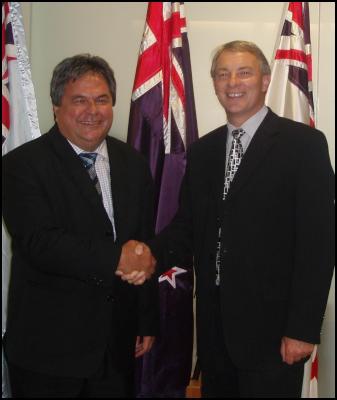
Minister of Trade Announces Conclusion of Substantive Bilateral Negotiations for Samoa WTO Accession


Trade Minister Phil Goff with Samoa Deputy Prime Minister Misa Telefoni
*****


New Zealand and Samoa have successfully concluded negotiations on the major outstanding issues in Samoa’s World Trade Organisation (WTO) bilateral accession negotiation, Trade Minister Phil Goff announced today.

To accede to the WTO a state is required to obtain endorsement from a WTO Working Party that its trade regime is consistent with WTO rules. It must also conclude individual bilateral negotiations on the terms of their entry to the WTO with other members.

“Samoa sees membership of the WTO as being important to achieving its economic goals, and we support their efforts to realise this ambition,” Mr Goff said.

“The conclusion of our substantive negotiations with Samoa on the key goods issues is a major milestone towards Samoa’s objective.

“A clear process has been agreed to complete remaining technical work necessary for the agreement to be concluded.

“The agreement will reflect Samoa’s level of development, the significant progress it has already made in restructuring its economy and substantially reducing its tariffs and the close friendship between our two countries,” Mr Goff said.

The agreement will be signed by Samoa’s Deputy Prime Minister Misa Telefoni and New Zealand’s Trade Minister Phil Goff in early March.

ENDS

1/23/08

New Caledonia demonstration in support of jailed unionists


Posted at 23:26 on 22 January, 2008 UTC

An estimated 500 people have held a demonstration outside New Caledonia’s main court house in support of ten members of the USTKE union who were arrested during last week’s violent clashes in Noumea.

The ten were to be sentenced for joining an armed mob after being ordered to disperse and of assaulting members of the security forces as well as damaging public property.

The clashes, which left more than 20 people injured, erupted after police tried to end the occupation of land next to a bus depot at the centre of an industrial dispute.

The court has deferred the case until February the 22nd after the defence asked for more time to prepare its files.

The ten accused have been remanded, with the defence saying there should be the presumption of innocence and the men should not be kept in jail just to satisfy public opinion and political interests.

http://www.rnzi.com/pages/news.php?op=read&id=37601

1/18/08

More arrests expected in New Caledonia after Noumea clashes


Posted at 03:31 on 18 January, 2008 UTC

Police in New Caledonia are expected to make more arrests following Thursday’s clashes between security forces and those supporting the USTKE union which has been on strike at a Noumea bus depot.

45 people were arrested during hours of clashes which left nine members of the security forces injured while more than 10 USTKE supporters were hurt when police used tear gas and rubber bullets to dislodge them.

Several cars were burnt, including police vehicles, and footage from the incidents is now being used to track down more people suspected of involvement in the violence.

Local reports say among those detained were 10 women and a minor.

A meeting has been held this morning between the French high commissioner, who instigated the police raid, and the head of the USTKE union, but neither of them has commented to the media.

The strike at the Carsud bus depot was called in support of a union demand to have a sacked worker reinstated.

http://www.rnzi.com/pages/news.php?op=read&id=37537

1/16/08

Aotearoa 2007 - Indymedia Highlights

thanks to the Aotearoa Indymedia Crew

8273327a6107085123l.jpg
October 15th Raids

In a wave of massive state repression in Aotearoa / New Zealand, 300+ para-military police carried out dawn raids at houses around the country on Monday October 15th 2007, making 17 arrests. Search warrants were carried out in Auckland, Whakatane, Ruatoki, Hamilton, Palmerston North, Wellington and in Christchurch in the South Island. The police wanted to charge 12 people under the Terrorism Suppression Act (TSA). A massive solidarity campaign formed around Aotearoa and the world to support the activists in jail and after almost 4 four weeks, the Solicitor-General, David Collins, announced that he would not be granting permission to the police to lay charges under the TSA. Everybody got released on bail. However, 16 people - people from Tūhoe, Te Atiawa, Maniapoto, Pakeha; indigenous activists, anarchists, environmental and anti-war activists - are still facing charges under the Arms Act. More information: The Struggle continues… | October15thSolidarity.info | Te Mana Motuhake ō Tūhoe | State Repression in Aotearoa

trflag.gif
Tino Rangatiratanga - Tangata Whenua:

In Janurary, Tūhoe set up a blockade at Paekoa Rd in Ruatoki. On Waitangi Day, the Tino Rangatiratanga did not fly on the Auckland Harbour Bridge. However, it flew around Aotearoa and the world (and in May was flying/jumping on/off the bridge). In April, Ngati Haua was occupying their ancestral Maunga Whakakoro in the far northto stop it from being alienated from the Hapu forever. Maori Revolutionary Syd Jackson died in September. Thousands of people attended his tangi in Hastings. Michael Cullen had to be protected from angry protesters after being verbally abused and jostled at Taemaro Bay in December. Ngati Aukiwa has been fighting for their land for years and oppose they oppose the Office of Treaty Settlements negotiations with the Ngatikahu ki Whangaroa Trust Board. In late December, activists started to gather in the Urewera to celebrate the 10 year anniversary of the occupation at Waikaremoana.

svNPAPUA_wideweb__470x349,0.jpg
Pacific:

In February, Australian composer Martin Wesley-Smith's piece Papua Merdeka (Free Papua) was dropped from the Asia Pacfic Festival in Wellington after pressure from the Indonesian Embassy. May saw the relese of The Nu Face of Youth Rebellion, a film produced for Aotearoa Indymedia on the uprising in Tonga in late 2006. An Indonesian Military officer started a course in NZ in May, sparking protests from human rights activists. The same month, Auckland University students protested against a visit by former Indonesian Foreign Minister Ali Alatas. Five Tongan People's Representatives were charged with sedition in June. June also saw progress towardsa Free Trade Area of the Pacific. While the G8 met, the people of Tuvalu becamethe global face of climate change. As the Aboriginal communities of the Northern Territory in Australia came under renewed attack, people mobilised to support them across Aotearoa - Resistance is Existence: Aotearoa stands in solidarity against Australian Racism, International Day of Action: Stop the Genocide on Stolen Aboriginal Land & "Stop the Genocide!" - Protests Across Aotearoa. Helen Clark visited Jakarta in July, and ignored the abuses taking place in West Papua at the hands of the Indonesian Government. Australian Foreign Minister Alexander Downer came to Auckland to speak to the National Party in July, and was met with protests. August saw Fijian public sector workers on strike despite intimidation and death threats from the military government. Meanwhile, Indonesian Police used guns to threaten a West Papuan activist who toured Aotearoa in 2006. As the US-NZ Partnership Forum prepared to meet in Auckland, AIMC carried analysis of the effects of the policies it promotes in the Pacific.

12/4/07

Spin Cycle

This appeared in the embedded 'jurno' wipe ya Herald Sun, Victorian police officers in limbo after G20 protests

What complete pig spin, are the press aware that they are the Police Associations PR? Because their reputation is being trashed at the moment, rotting from the inside with corruption, racist policing of the African communities in Flemington, looks like the only positive pr they can get in this climate is to have another go at us mob and hide the fact that they brutally bashed people outside the museum.

Tactical and orchestrated on their part for sure. Check this out :


CASE STUDY: Victoria Police at G20

Situation: Victoria Police are involved in crowd control at
major events and protests. The aim of these events is to keep
the crowd peaceful and act quickly if things escalate.

Challenge: During an event, on-site officers move amongst
the crowd reporting activities and crowd behaviour to the
Police Operations Centre (POC) and/or Forward Command.
Traditional approaches to crowd management involve officers
patrolling in-the-field and then relaying information via radio.
Incidents can often only be dealt with in a reactive manner
once they are occurring.

The G20 meetings, held all over the world, often result in
protests and demonstrations. In anticipation of Melbourne
hosting the G20 Victoria Police wanted to investigate the
how live video streaming could assist with more accurate
information gathering and quicker decision-making.

Solution: Officers moving around in the field used the
fully mobile m-View GoPack, allowing experts at Command
and Control to watch the action as it happened. Police
captured and streamed video from the protest live to POC and
Forward Command. Many high-quality snapshots were taken,
recording crowd behavior and evidence.
http://momentumgroup.com.au/


Police attack G20 protesters at Melbourne Museum

Sunday afternoon a group of 50 demonstrators were beaten and trampled by police during a peaceful anti-G20 protest inside the foyer of the Melbourne museum. A woman was severely injured after police used batons and fists to disperse the small group of singing, dancing demonstrators. Several hundred police, including two divisions of riot police, were deployed in the incident.

Police attack G20 pr...
click to enlarge


Sunday afternoon a group of 50 demonstrators were beaten and trampled by police during a peaceful anti-G20 protest inside the foyer of the Melbourne museum.

A woman was severely injured after police used batons and fists to disperse the small group of singing, dancing demonstrators. Several hundred police, including two divisions of riot police, were deployed in the incident.

The group consisted mostly of women and included musicians and children. “We were given no warning and were not asked to leave before police charged.” Said one of the demonstrators. Members of the group were badly shaken after the event, and the severely injured woman was hospitalised with suspected broken ribs.

“We were singing and dancing at the front of the Melbourne Museum, as a non-violent way of publicly raising our concerns about the G20”, said one of the demonstrators. “Without warning we were baton-charged by heaps of cops. It was frightening, especially when a couple of busloads of riot police turned up afterwards.”

Police only called an ambulance to attend to the injured woman 10 minutes after the incident, despite repeated requests from members of the group.

Protesters afterwards attempted to disperse peacefully, but were followed for twenty minutes by a large police contingent.

Today's incident follows on from two days of protesting against the G20, a gathering of finance ministers, reserve bank governors and the heads of the IMF and World Bank.

police at door...
click to enlarge


police baton hit...
click to enlarge


poice baton hit 2...

police baton hit 3...
click to enlarge


police charge...
click to enlarge


police charge...
click to enlarge


woman being carried...
click to enlarge


injured women on gro...

10/26/07

King Kapisi - Reverse Resistance


Dedicated to Omar Hamed, with love from our family, made a beautiful banner bro for the tautoko rally apopo. Kia Kaha Bro, Ka Whawhai Tonu Matou Ake Ake Ake !!!!!!

10/17/07

Protests in Melbourne over NZ Crackdown

AUST: Protests in Melbourne over NZ terrorist raids -16/10/2007
Political activists opposed to this week's police operation inNew Zealand against alleged guerilla-style training camps in the eastern Bay of Plenty have staged a demonstration in the Australian city of Melbourne. Around25 people gathered outside the New Zealand Consulate in Collins Street,Melbourne, earlier today, watched by eight Australian Federal Police officers.Speaker - Sina Brown-Davis, Polynesian anti-globalisation activist

www.radioaustralia.net.au/pacbeat/stories/s2061270.htm

9/8/07

Jane Kelsey Rallies Anti-APEC Gathering

Prof Jane Kelsey Rallies Anti-APEC Gathering in Sydney

# Scoop Audio: New Zealand academic Professor Jane Kelsey spoke to an anti-APEC rally in Sydney's Hyde Park on Friday. Prof. Kelsey said APEC's trade liberalisation agenda is causing families to become further impoverished in many developing world countries. She said the US-Australia plan to develop nuclear power generation technology as a means to solve the world's climate change problems was dangerous and self-serving.

http://img.scoop.co.nz/media/audio/0709/JaneKelseyAntiAPECRally70907.m3u

http://www.scoop.co.nz/stories/HL0709/S00143.htm

9/3/07

Important Legal Briefing- From Sydney Human Rights Monitors

For all of those who plan to excerise their cvil and human rights in Eora Country over the course of Asshole Politicians Excrete Capitalism
Love,and Solidairty to All.
Haere Atu apec

2 September 2007

Special Melbourne edition !!!

This edition of the Human Rights Monitors Info Sheet is intended for those coming to Sydney form Melbourne and other non-Sydney locations around Australia.
The meeting of 21 of the world's leaders to Sydney has led to unprecedented security measures being taken during their visit. Special powers have been given to police under the APEC Meeting (Police Powers) Act 2007 and these will be in force from August 30 to September 12. The main APEC event is the Leaders' Week, with September 7 (the Friday) a public holiday.

Although this was written on 2 September 2007, the situation in Sydney is fluid and it would be a good idea to try and get an update from locals when you arrive in Sydney.

Who's who

The main protest march, planned for the Saturday, is being organised by the Stop Bush Coalition ( http://stopbush2007.org). A number of autonomous actions are also being organised by Flare in the Void ( http://flareinthevoid.wordpress.com). Some actions may also be organised by other groups. Some information about events is deliberately not mentioned in this newsletter as the details are confidential.

What's when

The following information on the Stop Bush Coalition is from the website, Flare in the Void info is from their August 2007 zine, and other information is from the corporate press. You should check with each group that the information is still accurate.

Tuesday 4th

rally at 5.00pm to mark the arrival of Bush in Australia. At the time of writing, the location is undecided, but is probably Central. Please check
http://stopbush2007.org for more info. Organisers estimate 1,000 people.
Opening of Flare in the Void from 5.00pm-ish. To find out where Flare in the Void is being held, text 0434 585 264.

Wednesday 5th

Student strike. Organisers estimate 1-2,000. Please check
http://stopbush2007.org for more info.
Flare in the Void workshops.
Legal training sessions for legal observers. 6.00-8.00pm at University of Technology, Sydney, Students Association Backroom. Building 1 (the main building), opposite Central station.

Thursday 6th

Flare in the Void decentralised actions day across Sydney. Contact Flare in the Void for more info.

10.00am Flare in the Void legal briefing for latecomers.
Falun Dafa protest, march from Hyde Park through Sydney CBD
Friday 7th
A public holiday in the Sydney Metro area.
Falun Dafa protest - CBD
Maritime Union of Australia protest - Hyde Park
Chinese Freedom rally - location not known.
Flare in the Void workshops.
1.00pm (perhaps 2.30pm). Flare in the Void Legal briefing for latecomers.
Stop Bush 2007 convergence in Newtown. Check website for more info.

Saturday 8th

The main protest march. Police estimate 5-10,000 will attend. Check
http://stopbush2007.org for more info. The march route is contested. A meeting of the Stop Bush coalition on 27 August 2007 reaffirmed its march route (Town Hall/George St/Martin Place/Hyde Park). The police have consistently opposed this march route and as of today there is no agreement. The last meeting of Stop the Bush before the protest will be on Monday 3 September 2007. Again, check the website for more details.

Vietnamese community protest - Belmore Park
Amnesty International protest - Victoria Park
Chinese People for 2008 Olympics - Chinatown
Sunday 9th
Mutiny chill-out picnic.
--------------------------------------------------------------------------------------------------------------
The legal stuff: restricted areas and declared areas

The Act introduced for APEC speaks of two types of security zones: "restricted areas" and "declared areas". To make them easier to visualise, this article will refer to them as red areas and green areas (respectively).
The red areas are areas of maximum security. Police may search all non-residential premises without a warrant. It is likely that they will be surrounded by fences and armed police. There is a legal obligation to provide ID to a police officer on request. It is an offence punishable by 6 months imprisonment (in some circumstances, 2 years) to try to enter a red area without special justification. Special justification means that you live or work in the area: it is up to you to prove this if you are claiming a special justification for being in a red area. The rest of this article will only speak about green areas. It is assumed that, as a protester, you will get nowhere near a red area. There is no legal obligation to tell the public where the red areas are, but press reports indicate the Sydney Opera House, Government House, various hotels and the Sydney Convention/ Exhibition Centre. The rest of this article will only speak about green areas.

Green areas: geography, check points, cordons and road blocks

The largest green area is that part of the CBD north of King Street. There is a presumption that members of the public can enter and leave the green areas. At the entrance to green areas, or once inside a green area, the police may set up check points, cordons or road blocks in order to stop and search people or vehicles. The police can close roads.

The largest green area includes most of the CBD north of King Street, Hickson Road and parts of Darling Harbour. Part of this area will be fenced off in any event, with a 2.8 metre tall fence, running along Bridge St, the location of the Australian Stock Exchange. At the time of writing, the fence has been extended so that it covers much of downtown Sydney, near Martin Place, and Circular Quay, where the ferries are. The fences are secured by concrete blocks and seem impossible to push over.
On August 24, other green areas were added: Sydney airport, RAAF Airbase Richmond, parts of Kirribilli, the Icebergs Club and surrounds in Bondi, and a number of hotels (the Sheraton on the Park in Elizabeth St, Hilton Hotel on George and Pitt Sts, Observatory Hotel, Kent St and the Marriott Hotel, College St.). The law allows for the Minister to add other green areas. Check the daily press for details for any added green areas closer to the day.

Note: the press speaks of "no-go areas." This is inaccurate, as that might indicate a red or a green area. Check with the APEC legal hotline (below).
Green areas: searches and prohibited items
The police may do a pat-down search as a condition of entering the green area. A person's entry may also be made conditional upon giving the police a prohibited item. A police officer who is given or seizes a prohibited item doesn't have to give it back.

Prohibited items are spray paint cans, chains, handcuffs or other devices capable of being used to lock persons to other persons or things, poles that are more than 1 metre in length, marbles, ball-bearings or other similar spherical items, smoke devices, flares, flammable or noxious liquids or substances, laser pointers, devices that are capable of being used to interfere with broadcast or communication devices. Regulations closer to the time might add other items to the list.

Green areas: reasonable directions and showing ID
Police officers have the power to give reasonable directions to any person or group providing that it substantially assists security, safety or "in preventing or controlling a public disorder." There is a clear obligation to give your name to a police officer upon request if they are in a red area. There is no clear obligation to do so in a green area. A police negotiator advised a representative of Stop Bush 2007 on August 17 that people will be have to show their IDs to police officers in the green areas. However, this is legally doubtful. If asked for your name or ID, consider asking the police officer if you are legally obliged to do that and what the basis of that obligation is. Some people have been reported that they will enter the green area without ID in order to test police powers.

Refusing to comply with a "reasonable direction" is not an offence, but allows the police to escort that person from the green area. The legislation does not appear to provide a limit on how far a person can be escorted from the green area, but in past protests the police have arrested people for breach of the peace and then escorted them many miles away and the released them. This is of doubtful legality.

Green areas: keeping people out and the excluded persons' list
A person can be excluded from a green area if they fail to agree to a pat-down search; fail to agree to their vehicle being searched on entering; unlawfully resist, hinder or obstruct a police search; fail to give up a prohibited item as a condition of entry; are on a road closed for APEC purposes or fail to comply with a reasonable direction. One of the powers that have gained media attention is the creation of an excluded persons' list. No criminal convictions are necessary to be on the list. It is only necessary that the Police Commissioner satisfy himself that a person would pose serious threats to the safety of persons or property in a green or red area. No more specific criteria have been announced so far. Police have said they will write to people beforehand saying that they are on the list, but they don't have to legally keep this promise.

According to media reports, 29 people are on the excluded persons list. A Sydney tabloid has published the names and photos of 27 of them. There may be another list (or lists) for private police consumption. You will only know if you are on this list when told by the police - perhaps even at the entry to a green area.

Bail
Bail laws have been changed in relation to three offences: assaulting a police officer, throwing a missile at a police officer and maliciously damaging property. There is a presumption against bail for people charged with these offences. This is open to abuse, as any act of escorting a person from the green area, or any arrest, can easily allow the police to manufacture an allegation of assault.

We have been advised that those arrested during APEC will be taken to Parramatta and Surry Hills police stations. The police have boasted that they can process up to 500 people. The Act allows for special audiovisual links in relation to bail applications for these offences. If arrested after 2.00pm or so, it may be difficult to get in a bail application that day. It may take longer to process out of state persons as the police of that state will be contacted by NSW police.

If appearing before a court, it may be the case that you are subjected to a strip search. It should be performed in minimum time and with respect. It can be (but does not have to be) humiliating - it happens to people in prison all the time.
People arrested may be detained in buses. You may be there a long time. Consider having medication or a medical certificate if prolonged detention will cause problems. This will not guarantee that the police look after you, but it may help.

This newsletter has only one passage in bold and in a box, because it is so important:

If arrested, do not give an interview or make any comments about any alleged offences. Anything you tell a police officer is never off the record. Threats to charge you if you don't give an interview are bullshit - they will charge you anyway.

Human Rights Monitors: policing the police
Human Rights Monitors are a Sydney-based community group, mainly of law students and lawyers, who are concerned about aggressive policing and protests. We will be attending the main APEC protests and other actions by invitation.
We will be wearing marked yellow vests and normally operate in pairs. Our aim is to collect eye-witness, photographic and video evidence of any misbehaver or illegal activity by the police. We will also be handing out bust cards, which will have the phone number to ring in case you want to speak to a solicitor for legal advice.
We will have 20-30 Human Rights Monitors, a number working 'undercover' and 30 solicitors on-call to give phone advice.

Further information
An 8-page leaflet will be handed out by Human Rights Monitors at protests, Flare in the Void and elsewhere on request. A limited number of workshops for particular groups can be arranged. Contact Dale on dalemills@cantab.net or 0422 644 363 for more information about Human Rights Monitors.
The APEC Legal Hotline will be 0401 427 588 or 0432 598 318. This number will be open during the main protest days and also be distributed on stickers and laminated business cards.

8/15/07

A call for shared intent against the violence of APEC


Sydney :: Public Meeting on APEC & Direct Action
Wednesday August 22 :: 6.30 pm
University of Technology Sydney, Tower Building

"We're not going to sit in silence, We're not going to live in fear."- John Farnham

The Asia Pacific Economic Co-operation (APEC) is a forum where heads of governments in the Asia Pacific region, will meet to discuss economic and military strategies that will benefit ruling powers in the region. APEC heads of state will arrive in Sydney on Friday 7th and meet Saturday 8th September at the Opera House and Sunday 9th
September at Government House.

In Australia, the policies of APEC have resulted in the privatisation and degradation of public transport, low wages, de-unionisation of workplaces, high cost housing, an elitist
education system, increased military funding at the expense of education and health, and the lack of prevention of climate change.

As a colonial power in the Asia Pacific region, the Australian government has a direct interest in implementing these policies. In Papua New Guinea, East Timor, the Solomon Islands and elsewhere,
Australian companies profit, with military enforcement, from the privatisation of public assets, the displacement of local indigenous peoples and environmental degradation.

These policies create situations whereby people have a right to respond with anger. Governments can only maintain the legitimacy of such policies by maintaining an image of social control and demonising protest by committing millions of taxpayers' dollars to surveillance, repression and violence. But we are fighting for a better world.

The people who speak out against the repression of APEC will attend the protest as individuals on their terms. But with shared intent,
good communication and collective organisation, we can participate in mass direct action that is both meaningful and strategic. This can send a strong message against the poverty and violence imposed
by APEC's policies. It is important that we stay safe and minimise the repercussions of police repression in our families and communities.

We invite local community groups, individuals, unions and others to work with us and communicate with us before the event to develop a shared intent. A number of direct action training sessions will take place in Sydney and Melbourne to prepare for a mass, strategic intervention to the APEC meeting. We also support and hope to work
alongside others taking action in whatever way they see fit.

By the very praxis of stepping out and challenging their control of space we are committing what is regarded as a violent act. It is the violence of articulating resistance; it is a violation against
their understanding of our lives.

We want to act together with an approach that is empowering, strategic and fun. We want to use their borders against them. Our proposal is to disrupt their meeting by disrupting their control of the space, to challenge the exclusivity of their politics. We want together as a mobile obstruction and where we see a border silence
us, we challenge them, we turn their zones into the political forum we want to have. We make it known that we don't agree and we are not going to live in fear.

A call for direct action at the anti- APEC protests will be big news in Sydney. But will people join us? Only if we can successfully delegitimise APEC, give people hope that disruption is possible, communicate powerfully why they should participate and most importantly counter the huge fear campaign which the state has
rolled out against the people of Sydney.

This is a statement of our intent to disrupt the APEC conference, because we believe it promotes exploitation, inequality and the destruction of the planet. We are dreaming up ways to disrupt the
conference whilst communicating our deeply held convictions against capitalism and the authoritarian state, and our belief that another
world is possible. We call out to others to join us in planning creative, strategic disruptions, and to plan your own actions of disruption.

sharedintent(*)gmail.com

Related

* http://indyhack.blogspot.com/2007/06/apec-black-list-why-are-you-surprised.html
* http://uriohau.blogspot.com/2007/08/head-pig-for-apec.html

8/14/07

Picket and Demo Against CN Rail and SPP

- Support indigenous struggles for sovereignty, dignity and self-determination on Turtle Island ...

-- Oppose CN Rail's racism and colonialism ...

-- Protest Bush, Harper, Calderon and the "Security and Prosperity Partnership" (SPP)

::::::::::::::::::::
TUESDAY, AUGUST 14th, NOON
Picket and Demonstration
Montreal Central Train Station
metro Bonaventure
(enter via the metro,
or via the street at 895 de la Gauchetière West,
between University and Mansfield)
::::::::::::::::::::

** Meet at the large departures/arrivals sign in the main lobby of the train station. Bring your banners, placards, flags and other symbols of dissent. **

-- We demand that CN Rail drop their racist lawsuits against Mohawk activists at Tyendinaga;
-- We stand in support and solidarity with indigenous struggles for sovereignty and self-determination all over Turtle Island;
-- We denounce CN Rail's role in the corporate North American
Competitiveness Council and the Security and Prosperity Partnership (SPP).

"When justice fails, block the rails!"


CN Rail is a multi-billion dollar company, headquartered in Montreal, whose tracks and installations occupy native lands from ocean-to-ocean.

CN Rail is currently pursuing multi-million dollar lawsuits against Mohawk activists from the community of Tyendinaga who are actively involved in the defense of their land.

The Mohawks of Tyendinaga are demanding the return of the Culberston Tract, which was stolen from them in 1832. Recently a portion of the land was reclaimed, with the Tyendinaga community demanding that the Ontario government revoke the license legitimizing a private quarry operation that is literally removing land from the Culberston Tract. For more info, consult:

http://ocap.ca/firstnations/tyendinaga/culbertson

CN is threatening more lawsuits against other indigenous communities and activists who block CN rail lines.

CN Rail and their executives are targeting indigenous community organizers who have effectively brought the issue of native sovereignty to the forefront. In the context of unsettled land claims, and the fact that their tracks sit on appropriated native territory, CN Rail's actions are colonial and racist.

While CN uses the courts to attack native activists, their CEO -- E. Hunter Harrison – is a member of the North American Competitiveness Council, a key promoter of the recently formed "Security and Prosperity Partership" (SPP) between Canada, the United States and Mexico. The SPP continues the imposition of the neo-liberal North American Free Trade Agreement (NAFTA), combined with paranoid "Homeland Security" policies.

The SPP is an attack on all working and oppressed peoples, especially the indigenous peoples of "North America". The SPP leaders – George Bush, Stephen Harper and Felipe Calderon -- will be meeting later this summer, from August 20-21, in Montebello, Quebec (just 90 minutes from Montreal).

Join us on August 14 in Montreal, as we build towards the protests against Bush, Harper and Calderon in Montebello on August 20 (info: www.psp-spp.com )

Organized and endorsed by: Block the Empire-Montreal (BLEM), Liberterre, NoOne Is Illegal-Montreal, La Rue Brique, Solidarity Across Borders, Tadamon! Montreal, La Pointe Libertaire and others (to add your group endorsement, please contact noii-montreal@resist.ca)

-> Text of the flyer passed out at the picket against CN on July 1,
2007 in Montreal:

http://nooneisillegal-montreal.blogspot.com/2007/07/flyer-text-why-we-are-protesting.html

-> “About the SPP” Background: http://www.psp-spp.com/?q=en/aboutthespp


INFO: 514-848-7583, noii-montreal@resist.ca

No a la Apec

No Apec

indyhack - a cellular semiotic revolution: APEC black list - Why are you surprised?

indyhack - a cellular semiotic revolution: APEC black list - Why are you surprised?


Are you on a list of "excludable persons" from APEC07?

Proposed laws around APEC are a draconian, unreasonable curb on the right to protest - a direct attack on every citizen’s right to dissent.

The APEC summit will discuss how to best push their policies of cuts, privatisation, free trade, and IR laws down workers throats. The world’s biggest war criminals, environmental polluters and exploitative bosses will discuss ways of increasing profits while ordinary people with legitimate concerns are locked out.

The unprecedented security operation to protect George W Bush and other political leaders will see the introduction of new APEC security legislation. These new laws will include the "suspension of normal bail provisions, new powers to do random searches, and exclude "prohibited" people from restricted zones. Anyone under suspicion can be arrested and held without bail.

The "APEC Meeting (Police Powers) Bill 2007" allows the Police Commissioner to create a secret list of people who are excluded from APEC "security areas". Police Minister, David Campbell:

"Those who have been involved in violent and disruptive protests in the past will most likely be on this list. They won't need to be informed - they know who they are."

Police will be able to compile a list of people or organisations without any fundamental justification, who can be listed as "excludable persons" - reminiscent of communist East Germany.

These measures are not aimed at possible terrorist attacks but at criminalising dissent and stifling opposition to the neo-liberal polices that APEC represents. The Police say they will "use any number of methods to gather intelligence about individuals and organisations"...

The APEC Bill will, according to the NSW government, prevent protesters from "terrifying the public". The law would:

- create "restricted" and "declared" areas in large parts of central Sydney;

- allow the police to stop and search anyone in or around these areas and confiscate items considered "prohibited", including banner poles;

- allow for six-month jail terms for simply entering a restricted area without justification and two years’ jail for carrying a “prohibited item”;

- and presume against bail for many offences (meaning people arrested could be detained for up to two weeks).

The law would also:

- severely limit police liability, raising the possibility that the police will be allowed to break the law with impunity,

- allow police to create secret lists of "excluded people" including those who fail to comply with a police order during APEC and those who the police consider pose a "threat" to people or property during APEC. These people will be prevented from entering parts of Sydney during APEC.

These extraordinary police powers, aimed at protesters, are designed to deflect the public discussion [around] APEC away from the real and terrible violence and injustice in the world today...

Corporations and IGOs


This is from Anhi's excellent intercontinentalcry, which gives a global look & analysis of Indigenous peoples and our struggle/s.

The purpose of this section is to give people a primer on economic globalization, NAFTA, FTAA, the WTO, World Bank, and Corporations.

http://intercontinentalcry.org/library/corporations-and-igos/