A recent document released under the Official Information Act (OIA) shows that the Police are heavily spying on and running operations on protest groups. In the Police annual report for the year ending 30th June 2009, a reference was made to “84 operation orders” made in relation to “public demonstrations”. An OIA request for a list of all these operation orders made in October 2009 has now finally been answered by Police National Headquarters and the results are chilling.
In 2008/9, the police ran operations on a “Tibet candlelight vigil”, the “Stagecoach Bus Strike” and a “Palestine Peace Vigil” in Wellington, a “Bible group” outside the US embassy, the “Waterside Workers' Strike” in Auckland and a protest in Otahuhu “re lack of swimming pool”.
A list of the 84 operation orders has been released. However, access to the actual orders has so far been denied.
Peace Action Wellington condemns the action of the NZ Police in conducting operations on protests against the annual weapons conference hosted by the NZ Defence Industry Association and against legitimate political dissent. ‘Protecting these people is protecting war mongers and war profiteers from public disgust, outrage and resistance to their activities’ said Valerie Morse, Peace Action member. ‘In my experience, the police see their role as shutting down protests, and they will do whatever is necessary in order to accomplish that, including extensive surveillance, arbitrary arrest and detention of people without any cause whatsoever.' Continue reading article here
Showing posts with label Haere atu nga poaka. Show all posts
Showing posts with label Haere atu nga poaka. Show all posts


1/1/10
4/29/09
Bugged! State Surveillance under the microscope

Fri 8th May: Film world premier, music and more
An awareness raising event to provide information about current State Surveillance practices in Aotearoa, and how they relate to the State Terror Raids of October 2007. The evening will raise money for those affected by the raids, and their communities.
Newtown Community Center Theatre, Crn Rintoul and Colombo
7pm till late
$7 unwaged, $10 waged
BYO and Food available for Koha
World Premier of Rise UP! A documentary film about the community response to the 2007 ‘terror’ raids
Talks by:
Keith Locke Green MP
Music from Mara TK + others
On the morning of October 15th 2007, hundreds of police raided houses across Aotearoa arresting activists, under the guise of catching "terrorists". In reality, the terrorism charges were never laid, and in order to save face,
the police pursued charges against 20 people under the Arms Act. In Addition, five of the defendants have now been charged with membership in a criminal organisation and all of them are facing a long, drawn-out trial.
These actions were all part of the global 'war against terror' which the New Zealand Government signed up to with the Terrorism Suppression Act 2002. The arrestees had been spied on for years by the SIS (Security Intelligence Service) with the assistance of inflated police budgets and powers since 9/11.
The raids and subsequent charges are racially and politically motivated. The New Zealand Government aims to silence dissenters who question the
State’s processes, decisions and actions. Political agitators, activists and Maori struggling for sovereignty, for Tino Rangatiratanga are being directly targeted by the State. The state then labels them 'terrorists' in order to gain public support for its actions.
If you want to find out more about the raids and their consequences throughout Aotearoa/New Zealand, as well as how state surveillance in this
country affects you, visit
An awareness raising event to provide information about current State Surveillance practices in Aotearoa, and how they relate to the State Terror Raids of October 2007. The evening will raise money for those affected by the raids, and their communities.
Newtown Community Center Theatre, Crn Rintoul and Colombo
7pm till late
$7 unwaged, $10 waged
BYO and Food available for Koha
World Premier of Rise UP! A documentary film about the community response to the 2007 ‘terror’ raids
Talks by:
Keith Locke Green MP
Music from Mara TK + others
On the morning of October 15th 2007, hundreds of police raided houses across Aotearoa arresting activists, under the guise of catching "terrorists". In reality, the terrorism charges were never laid, and in order to save face,
the police pursued charges against 20 people under the Arms Act. In Addition, five of the defendants have now been charged with membership in a criminal organisation and all of them are facing a long, drawn-out trial.
These actions were all part of the global 'war against terror' which the New Zealand Government signed up to with the Terrorism Suppression Act 2002. The arrestees had been spied on for years by the SIS (Security Intelligence Service) with the assistance of inflated police budgets and powers since 9/11.
The raids and subsequent charges are racially and politically motivated. The New Zealand Government aims to silence dissenters who question the
State’s processes, decisions and actions. Political agitators, activists and Maori struggling for sovereignty, for Tino Rangatiratanga are being directly targeted by the State. The state then labels them 'terrorists' in order to gain public support for its actions.
If you want to find out more about the raids and their consequences throughout Aotearoa/New Zealand, as well as how state surveillance in this
country affects you, visit
3/18/09
Caught on film and stored on database: how police keep tabs on activists
from the guardian, 11 March 2009:
Police footage obtained by the Guardian has revealed the crude monitoring methods deployed across the country against protesters, thousands of whom have their personal details stored on criminal intelligence systems for up to seven years...
* Paul Lewis and Marc Vallée
* guardian.co.uk, Friday 6 March 2009 19.30 GMT
[original article]
Shocking footage shot by police, accompanied by their own critical commentary, shows how their officers monitored campaigners and the media – and demanded personal information – at last August's climate camp demonstration in Kent.
At 11:37am on August 8 last year (2008), two police surveillance officers sat in a patrol car in Kent and switched on their Sony digital video camera.
When the tape started to roll, they stated they were "evidence gatherer" surveillance officers and explained the purpose of the operation. A lead surveillance officer and his assistant, they were on duty to help police the Climate Camp demonstration, an environmental protest against the nearby Kingsnorth coal-fired power station.
What the pair did not know when, 20 minutes later, they stood on a grass verge at the entrance to the camp and started work, was that their surveillance footage would be obtained by the Guardian. It would provide evidence of the crude monitoring methods used to glean information about campaigners and would prove that journalists are being targeted by police surveillance units.
This was no rogue operation. An investigation by the Guardian has established that surveillance footage such as that shot by the Kent officers is routinely uploaded onto a police database. In fact it seems that thousands of activists – from campaigners against Heathrow's third runway to anti-racism marchers – have their personal details stored on criminal intelligence systems for as long as seven years.
The Metropolitan police's Forward Intelligence Teams (FITs) and Evidence Gatherers (EGs) have over the last decade pioneered the controversial use of "overt surveillance", a technique now widely used by forces across the country at political demonstrations. It is designed to "record identifiable details" of protesters who may commit crime or anti-social behaviour and gather intelligence that could help police a public order event.
The Association of Chief Police Officers (Acpo) recently commissioned the National Police Improvements Agency (NPIA) to establish a "national standard" for overt surveillance, to which all forces in England and Wales have signed up.
Surveillance officers receive briefings before protests about key targets and are handed "spotter cards" containing the images of individuals police want to monitor.
The operations are normally carried out by regular police officers who have received additional training in surveillance. The human rights watchdog Liberty – which did not know about the database – is challenging police surveillance tactics in a judicial review at the court of appeal.
Privacy rights
However police appear not to have disclosed to the court they were transferring the private details of campaigners to a database. Lawyers believe the transfer makes it more likely the technique is in violation of privacy rights under Article 8 of the Human Rights Act.
"The time is now 11.57 hours," said the lead officer. "We're up at point three, the front entrance to the climate camp site." The camera panned to show officers from West Yorkshire police, among thousands drafted into Kent from across the country in the £5.9m policing operation, searching activists as they entered the camp.
Kent police, which was in command of the operation, had activated an order under section 60 of the Criminal Justice and Public Order Act 1994, authorising officers to search anyone in the area for dangerous weapons. The film shows how police zoomed in on virtually any protesters in the area, noting down items of clothing or other distinctive features. They also appeared to have knowledge of some activists' past political activity, on one occasion noting that a protester had "spent a lot of time" at a different part of the camp. Others seemed to have been targeted for standing beside, or near, prominent environmental campaigners.
But whenever journalists were in the area, the lens was almost exclusively pointed at them. In total 10 journalists were monitored emerging from the camp, where they had been interviewing protesters.
The officers zoomed in to pick out the logo on the back of a Sky News cameraman's jacket, monitored several photographers and followed an ITV Meridian news crew, including the anchor of the evening show, Ian Axton.
"A lot of press officers aren't there. Just think they can bloody wander in and out of the field. It's wrong, I think," the lead officer remarked when the ITV crew was in shot. "I trust them less than the protesters."
Later, referring to ITV cameraman Pete Lloyd Williams, he said: "The time is now 13:19 hours. Same date. Same location. Press cameraman here. Being awkward a little. Being asked to stand back by officers on at least two occasions and then asked to stand by the inspector. Or asked by the inspector to stand out of the road. Coming out with witty comments."
After spotting a videographer and photographer across the road, the assistant officer said: "Inquisitive, ain't they – these two, by the pole."
The lead added: "He don't like having his photograph taken – that one there with the bald head."
The surveillance lens returned to the ITV crew after the pair overheard a discussion between an officer and Lloyd Williams.
"He's giving him a ticket if you want to record any of that? As to whether or not he wants to give his details," the assistant officer said.
The officers walked closer, to within earshot. "Did he give details?" asked the assistant officer. "Don't know if he did or not," replied the lead. "Think he just said he was from ITV Meridian. Don't know if he gave personal details." This was not a one-off event; the National Union of Journalists (NUJ) has documented eight occasions over the last year when, it says, police surveillance officers photographed and filmed journalists.
In May the general secretary of the NUJ, Jeremy Dear, alerted the Home Office that journalists – particularly photographers – were "routinely and deliberately" watched by police surveillance teams.
The home secretary, Jacqui Smith, replied that the government "greatly values" the free press, but "decisions may be made [by police] locally to restrict or monitor photography in reasonable circumstances". Senior police officers in turn also assured the NUJ that journalists were "not being targeted unfairly".
Moments after the camera stopped rolling at the Climate Camp, a group of journalists, including some of those caught on the surveillance footage, were followed by a team of surveillance officers to a McDonald's restaurant several miles from the camp.
Police filmed the journalists, who were using wireless computer networks to file their material, through the restaurant window. Kent police later apologised after complaints about the McDonald's surveillance incident and the use of the Section 60 order to subject journalists in the area to intensive searches.
Heavy-handed
Assistant chief constable Allyn Thomas, Kent police's commander of the operation, said in November his officers had not been properly briefed about actions they could "reasonably take when engaging with members of the press".
The forces's heavy-handed approach to the Climate Camp demonstration received widespread criticism, including in parliament.
Home Office minister Vernon Coaker, who initially claimed Kent police's approach had been "proportionate and appropriate", was forced to apologise to MPs after the Guardian revealed the 70 police officers he claimed had been injured in clashes with protesters had actually suffered from unrelated ailments such as bee stings and toothache.
Many of those captured in police surveillance footage – which is filmed at all types of political demonstrations – will want to know what their images are being used for. The raw data gleaned through police surveillance material is stored on marked CD-Roms in a warehouse, and is not searchable by the names of activists.
However, disclosures obtained under the Freedom of Information Act by the law firm Hickman and Rose, representing the NUJ, document how in the case of the Metropolitan police the surveillance material is "added to a corporate intelligence database". They continue: "If names are known, they will be included" and: "generally, records are retained for seven years".
Superintendent David Hartshorn, a senior officer from the Metropolitan police public order branch, told the Guardian the database in question was CrimInt, a general intelligence system used to catalogue details about criminal activity.
"In relation to what we can keep on databases, we are governed quite strictly on that," he said. "Obviously you've got the Data Protection Act but also, in terms of intelligence, we have to justify what we are able to keep on our systems.
"So for example, if we've got someone who is a known activist for a particular group, and we keep their images live on that intelligence database, along the side of that intelligence there will be a report justifying why that image is being kept." He added: "We can't just randomly take your photograph and hold it on a database. There has to be a reason for it."
Reasons, Hartshorn said, include if a person has a criminal record for activity relating to a demonstration or is an outstanding suspect for an offence.
He added a third category. "There are people we have seen on a regular basis involved but may not have been charged or arrested – but believed to be on the periphery." That might include people "bordering on civil disobedience" or "doing something more than attending a rally".
He said the data was reviewed annually to ensure it remains "valid". "Just because someone did something 10 years ago and they might, off chance, do it again in the future, that is unlikely to justify keeping them on the database."
Asked why law abiding citizens should be held on a database because of their political activity, he replied: "We have to be able to say: this person has been seen at this event. They've been dealing with a person who was arrested at this event. It's not just: we've seen them floating around, don't know who they are, we'll keep them."
Hartshorn conceded that police can use the database to search which political events an individual may have attended. Although surveillance teams attend hundreds of events each year, Hartshorn claimed not to know how many political activists have their details stored on CrimInt.
However lower rank surveillance officers have indicated in open court testimony that officers can search the database for "thousands" of protesters.
In trials of Jeff Parks, an activist from London twice convicted for blocking police cameras at protests, surveillance officers revealed, according to solicitors' notes of proceedings, that one reason they were monitoring him was to gather information for the database.
In December PC Dan Collins told the City of Westminster magistrates court that his material was uploaded onto a central "intelligence system" which enabled police to search the political history of Parks, as well as "thousands" of other protesters.
Last month at Tower Bridge magistrates PC Hall and PC Pritchard accepted that there was a general police database that would include records of surveillance material relating to Parks.
"From the evidence of police officers in these cases, it is becoming clear that the police are maintaining a systematic record, including photographs, of those who attend demonstrations or even political meetings," said Parks's solicitor Raj Chada, who is appealing against his client's convictions. "Our cases suggest if you attend an anti-war meeting or other political meetings, your photograph will end up stored on some database."
12/21/08
Howard Broad Poaka Fraud
Video evidence collected at demonstrations in Wellington as recently as last week expose Police Commissioner Howard Broad as a bold-faced liar notes Michael Medved, spokesperson for the Justice NOW! Collective
Howard Broads precise words were that they "Were not interested in the to-ings and fro-ings of protest groups who might be wanting to stand outside a building and put placards up or do all the sorts of things you associate with lawful protest in a free and democratic society."
Watch this video and see for yourself that Howard Broad is simply not telling the truth. said Dr Medved.
A solidarity demonstration outside of the Greek Embassy in Wellington on Friday 12 December (immediately before the revelations about informant Rob Gilchrist) was heavily surveilled, videoed and photographed by police staff simply for standing outside the embassy with banners. Everyone at the picket was a target of the police photographer, uniformed police and the diplomatic protection squad. A similar demonstration outside the annual weapons conference in Wellington in October was surveilled by both police and intelligence contract agents from security firm Thompson and Clark who are working closely with police to target and exploit activists. This is the normal behaviour of police, not some exceptional circumstance.
The sole purpose of this police surveillance is to gather intelligence on political action and activity. Frankly, it smacks of a police state. The Police Commissioner should resign and the SIG should be disbanded immediately for this grotesque intrusion into legitimate political activity concluded Dr Michael Medved of Justice NOW!
Howard Broads precise words were that they "Were not interested in the to-ings and fro-ings of protest groups who might be wanting to stand outside a building and put placards up or do all the sorts of things you associate with lawful protest in a free and democratic society."
Watch this video and see for yourself that Howard Broad is simply not telling the truth. said Dr Medved.
A solidarity demonstration outside of the Greek Embassy in Wellington on Friday 12 December (immediately before the revelations about informant Rob Gilchrist) was heavily surveilled, videoed and photographed by police staff simply for standing outside the embassy with banners. Everyone at the picket was a target of the police photographer, uniformed police and the diplomatic protection squad. A similar demonstration outside the annual weapons conference in Wellington in October was surveilled by both police and intelligence contract agents from security firm Thompson and Clark who are working closely with police to target and exploit activists. This is the normal behaviour of police, not some exceptional circumstance.
The sole purpose of this police surveillance is to gather intelligence on political action and activity. Frankly, it smacks of a police state. The Police Commissioner should resign and the SIG should be disbanded immediately for this grotesque intrusion into legitimate political activity concluded Dr Michael Medved of Justice NOW!
12/18/08
Cops Kill Everywhere II

International Day of Action Against Murder by the State
Saturday 20/12/08, 1pm
Victorian State Gubbament
Remembering all state murders, particularly indigenous deaths in custody and in solidarity with the struggle in Greece. Bring photos of those killed, dress in old clothes if you wish to be part of the die-in
<<<<<<<<<<<<<<<>>>>>>>>>>>>
International Day of Action Against Murder by the State
Saturday, December 20, 2008 : 11 am
Greek Consulate
223 Castlereagh St, Sydney
WE DON’T FORGET, WE DON’T FORGIVE: End State Murder
Solidarity With Uprising in Greece
Remember Those Killed by the State
No More Deaths in Custody
Free Lex Wotton
River of Tears: Drones cover Kev Carmody
12/15/08
Politricks
A powerful film about deaths in police custody in the UK, featuring the poet Benjamin Zepheniah
12/14/08
Cops Murder Everywhere


see also
http://www.myspace.com/mulrunji
Australia's Persistent Racism
Aboriginals in Queensland: Singing one day, bashed to death by police the next

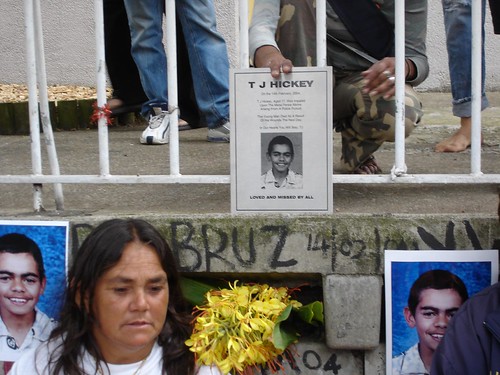
TJ Hickey & The Redfren Riot
A critical Media Anaylsis of the Redfern Riot
Justice for TJ
http://www.myspace.com/mulrunji
Australia's Persistent Racism
Aboriginals in Queensland: Singing one day, bashed to death by police the next

TJ Hickey & The Redfren Riot
A critical Media Anaylsis of the Redfern RiotJustice for TJ
15-year-old shot dead by police in Athens; 15-year-old shot dead by police in Melbourne
Steven Wallace12/9/08
THE STATE MURDERS - communique by the Polytechnic School Occupation in Athens

ALEXANDROS GRIGOROPOULOS (R.I.P.)
THE STATE MURDERS!
On Saturday December 6, 2008, Alexandros Grigoropoulos, a 15-year old comrade, was murdered in cold blood, with a bullet in the chest by a cop in the area of Exarchia.
Contrary to the statements of politicians and journalists who are accomplices to the murder, this was not an “isolated incident”, but an explosion of the state repression which systematically and in an organised manner targets those who resist, those who revolt, the anarchists and anti-authoritarians.
It is the peak of state terrorism which is expressed with the upgrading of the role of repressive mechanisms, their continuous armament, the increasing levels of violence they use, with the doctrine of “zero tolerance”, with the slandering media propaganda that criminalises those who are fighting against authority.
It is these conditions that prepare the ground for the intensification of repression, attempting to extract social consent beforehand, and arming the weapons of state murderers in uniform!
Lethal violence against the people in the social and class struggle is aiming at everybody’s submission, serving as exemplary punishment, meant to spread fear.
It is part of the wider attack of the state and the bosses against the entire society, in order to impose more rigid conditions of exploitation and oppression, to consolidate control and repression.
From school and universities to the dungeons of waged slavery with the hundreds of dead workers in the so-called “working accidents” and the poverty embracing large numbers of the population… From the minefields in the borders, the pogroms and the murders of immigrants and refugees to the numerous “suicides” in prisons and police stations… from the “accindental shootings” in police blockades to violent repression of local resistances, Democracy is showing its teeth!
From the first moment after the murder of Alexandros, spontaneous demonstrations and riots burst in the center of
Demonstrations, attacks and clashes erupt in
On Sunday the 7th December, thousands of people demonstrate towards the police headquarters in
Many demonstrators are injured and a number of them are arrested.
We continue the occupation of the
In the barricades, the university occupations, the demonstrations and the assemblies we keep alive the memory of Alexandros, but also the memory of Michalis Kaltezas and of all the comrades who were murdered by the state, strengthening the struggle for a world without masters and slaves, without police, armies, prisons and borders.
The bullets of the murderers in uniform, the arrests and beatings of demonstrators, the chemical gas war launched by the police forces, not only cannot manage to impose fear and silence, but they become for the people the reason to raise against state terrorism the cries of the struggle for freedom, to abandon fear and to meet –more and more every day- in the streets of revolt. To let the rage overflow and drown them!
STATE TERRORISM SHALL
IMMEDIATE RELEASE OF ALL THE ARRESTED IN THE EVENTS OF SATURDAY AND SUNDAY (7-8 DECEMBER).
We are sending our solidarity to everyone occupying universities, demonstrating and clashing with the state murderers all over the country.

see also: Athens Indymedia Centre
9/10/08
Pascoes Waka
 this is an eye witness account of the pressure and intimidation that continues on the defendants and their whanau. With the reporting of the "evidence" being suppressed, the media part of this state/police repression operation/campaign was given a major blow, so it looks like nga poaka are feeling desperate
11/09/08 around 11am Maryanne and I walked down from the court course making our way across the road to the coffee shop to purchase a bottle of pump water and a cuppa chino.
As we crossed the road several cars were parked outside the coffee shop. We walked behind 1 of the cars as it was pretty much right outside the coffee shop. We walked behind this car towards the coffee shop. Maryanne noticed marks on the silver car she pointed as we walked by look at that I starred as we carried on walking to the shop oh hell wander who owns that car. Maryanne said I think its Pascoe’s. I said oh hell someone don’t like him as we carried into the shop. We purchase a bottle of pump and waited for our cuppa chino. We then turned around to go back to the court.
Outside the coffee shop a man in a white stripped t-shirt forcefully holding our whanau members arms namely Watene. The man in the white stripe t-shirt was vicious as he was continuous yelling at Watene accusing him of damaging police property. The man in the white striped t-shirt started going red as a beetroot shaking he was very shaky his hands were shaking his face was evil. Watene’s partner was holding onto his arms saying this is my husband why are you doing this to him he hasn’t done anything your just picking on us. The man in the white striped t-shirt then whacked Bonnie in the head with his right hand. She flew back from the blow trying to balance her self from falling. She came back yelling leave my husband he’s done nothing who are you. Watene was holding onto his sausage roll it fell and someone picked it up and ate his sausage roll.

I tapped the man in the white striped t-shirt and said why he is under arrest he turned around and whacked me on the chest with his right arm. I then yelled out on the loud speaker to the audience of people who watched it all going down, did you see that people did you see that man assault me. The man yelled and told me to shut up. I continued to use the loud speaker. Within seconds 3-5 police cars showed up. They all got out of their cars some ran to the scene some walked. The man in the white striped t-shirt then pulled out from his waste area a badge showed it to the police and told them to arrest watene’s partner namely Bonnie.
They immediately grabbed her she continued yelling that’s my husband leave him alone why are you doing this we have done nothing leave us alone leave us alone. The police who grabbed Bonnie from behind grabbed her arms pulled them to the back and were pulling her towards their vehicles. I heard them saying to Bonnie your under arrest for resisting arrest. They then took her to the police vehicle and put her and drove off. They also did that to Watene. There were lots of people watching this scene there were also a couple of media I believe as I saw them taking photos.
We then proceeded to the police station taking all of Watene and Bonnie tamariki with us.
While waiting at the police station Bonny’s baby was screaming for milk as the baby is a breast fed baby. We asked if they could allow Bonnie to feed her baby. They denied our request and said not at this time she be 10min. 10min went by 20 minutes went by so we asked again could you take baby to be fed she’s a breast fed baby. They refused saying she wont be too long half and hour. 45 minutes later she was released.

8/13/08
Watchdog pans Queensland police over delays in Doomadgee death probe

QUEENSLAND'S anti-corruption watchdog has attacked state police over years of delay in the completion of an internal inquiry into the mishandling of the investigation of the 2004 death in custody of Palm Islander Mulrunji Doomadgee.
In a rare public stoush between the two leading law enforcement agencies in Queensland, Crime and Misconduct Commission head Robert Needham yesterday told The Australian he was concerned about the stalled inquiry and had repeatedly asked police to hand over the final report from its Investigation Review Team.
At least five officers face disciplinary action, and possibly criminal charges, over the death in custody and the police investigation, which was slammed in 2006 by deputy state coroner Christine Clements as lacking transparency, objectivity and independence.

Indigenous Deaths in Custody 1989 - 1996
8/12/08
APEC conviction overturned in right to protest victory

In another victory for the right to protest, one of the few court convictions over the APEC demonstration was overturned on appeal yesterday in the District Court. In the face of the continuing attempts to ramp up police powers by the NSW government, last seen in the ridiculous World Youth Day anti-annoyance laws, this is a further sign that we can defend our right to dissent.
Marcela Olea challenged her conviction for assaulting a police officer during chaotic scenes following the unprovoked police arrests of two protesters on their APEC "black list". Under the APEC legislation police compiled a list of protesters who were banned from certain parts of the city. Despite never venturing into the "red zone" at any time, the two peace activists were arrested by police.
Marcela was cleared of her charge on the grounds of self defence: in fact she was trying to film the events for an independent media production and tried to protect her camera from police jostling as they were arresting and manhandling protesters.
Her victory was assisted by huge public sympathy for the APEC protest, with the judge conceding that the staging of APEC had been politically and financially controversial. The prosecution had tried to smear Marcela by pointing out she was there to protest not just to film, but this was rejected by the judgement — another recognition that the right to protest must be
preserved.
Marcela is thrilled to have beaten the charge after what had been a traumatic experience at the hands of the riot police. "This is a great day for civil liberties," she says.
The legitimacy of police anti-protest operations suffered a huge setback as a result of the heavy-handed police behaviour during the summit and the farce The Chaser team made of security arrangements. In a possible further humiliation, one of the blacklisted protesters is set to bring a case of wrongful arrest against the NSW police over the arrests which sparked the incident.
Anti Terrorism and the Criminalisation of Dissent-Lou Thatcher
Fuck the apec police stateJane Kelsey Rallies Anti-APEC Gathering
3/4/08
Paramilitary Policing and Global Control
Since the rise of civilization the world has been divided into areas which fall under the exclusive control of one gang or another. These areas defined within borders where the control of one gang ends and another begins have become known as states.
Traditionally there have been two types of armed enforcers for each state - the police and the army.

The role of the police is the control of internal enemies and the role of the military is for offence and defence against external enemies. The concept of a single global economic system attempts to eradicate these borders, encompassing all, and de marking the distinction between the enemy within and the enemy without. It will view all enemies as internal, dissidents opposing the imposition of economic imperatives as opposed to rival states attempting to gain control of resources. As the borders between nation-states weaken for capital and its elite, the borders between rich and poor are fortified.
Armies have existed for as long as societies have produced enough surplus to support their existence as specialized soldiers. Big political men have hired big physical men to carry out raids, invasions and occupations in the form of armies, and these armies became the enforcers of the state's will upon its enemies. The origins of police forces are less historically definable. The first modern police force is generally recognized as being the London Metropolitan Police set up by Robert Peel in 1829, with forerunners in Scotland and London docks. [Paris and other French cities had established local forces as early as 1667]
Prior to this local militias were employed by sheriffs to act as enforcers of domestic law, often employed casually to be authorized to act as the need arose. The emergence of modern police forces roughly coincided with the establishment of modern nation-states, and the monopolization of power within their borders became central to their construct. (1) A definition of The State could be the body that claims sole use of the right of force within a certain area. The birth of modern European nation-states in the nineteenth century also coincided with a rapid expansion of industry and the corresponding shifts in the class composition of newly industrialized societies. The cities were filled with masses of displaced rural workers looking for work, and desperate for the basic necessities of life now denied to them, they turned to robbery of the rich and others. This creation of an identifiable underclass as opposed to random bandits and social deviants led capitalist society to respond with the creation of its repressive opposite, a police force.
A capitalist society does not particularly desire the creation of an underclass of thieves and outlaws, but its logic does require the creation of a class of beggars and unemployed. The unintended creation of the former arose when rogue human elements came into play and people refused to quietly accept the shit that was dealt to them. In order to enforce its desired social structure, capital's managers were forced to create a counterforce to this unintended outcome of class division. This application of force to determine the outcome of complex social relations is of course crucial to the way things are. Subtler means of coercion including mis-education, profit sharing and so on may prove beneficial depending on the conditions, but force remains the ultimate threat.

Society is a human construct designed to predict and control human behaviour in favour of those who control it. In a capitalist society there is a very definite order in which masses of humans need to be arranged in order for the system to work in favour of those who control it. This idea of continuing action, reaction and correction could be applied to many aspects of what is termed progress. Progress could be seen as the increasing ability of humans to control and shape the natural world. However as life is a chaotic and often unpredictable force, what are initially hailed as advances in the fields of science and technology, etc. usually prove to have unexpected side-effects or outcomes when applied into the real world. As the scientist/doctor/politician formulates a new invention/medicine/law, unpredicted glitches/side-effects/social reactions arise after its introduction that require the implementation of secondary controls. As an example, the emergence of super bugs in recent years is a growing and worrisome aspect of modern medicine. Due to the massive use of antibiotics for decades to treat even minor ailments, extremely virulent and antibiotic resistant viruses are appearing (most notably MRSA), which results in more efforts to combat them and more strains of super bugs in retaliation. This is a vicious seesaw that is threatening to derail modern medicine systems by making hospitals inoperable by flooding them with viruses.
The outcome of the Second World War was the establishment of two rival economic blocs who posed against and threatened each other. Prior to the First World War, the individual nation-states of the developed world vied with each other for control of the world's resources in order to increase the wealth of the elite in these countries. This nationalist based version of capitalism resulted in massive death and destruction when things eventually came to a head with the outbreak of world war one. The Second World War was a finishing off of these grievances that left the previously powerful nations of Europe in the control of the two emergent superpowers of the US and the USSR.
This balance of power and the threat of Mutually Assured Destruction by nuclear war kept the two economic systems played off against each other for almost fifty years. The world has changed dramatically since the collapse of the USSR and the state-capitalist system it supported. Since then, capitalism has asserted itself as a global hegemonic system. This process of globalization has been written about extensively but basically constitutes an unchallenged assertion of free-market capitalist economics on a worldwide scale without any serious challenges to its ideology or its functionaries. With this cohesion into a single system of operating, it might be useful to conceive of the world as becoming a unified state, at least in economic terms if not practical local details. With this shift in the balance of power, there also occurred a shift in the military strategies of the main players on the world stage. If there is no longer an external enemy to be countered, that leaves only internal enemies - maladjusted areas which need to be realigned, the normal scene of policing operations. Another view could be of these actions as attempting to incorporate unproductive areas into the hegemonic system, a type of empire building, a traditional use of military force reminiscent of pre-nation state eras.
If we look at the military adventures of the leading economic powers since the end of the cold war we see examples such as Iraq, Yugoslavia, Somalia, Afghanistan, East Timor, Haiti etc. It's brutally obvious that these are nothing like the large-scale inter-European wars of the past between large economic powers vying for dominance. Almost all of these were co-ordinated operations involving groups of nations such as the UN or NATO, thus making the comparison even more ridiculous. These operations could better be viewed as large-scale policing operations where rogue areas need to be brought under control, a bigger version of the riotous housing project if you will.

The phrase 'policing operation' has become part of military terminology in recent years. With these new objectives, there are new rules of engagement. Less frequently is crude propaganda used to raise excitement for a bloodbath; instead the soldiers are painted as peacekeepers on humanitarian missions and are given directions to behave like so. Given the possibility of media leaks of unsavoury incidents that don't fit with the public agenda, great lengths are gone to minimize civilian casualties. This might seem a moot point to someone who's wedding party just got gate crashed by a wayward smart bomb. But compared to the carpet bombing of North Vietnam for example there is a massive qualitative difference in the level of death being doled out. With the installation of soldiers as policeman into insurgent zones, a new dynamic has been created where soldiers are being ordered to impose order on large numbers of civilians, both in volatile crowd situations and in the daily control of social behaviour. In order to do so they are being armed with less-lethal weapons and trained in crowd control techniques. Riots can be great excuses for massacres if that is what is required, and less sophisticated states frequently resort to such measures, but for the leading nations of the free world, a clean image is everything, and corpses must be kept to a minimum.

The flip side to this increase in armies engaging in policing operations overseas is the increasing militarization of domestic police forces. The image of police officers is a multi-layered one. They are to be portrayed to Mr. Average who works permanently and invests in his own property etc. as the good guys, defending property, stopping violence and arresting thieves and assailants. However they also need to be portrayed to the criminal class as a force to be feared and hated. Ostensibly the first image is portrayed though the usual channels - smiling from the pages of the local paper, teaching school kids how to be safe, directing lost tourists and walking casually along community patrols. The nasty side needs only be shown on need-to-know basis, on dark streets, in your home, up close and personal away from the lights and cameras. Let's not forget though, that the enemy has been found in broad daylight, killing in front of everyone, like the horrific public murder of Jean Charles de Menezes or Carlo Guiliani.
The past decade or so has seen a massive move towards the militarization of police forces in the most developed nations. Looking at old footage of protests from the 80's/early 90's it is eye opening to see how little riot gear and less-lethal weaponry was available to the forces of order. This militarization most visibly takes place on the streets. Ordinary officers with more gadgets hanging from their belts, action heroes with sub-machine guns loiter in public places for no discernible reason, gangs of men in blue overalls lurk in vans in less-salubrious neighbourhoods and robocop makes his appearance at every minor protest. Shiny shoes are replaced by paratrooper boots, silly hats with baseball caps, clean shirts are covered with flak jackets and ever-increasing numbers of helicopters circle overhead. Slowly the gadgetry is increased but compare the average officer to his counterpart of a decade ago and the changes are obvious. This visible tooling-up is accompanied by a massive increase in the use of surveillance technologies, information storage and retrieval, identification databases and so on.
As with other aspects of repression it's not a voluntary movement; it is in response to changing social conditions. It is in the interest of capital to create as friendly and co-operative an image as possible. It means everyone is on the same team and creates an illusion of social stability. If there are heavily armed men in uniforms walking the streets then obviously something is amiss. The veneer of social cohesion is cracking. Many point to the terror attacks of September 11th and others in Madrid, London and elsewhere as being the excuse the elite needed to implement these measures, and to a large part this is true. Another smaller factor was the series of violent anarchist-led assaults on the tea-parties of the rich that enabled police chiefs to demand and receive funding for huge amounts of crowd-control technologies, lest the local elite lose face with its inability to deal with troublemakers while their mates are in town. It has largely been a case of the police responding to greater periods of class conflict and other moments of unstability.
The LA riots were a key point in the moment of policing in the United States, they were totally unprepared for the strain on their communications, fire-power, mobility, after the riots had susided there was a tremendous rush to get not only the LA cops but the rest of the pigs in the United States up to speed in terms of not only technology and resources, but minimum fitness and intelligence standards. These American methods of policing have been pushed all over the world. The carnivalistic riot which happened on June 18th 1999 in Londons financial district was a key moment for the resurgent anti-capitalist / anarchist movement, and also for how the state dealt with it. The planning for the day had inexplicably escaped the monitoring gaze of the British state despite being hyped for a year before hand across the country. This led to a sound-system riot of beautiful proportions and an after effect of widespread clampdown and surveillance of grass-roots political organising. The UK Police 'Forward Intelligence Team' (teams of cops who profile and harass activists) and the 'National Extremist Tactical Coordination Unit' (NETCU) are one part of this.
Of course once acquired, new technologies and police units are usually never relinquished and must be maintained and updated regularly. Whatever the crowd-control technologies bought to counter large-scale protests, the militarization is a much bigger deal than fancy-looking robocop outfits. It is in its applications in daily policing that its true essence is revealed, not in the extraordinary circumstances of the occasional rowdy demo.
Terror attacks were the excuses used to implement or speed up these changes. A common analysis of this project is that it is used to create an image of security to counter the fear created by outside attacks, while at the same time creating fear of the potential attacks by reminding you constantly of their possibility. A double bluff to make you trust your dear leaders with your safety. However another side to this is reflected in the same basic dual-image of good cop/bad cop mentioned earlier, and that's to scare the shit out of the underclass. Speaking from experience it's a lot more nerve-wracking to be searched while someone trains a machine-gun at your head than if it's just Officer Dickwad with his hard little stick. The increasing visibility of police power can be seen as recognition by the ruling elite that the social fabric of western democracies is coming unravelled. As capital continues along its merry way, the social order is stretched wider apart with ever-expanding wealth gaps. Increasingly polarized societies create increasing numbers of underclass bandits, marginalized and struggling working poor communities and more gated communities and glitzy high-rises.
Globalized economics are not just to blame for increasing misery in the third world; they are also creating more and more third-world areas in the advanced industrial and post-industrial nations. A trip to Brazil would show you no lack of wealth, flash cars, gold-plated banks, and also no end of deprivation, glue-addled street kids and a cheapness of life that's hard to stomach. This is the increasing reality for G8 and EU nations albeit on a much smaller scale so far. The social safety nets of unemployment payments, affordable health care and pensions are being stripped away as the world's resources get ransacked.

The increased police measures are needed for a simple reason. The numbers of dispossessed in the bellies of the beast is growing, and as the numbers go, so they are becoming more and more restless and ungovernable.
Social upheaval in French ghettos burned out of control for two weeks in late 2005, and had a knock-on effect when more politically motivated demonstrations paralyzed the country a few months later in response to legislative attacks on young workers. Now the banlieues are in flames again, with widespread accompanying industrial action and sabotage due to the neo-liberal policies of Prime Minister Nicolas Sarkozy. Everywhere the police patrol the cities train and bus stations armed with high power weapons, checking documents and repressing the people. Massive uprisings in Bangladesh and Mexico have had their events mirrored in some ways in outbreaks of social upheaval such as sports riots and ghetto upheavals in the more prosperous nations. Just as the medical researchers race to try and beat the continued and growing attacks by super bugs, so do capital's managers try to plug the holes in its ship with technological fixes and draconian legislation. The increased reliance on technological policing devices throws open their susceptibility to sabotage and misdirection. The massive increases in surveillance, policing, and penal institutions just reflect the fact that they're increasingly worried about it all coming apart. If they weren't getting worried that we could sink the fucker they wouldn't bother keeping such a close eye on us.
Be the virus.
Subscribe to:
Posts (Atom)