Showing posts with label Police Murder. Show all posts

12/18/08

Cops Kill Everywhere II


International Day of Action Against Murder by the State

Saturday 20/12/08, 1pm

Victorian State Gubbament

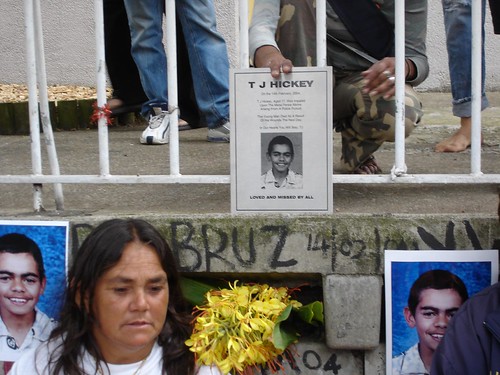
Remembering all state murders, particularly indigenous deaths in custody and in solidarity with the struggle in Greece. Bring photos of those killed, dress in old clothes if you wish to be part of the die-in

<<<<<<<<<<<<<<<>>>>>>>>>>>>

International Day of Action Against Murder by the State
Saturday, December 20, 2008 : 11 am
Greek Consulate
223 Castlereagh St, Sydney


WE DON’T FORGET, WE DON’T FORGIVE: End State Murder


Solidarity With Uprising in Greece
Remember Those Killed by the State
No More Deaths in Custody
Free Lex Wotton


River of Tears: Drones cover Kev Carmody


12/15/08

Politricks


A powerful film about deaths in police custody in the UK, featuring the poet Benjamin Zepheniah

10/5/08

Lex Wotton Warrior for Aboriginal Rights


Australian Racism - A Case Study - Palm Island 2004 - 2006

For those interested in the manner in which institutionalised racism functions in the Australian context, one need look no further than the case of the death of an Aboriginal man on Palm Island, the historically notorious QLD Government 'punishment camp' under the old QLD 'apartheid system'.

The death of Mulrunji Doomadgee at the hands of a QLD Police officer led to a riot and a subsequent 'comedy of errors' as the Beattie Labor Government struggled to contain the political damage at the same time as maintaining an apologetic approach to the powerful QLD Police union.

The unmentioned 'elephant in the room' was the long entrenched culture of racism that permeates QLD society and politics.

It is in that context you might read this index of the history of the recent events on Palm Island, as seen through the prism of the sometimes questionable newspaper coverage by Australian media.

This chronological index nevertheless provides an interesting history of how this issue became a major crisis largely through the political ineptitude displayed by the Beattie Government over a protracted period between 2004 and 2006.

The saga continues to unfold and future episodes will be incorporated into this index


Lex Wotton has been portrayed by the Queensland police, government and mainstream media as the ringleader of the so-called “riot” that occurred on Palm Island on November 26, 2004. A police station and residence were destroyed after a police report on the death of community member Mulrunji Doomadgee . Wotton will face court in October 2008.


7/6/08

Police face new probe into the killing of Steven Wallace


more than 8 years on ...

http://www.nzherald.co.nz/section/1/story.cfm?c_id=1&objectid=10520080&pnum=0

Police face new probe into street shooting
Saturday July 05, 2008
Patrick Gower


On April 30, 2000, Steven Wallace walked down the main street of Waitara in Taranaki, smashing shop windows with a golf club and a baseball bat.

He was shot dead by Senior Constable Keith Abbott who was acquitted of murder but later criticised in a coroner's inquiry. Now - eight years after the shooting - a new independent body in charge of police conduct is investigating the killing.

A new inquiry into the 2000 shooting of Steven Wallace has started.

The Independent Police Conduct Authority is investigating possible misconduct or neglect of duty by the officers involved.

The new authority has reviewed the shooting and found "matters that require further independent investigation".

Authority head Justice Lowell Goddard, QC, has made a symbolic visit to the scene of the shooting on Waitara's main street as part of the 10-month inquiry.

Mr Wallace's family, witnesses and several police officers - included the shooter, Senior Constable Keith Abbott - have been interviewed.

The extensive inquiry into the contentious shooting suggests Justice Goddard is determined that the IPCA will make its mark as an independent civilian oversight of the police, unlike its much-criticised predecessor, the Police Complaints Authority.

Justice Goddard has also visited Ruatoki as part of an inquiry into police actions in the Tuhoe terror raids.


The IPCA is aiming to release its findings on Mr Wallace's shooting in October and police must act on its recommendations - which could include that disciplinary action be taken against officers.

Mr Wallace, 23, had been walking down Waitara's main street breaking shop windows with a golf club and a baseball bat before Mr Abbott killed him with two shots from a pistol.

The IPCA would not go into specifics of its inquiry, saying that it was "looking at everything from when the police were called out" and "questions of misconduct and neglect of duty".

The former authority used police officers to complete its inquiries into Mr Wallace's shootings.

The result of these was never made public because of its practice of not reporting until police investigations, court hearings and a coroner's inquest were completed.

The coroner ruled on Mr Wallace's death in August last year, allowing Justice Goddard to "resume" the inquiry with the IPCA's independent investigators.

Justice Goddard said the eight-year delay was regrettable, and the IPCA had changed its practice of waiting for an inquest.

The authority had reviewed evidence from the Wallace family's unsuccessful private prosecution of Mr Abbott for murder.

And it was taking Coroner Gordon Matenga's ruling into account.

Mr Matenga's criticisms that Mr Abbott and the other officers involved, Constable Jason Dombroski and Sergeant Fiona Prestidge, erred in decision-making and had a lack of leadership were dismissed by Commissioner Howard Broad last year.

Mr Broad said he had "nothing but praise for the officers involved".

Police headquarters declined to comment yesterday on the IPCA inquiry, as did Mr Abbott's lawyer, Susan Hughes, QC.

Police Association president Greg O'Connor criticised the inquiry, saying it was an attempt to "satisfy the unsatisfiable".

Mr O'Connor linked the inquiry to recent criticism of police for being "tentative" before going in to assist fatally shot Manurewa liquor store owner Navtej Singh.

"The only thing police are tentative of is shooting someone because this is what they have to go through," Mr O'Connor said.

The police had "moved on" from Mr Wallace's shooting through "review after review".

"But the system just won't let this go away".

Mr Wallace's mother, Raewyn, hoped the inquiry "gets us the truth".

She was pleased the IPCA was independent and was looking at issues over police actions and procedures raised, but not necessarily addressed, in the private prosecution and the inquest.

"Justice Goddard came to where it happened. She looked and listened. I appreciated that."

STEVEN WALLACE: THE INQUIRIES

April 2000:
Senior Constable Keith Abbott shoots Steven Wallace dead.

Police homicide inquiry begins. Police Complaints Authority begins separate inquiry, saying it will not report back until after the coroner has ruled.

June 2000: Police homicide inquiry clears Mr Abbott of criminal charges.

May 2001: Coroner opens inquest, but it is adjourned while the Wallace family take a private prosecution.

December 2002: Jury clears Mr Abbott of murder.

July 2003: Coroner reopens inquest, but it is delayed by legal challenges from Mr Abbott's lawyer.

September 2005: Coroner resumes inquest.

August 2007: Coroner releases findings.

November 2007: Independent Police Conduct Authority formed with new powers and Wallace inquiry gains new impetus.

see also:

http://uriohau.blogspot.com/2007/06/shooting-of-steven-wallace.html


http://uriohau.blogspot.com/2007/08/steven-wallace-coroners-report-released.html


11/19/07

Remember Mulrunji


Today marks the 3rd anniversary of the Police murder in custody of Mulrunji Doomadgee. When the Queensland government tried to cover this up, it was the uprising in Palm Island and the Murri campaign, that put political pressure on Chris Hurley to be tried in a court of law, and surprise surprise an all white jury let him off. The family however are pursuing a civil suit against Chris(Im a murder) Hurley and the Queensland gubbament.

Mulrunji is my Steve Biko, you are forever in my heart brother, much love to all the mob in Palm island today. You will never be forgotten. No justice No peace fuck the Police.

"A police officer landed the fatal blows that killed Mulrunji Doomadgee while he was in custody on Queensland's Palm Island, a coronial inquest has found.An autopsy report in 2004 found Mulrunji, 36, died from a ruptured liver and portal vein and had also suffered four broken ribs.
"I conclude that these actions of Senior Sergeant Hurley caused the fatal injuries.

"It's a terrible tragedy that such a minor incident can lead to a man's death in custody."

Accused riot ringleader Lex Wotton placed his head in his hands as Ms Clements read her findings to a Townsville courtroom.

Mulrunji's former defacto partner of a decade, Tracey Twaddle, wept silently.

Mulrunji's three sisters were also in court."


http://uriohau.blogspot.com/2007/10/brisbane-stop-black-deaths-in-custody.html

http://uriohau.blogspot.com/2007/08/palm-island-uprising.html

Palm Island Verdict License to kill

Stray Aliens


11/16/07

More Dead Aboriginals in Police Custody :: Allegations of racism loom on first day of inquiry

Thanks to my brother Angry Indian for this
http://angryindian.blogspot.com/2007/11/more-dead-aboriginals-in-police-custody.html

As you know in Strayaliea Aboriginal murder in police custody & police racism are huge concerns. Much love , respect & solidarity to the families and relations of Frank Joseph Paul.


globeandmail.com: Allegations of racism loom on first day of inquiry

VANCOUVER -- Before Frank Joseph Paul was dragged out of a city jail like "garbage," and left in a back alley, where he died of hypothermia, he had been picked up by police 230 times for drunkenness, assault and disturbing the peace.

Now, nine years after he was left lying in the rain on a cold December night, instead of being housed in the Vancouver Police Department drunk tank or sent to a detoxification centre, some big and troubling questions are being raised about Mr. Paul's last time in custody.

As an independent commission of inquiry began yesterday into Mr. Paul's death, it became clear the issue is not just the mechanics of how the alcoholic, 47-year-old Mi'kmaq died on Dec. 5, 1998, but whether the police actions and a broader social safety net failed him because of racism.

"Why was Frank Paul left in an alley to die? Was it because he was aboriginal?" asked Kimberley Murray of Aboriginal Legal Services of Toronto, who is attending because the issue is of national interest.
------------------------------------------------------
First witness at inquiry seeks answers regarding death of native

First witness at inquiry seeks answers regarding death of native: "The family of Frank Paul, the New Brunswick native who died after police left him in a Vancouver alley in 1998, wondered how such a thing could happen. Peggy Clement, the 47-year-old's cousin, was the first witness to give evidence Tuesday in Vancouver during the opening of the public inquiry looking into the death of Paul in the Downtown Eastside."
-------------------------------------------------
Paul put out to die like 'garbage' cousin tells inquiry

Paul put out to die like 'garbage' cousin tells inquiry: "VANCOUVER -- Nine years ago Frank Paul, 45, an aboriginal man and a chronic alcoholic, died drunk, cold and alone in an Downtown Eastside alley where he had been dumped by the driver of a police wagon. He died of hypothermia, freezing to death behind a detox centre in soaking wet clothes. On Tuesday a full scale public inquiry into Mr. Paul's death began after years of lobbying by aboriginal groups and others in the Downtown Eastside."

11/2/07

JUSTICE 4 GARY KING JR


Please join Justice4GaryJr.,
20 yr Black Youth,
executed by OPD on 9-20-07


please copy & paste the follwingh link into your browser, then click
"Join" on the upport right corner !

http://groups.yahoo.com/group/Justice4GaryKingJr/


On Sept 20, 2007, while 100.000 racial Justice activists and families
were marching in Jena, Gary King, Jr., 20 Yr, AfriKan American Youth,
was randomly singled out by Oakland PD rogue cop, Patrick Gonzales, put in
a headlock, punched, tortured (tasered 7 times) until he managed to get away from
his assailant who then shot him twice at close range in the back, in front
of his horrified friends, who had gone to buy chips and sodas with Gary at a
nearby corner store.

This is not Gonzalez first killing (3) (+ permanent disabling of a 17
yr. Youth), all AfriKan Americans young Brothers......

~ Let's put this sinister crazed cop behind bars for good! ~


Check out the Block Report's interviews on KPFA Flashpoints (archives)
with Gary's father and Davey D's interviews with eye witnesses, also on
KPFA.

Please show love and support to Gary Jr. courageous family by joining
this website, and forward the link far and wide !

http://groups.yahoo.com/group/Justice4GaryKingJr/

Out of respect for Gary Jr family, we respectfully ask you to limit
your postings to Gary Jr' s case, and related news.

No political recruiting please (although we welcome you to post your
Justice4GaryKingJr. related events on our calendar and message link)

Everyone's welcome From: Friends of Jonathan Paul
Date: October 31, 2007 6:56:29 PM EDT
Subject: Update on Jonathan Paul

Early this morning Jonathan was interviewed by Amy
Goodman on Democracy Now. You can read the
transcript at http://www.democracynow.org/article.pl?sid=07/10/31/145201

At approximately 1:45 this afternoon, Jonathan
reported to FCI Phoenix accompanied by his sisters,
Caroline and Alexandra. He was informed that he would
be in the Annex for awhile and would not be able to
call out for a couple of weeks. They would not let
him bring in important legal documents, nor commissary
money which he had been told he could bring. They
also told me the commissary money I sent in earlier
would not be credited to his account because he wasn't
in custody yet. Kind of a pain, but easily remedied,
which I will take care of tomorrow.

One guard actually told Jonathan and his sisters that
FCI Phoenix seems like a camp compared to other medium
security facilities in the country. I guess we will
just have to wait and see. Jonathan walked in strong,
with his head held high and in good spirits. As
Jonathan told me just before he went in - "this is way
bigger than us, this is for the animals and the
planet, we will never suffer as much as they do."

The first month is usually the toughest, so please
write to Jonathan often. Feel free to post this far
and wide. Jonathan has been a great warrior for the
animals and the environment for over 20 years. Let's
not forget him now! And please remember to keep
writing
Jonathan's co-defendant's and other political
prisoners. As a photographer, Jonathan is very
visual, so he would love to get photos. You don't
have to print them on photo paper, you can just insert
them in a letter (if you are typing it on your
computer).

Jonathan Paul
#07167-085
FCI Phoenix
Federal Correctional Institution
37910 N 45th Ave.
Phoenix, AZ 85086
?
Please feel free to contact Jonathan's support group
at friendsofjonathanpaul@yahoo.com or e-mail me
directly at tamidrake@wildblue.net. If you are
interested in organizing a fundraiser or a letter
writing event, please let us know.

We plan to get a support website up for Jonathan very
soon.

Here are some guidelines for writing: (We've taken
this from Daniel's support website - thanks to
Daniel's support group for these comprehensive
guidelines)

When sending a letter, it's best to keep it simple.
Write or type on blank notebook or copy paper no
bigger than 8.5x11 and don't use any special colored
or gel pens or pencils, stamps, or stickers. Don't
write anything on the outside or inside of the
envelope except the prisoner's address and your full
name and return address in the upper left hand corner
of the addressed side of the envelope. Use plain white
envelopes without a clear plastic address window, or
any special decorations. Most prisons also REQUIRE a
return address on the envelope.

Please take a minute to read the following VERY
IMPORTANT guidelines.

- Write on both sides of the paper, since the number
of pages he can have may be limited. It is also
totally acceptable to type your letters. More will fit
on a page.
- Write your address inside your letter/card if you
think he does not have it, but DO NOT put an address
label anywhere inside or on the letter/card. Address
labels are ONLY OK to go on your envelope.
- Do NOT send him stamps, envelopes (self-addressed or
otherwise), blank paper or notecards. He will not be
able to receive them and he will be denied your
letter.
- Do NOT send him any form of currency, whether cash,
check or money order.
- Do NOT send photographs larger than 4x6. Do not send
polaroids and make sure the content is appropriate.
- Do NOT include any paperclips, staples or any extra
things in your letter.
- Do NOT send a card that has glitter or any 3-D
objects in or on it.
- Do NOT send cards with paper inserts glued in them.
- Do NOT tape your envelope shut.
- Do NOT ever write "legal mail" or anything implying
that you are an attorney unless you are
- Please use your common sense; don't write about
anything that is likely to get a prisoner in trouble
in any way.

Jonathan will not receive the envelope your letter is
mailed in, so write your return address and full name
in the letter as well. Also, number the pages like
"1/5, 2/5,3/5..." so that a prisoner can tell if some
pages are missing.
If you send Jonathan a letter and it gets returned to
you, please let us know about it so we can add any
other restrictions to the guideline list.
Please do NOT send in any books to Jonathan yet. We
are in the process of getting a system going for him
to receive books.

Jonathan's co-defendants:

Daniel McGowan
#63794-053
FCI Sandstone
Federal Correctional Institution
PO Box 1000
Sandstone, MN 55072

Nathan Block #36359-086
FCI Lompoc
Federal Correctional Institution
3600 Guard Road
Lompoc, CA 93436

Joyanna Zacher #36360-086
FCI Dublin
Federal Correctional Institution
5701 8th St - Camp Parks- Unit E
Dublin, CA 94568

SHAC:

Jacob Conroy # 93501-011
FCI Victorville Medium 1
Federal Correctional Institution
PO Box 5300
Adelanto, CA 92301

Lauren Gazzola #93497-011
FCI Danbury
Federal Correctional Institution Route #37
Danbury, CT 06811

Kevin Kjonaas # 93502-011
FCI Sandstone
PO Box 1000
Sandstone, MN 55072

Joshua Harper 29429-086
FCI Sheridan
Federal Correctional Institution
P.O. Box 5000
Sheridan, OR 97378

Andrew Stepanian # 26399-050
FCI Butner Medium II
Federal Correctional Institution
PO Box 1500
Butner, NC 27509

Other Green Scare:

Jeffrey Luers # 1306729
Lane County Adult Corrections
101 West 5th Ave
Eugene, OR 97401-2695

MCDAVID, ERIC X-2972521 4E231A
Sacramento County Main Jail
651 "I" Street
Sacramento, CA 95814

For the animals and mother-earth,
Tami


Friends and Family of Jonathan Paul
PMB# 267
2305 Ashland St., Ste. C
Ashland, OR 97520


**THE JAILS ARE THE REAL CRIME!!**

**FOR A WORLD WITHOUT PRISONS!!**

10/1/07

Inquest into police shooting at Wadeye/More White Mans Just Arse


October 1, 2007 - 2:04AM


A police officer who fatally shot an Aboriginal teenager in a remote Top End community had failed a firearms instructor's course just over a year earlier, an inquest into the death has heard.

Robert Jongmin, 18, was shot twice in the back during rioting in October 2002 at Wadeye, 350km south-west of Darwin.

Senior Constable Robert Whittington, a married father of one, was charged with murder over the incident, but after protracted court proceedings the Northern Territory Supreme Court quashed the charge.

Three judges dismissed an appeal, but proceedings stalled in February this year when the Director of Public Prosecutions decided not to take the matter to the High Court.

The shooting happened during a large payback fight between rival family members at the community oval.

When the teenager died, the community turned into a war zone as people trashed houses, torched cars and vandalised public property.

A 10-day coronial inquest into the death which started at Wadeye heard Snr Const Whittington had trouble with shooting and had failed a course 14 months before the incident.

"Senior Constable Whittington had general difficulty shooting the Glock pistol, particularly over long distances," said counsel assisting the coroner Philip Strickland CS.

"The senior constable failed the firearms instructor course. The instructor says he did so because he failed to meet the test performance criteria."

Mr Strickland told the court he failed to achieve the accuracy required because of difficulty using his right eye.

In addition, Mr Strickland said the constable shot Robert Jongmin from a distance of 40 metres when the training course only covered proficiency up to 12 metres.

But Mr Strickland said the constable's instructors were of the opinion he met the minimum requirements for an operational member of the police force.

The inquest continues.

More White mans Just arse

Northern Territory Police senior constable Robert Gregory Whittington allegedly drew his Glock semi-automatic pistol on October 23, 2002 and fired four shots during a violent confrontation between two gangs of Indigenous youths at the Wadeye Aboriginal community. One 18-year-old man died with a bullet in the back and another was hit in the arm. Constable Whittington will not stand trial over the shooting incident. Why? Because of a legal technicality that has nothing to do with his guilt or innocence. And the decision is likely further deepen the mistrust within the Indigenous community of a justice system run by white men.

The technicality that has allowed Const Whittington to walk away without having to face trial has to do the charges he faced at various times – murder, manslaughter and committing a dangerous act – and the way they were laid.

The policeman, who at the time was the officer in charge at Wadeye, was originally charged with two counts of committing a dangerous act after Robert Jongmin was shot dead and Tobias Worumbu wounded.

The shooting occurred during a confrontation between two gangs, the Judas Priests and the Evil Warriors, on the oval at Wadeye. At Const Whittington’s committal in 2004, witnesses said Mr Worumbu had been armed with a shotgun and Mr Jongmin had wrestled with him before the gun dropped to the ground and discharged. After the shotgun discharged Const Whittingon allegedly fired off four quick shots.

At the end of the committal Magistrate Anthony Gillies said there was sufficient evidence to lay a charge of murder and a third charge of committing a dangerous act against the police officer.

But sometime before the Const Whittington’s murder trial was due to start in October 2005, the charges were downgraded to one charge of manslaughter and one charge of committing a dangerous act. Then the trial was postponed while the defence went to the NT Supreme Court arguing a number of points of law, including that the case should not go ahead because the prosecution could not prove which of the four bullets from Const Whittington’s pistol killed Mr Jongmin.

In March 2006 the NT Supreme Court ruled the case should go ahead.

Then the prosecution dropped the manslaughter charge and instead issued a fresh indictment with just one charge against Const Whittington of committing a dangerous act. This prompted the policeman’s defence team to go back to the Supreme Court to argue that under the NT Police Administration Act, such a charge should have been laid within two months of the original incident.

The Supreme Court agreed and quashed the charge.

The Northern Territory’s director of public prosecutions then appealed to the Court of Criminal Appeal, with Crown Prosecutor John Tippet, QC, arguing time constraints did not apply because it was an alleged abuse of police power. On Monday the court dismissed the appeal (the decision will be published at a later date).

The DPP initially indicated it would appeal to the High Court, but earlier today issued a statement saying the matter was being dropped and it would take no further action.

“The DPP has been advised by independent senior counsel that a further appeal to the High Court is not recommended and the director has now conveyed that information to the father of the deceased,” the statement said. “The matter is now at an end.”

Const Whittington spent four years suspended on full pay and is already back at work. His legal costs were paid for by the NT government.

Which no doubt leaves the inhabitants of Wadeye wondering what happened to the “just” in justice.


9/12/07

30th Anniversary of Steve Biko's Murder


Biko

September '77
Port Elizabeth weather fine
It was business as usual
In police room 619
Oh Biko, Biko, because Biko
Yihla Moja, Yihla Moja
-The man is dead

When I try to sleep at night
I can only dream in red
The outside world is black and white
With only one colour dead
Oh Biko, Biko, because Biko
Yihla Moja, Yihla Moja
-The man is dead


You can blow out a candle
But you can't blow out a fire
Once the flames begin to catch
The wind will blow it higher
Oh Biko, Biko, because Biko
Yihla Moja, Yihla Moja
-The man is dead

And the eyes of the world are
watching now
watching now
(Peter Gabriel)


From Ridwan's awesome blog
Soweto riots of 2007
http://ridwanlaher.blogspot.com/2007/09/soweto-riots-of-2007.html

> Today is the 30th anniversary of Steve Biko's death at the hands of
> police in apartheid South Africa. As the radio talk back remembers
> the apartheid regime of South Africa and we a subjected to the
> endless bleating of non-Indigenous liberals about the state of South
> Africa then, I cannot help but recall that whenever Australia was
> asked to vote at the UN regarding apartheid, they dissented.
>
> I also cannot help but hope that one day Australia's oppressive
> covert state of apartheid will be recognised for what it is and that
> our Koori, Noonga, Nunga and Murri brothers and sisters are still
> dying in disproportionate numbers at the hands of police.....whilst
> the rest of suburbia kid themselves that this is the 'lucky country'
> and we are all about a 'fair go'.
>
> History will judge this country and it will be found wanting.
>
> Jo


Apartheid in Strayaliea will be brought down by International pressure,
how many Steve Biko's do we need we have had at least 400 state
murders in custody since 1990.

http://uriohau.blogspot.com/2007/05/life-death-of-steve-biko.html


http://uriohau.blogspot.com/2007/07/robert-sobukwe.html
http://zar.co.za/biko.htm

MERGER Biko (Live on Revolver 1978)

8/4/07

Steven Wallace: Coroner's report released


white wash, brown wash Steven Wallace was murdered by the pigs just
like Paul Chase and many others before him. Haere Atu Poaka!!!!


"3.5 The key to that historic context is that the Police exist to
enforce the will of the State, and that when the Force was established
in this country that will was to dispossess Maori. The Police culture
that developed in that context therefore saw Maori not just as
criminals, but as enemies of the State.

3.6 The will of the State was particularly enforced in Taranaki, and
the sacking of Parihaka was carried out by the "armed constabulary" as
part of a process to subordinate Maori to the authority of the Crown.
That will was obviously political, but it was also cultural because it
was sourced in an essentially racist view that Maori needed to be made
subject to the values and institutions of a "superior" people. The
Police as an organisation helped shape, and was shaped by, that culture.

3.7 As a result a tension was established between the Police and Maori
that was exacerbated rather than minimised when the State withdrew
from military conflict with Maori. Indeed as Maori society was
impoverished by the consequences of colonial dispossession Maori
ceased to be the "rebels" and became instead the poor who seemed to
fill the jails as criminals. The tensions between the Police and Maori
took on a new form, but they remained."


http://www.apc.org.nz/pma/smoana.htm


two corporate spin stories below ...

http://www.nzherald.co.nz/section/1/story.cfm?c_id=1&objectid=10455677

Coroner criticises action of police officers in Waitara shooting

3 August 2007

The two police officers at the scene of the fatal shooting of Waitara man Steven Wallace should have formulated a plan before approaching him, Hamilton District Court Coroner Gordon Matenga said today.

Wallace, after breaking a number of shop windows and brandishing a golf club and a baseball bat, was fatally shot in April 2000 by police in Waitara.

Mr Matenga's inquest findings, seven years after the incident, were delayed due to a murder trial brought against Senior Sergeant Keith Abbott.

Mr Abbott was acquitted of the charge.

The coroner's findings released today detailed the circumstances surrounding Wallace's death, examined police policy in dealing with violent offenders and looked at what first aid care was given to Wallace after the shooting.

On the evening of April 29, 2000, Wallace had driven into the Waitara township after an argument with his sister and father. He had previously been drinking at a local nightclub.

Once back in town, Wallace proceeded to smash a number of shop windows with a golf club.

Mr Abbott arrived at the scene about the same time as Constable Jason Dombroski and Constable Herbert in another police car.

Mr Abbott then saw Wallace smash the windscreen and side window of Mr Dombroski and Ms Herbert's car - at which stage Mr Dombroski asked police communications to tell Mr Abbott to arm himself.

Both officers subsequently retrieved guns from the police station while Ms Herbert observed Wallace.

During this time the officer's commanding officer, Sergeant Fiona Prestidge, had left the command centre in New Plymouth to get to the scene and had ordered a dog team to get to the area.

Mr Dombroski knew the dog team was on its way, but failed to tell Mr Abbott.

Both officers approached Wallace who threw the golf club at Mr Abbott, which missed him. At the time he was threatening to kill Mr Abbott.

While Wallace was closing in on Mr Abbott, Mr Abbott fired a warning shot and then a fatal shot at Wallace. He died in hospital a short time later.

- NZPA

http://www.radionz.co.nz/news/latest/200708031916/coroner_critcises_police_over_wallace_shooting

Coroner critcises police over Wallace shooting

03 Aug 2007

A coroner has criticised three Taranaki police over the shooting of Waitara man Steven Wallace in the town's main street seven years ago.

His findings, released on Friday, show that the officers involved showed a lack of leadership and did not properly plan their approach.

Mr Wallace was advancing on Constable Keith Abbot with a baseball bat, threatening to kill him, when the officer shot him in April 2000.

The 23-year-old died of a heart attack four-and-a-half hours later.

Coroner Gordon Matenga has found that the three officers' lack of leadership or command in responding to Mr Wallace was a result of their own performance rather than a failure of police procedures.

However, he recommends a review of police dog policies.

Two years ago, Mr Matenga investigated whether police followed proper procedure and offered enough medical help.

He did not determine whether police used excessive force, saying a jury in the Wallace family's private murder prosecution decided the degree of force was not unreasonable given the circumstances Mr Abbott believed he faced.

Central district police commander, Superintendent Mark Lammas, says things could have been done differently, but it was Mr Wallace who dictated the events of that night

Mr Lammas says a Police Complaints Authority report is still to be released, but there will be no disciplinary action against the officers.

Copyright © 2007 Radio New Zealand

<> <> <> <> <> <> <> <> <> <> <> <> <> <> <> <> <> <> <>
Peace Movement Aotearoa (PMA)
the national networking peace organisation
PO Box 9314, Wellington 6141, Aotearoa New Zealand
Tel +64 4 382 8129, fax 382 8173 email pma@...
PMA website - http://www.converge.org.nz/pma
Not in Our Name - http://www.converge.org.nz/pma/nionnz.htm
<> <> <> <> <> <> <> <> <> <> <> <> <> <> <> <> <> <> <>
>> war on terrorism? war is terrorism <<
<> <> <> <> <> <> <> <> <> <> <> <> <> <> <> <> <> <> <>

7/31/07

Why Fuck the Police

thanks to http://www.crimethinc.com/police/

Criticism of opposition to the police usually falls into one of five categories. The first common argument is that the police, as our fellow workers, are also exploited members of the proletariat, and should therefore be our allies. Unfortunately, there is a vast gap between “should” and “is.” The police exist to enforce the will of the powerful; anyone who has not had a bad experience with them is likely either privileged or submissive. Today’s police officers, at least in North America, know exactly what they’re getting into when they join the force; people in uniform don’t just get cats out of trees in this country. Yes, most take the job because of what they feel to be economic necessity, but needing a paycheck is no excuse for obeying orders to evict families, harass young men of color, or pepper spray demonstrators; those whose consciences can be bought are everyone else’s enemies, not potential allies.


This argument could be more persuasive if it was couched in strategic terms, rather than Marxist abstractions: for example, “Every revolution succeeds at the moment the armed forces refuse to make war on their fellows; therefore we should focus on seducing the police to our side of the barricades.” But again, the police are not just any workers; they are the ones who have most deliberately chosen to base their livelihoods and value systems upon the prevailing order, and thus are the least likely to be sympathetic to those who struggle against hierarchy. This being the case, it makes sense to focus on opposing the police as such, not on seeking solidarity with them. So long as they serve their masters, they cannot be our allies; by publicly deriding the police as an institution, we encourage individual police officers to seek other employment, so we can find common cause with them.

The second argument is that the police can win any confrontation, so we shouldn’t invest ourselves in strategies that involve confronting them[1]. It may seem that, with all their guns and armor and equipment, the police are invincible, but this is an illusion. They are limited by all sorts of invisible constraints—bureaucracy, public opinion, their own need to avoid inconvenient escalation. This is why a motley crowd armed only with the tear gas canisters shot at them can hold off a larger, more organized, better equipped force; contests between social unrest and military might are not played out according to the rules of military engagement.

Those who have studied the police, who can predict what they are prepared for and what they can and cannot do, can usually outsmart and outmaneuver them. Such small victories can be inspiring for those who chafe under the heel of police repression, as well as instrumental in accomplishing concrete goals. In the collective unconscious of our society, the police are the ultimate bastion of reality, the force that ensures that things stay the way they are; to fight them and win, however temporarily, is to show that reality is negotiable.

The third argument is that the police are a mere distraction from the real enemy, not worth our wrath or attention. Alas, state power is not just the politicians; they would be powerless without the millions who do their bidding. When we contest their control, we are also contesting the submission of their flunkies, and we are sure sooner or later to come up against those of the latter who insist on submitting. That being said, it’s true that the police are no more integral to hierarchy than the oppressive dynamics in our own communities; they are simply the external manifestation, on a larger scale, of the same phenomena. If we are to contest hierarchy everywhere, rather than specializing in combating certain forms of it while leaving others unchallenged, we have to be prepared to take it on both in the streets and in our own bedrooms; we can’t expect to win on one front without fighting on the other. We shouldn’t fetishize confrontations with uniformed foes, we shouldn’t forget the power imbalances in our own ranks—but neither should we be content merely to manage the details of our own oppression in a non-hierarchical manner[2].

The fourth and most despicable argument is that we need police. According to this line of thinking, even if we can aspire to live in a society without police in the distant future, we need them today, for people are not ready to live with each other in peace without armed enforcers. As if the social imbalances and submissiveness maintained by the violence of the police are peace! Opponents of the police need not even answer this charge, however. It’s not as if a police-free society is suddenly going to appear overnight, for good or for ill, just because someone spraypaints “Fuck the Police” on a wall—if only it was so easy! The protracted struggle it is going to take to free our communities of police repression will probably go on as long as it takes us to learn to coexist peacefully; indeed, no community incapable of sorting out its own conflicts can expect to triumph against a more powerful occupying force. In the meantime, anti-police sentiments should be seen as objections to one of the most advanced and egregious forms of conflict between human beings, not arguments that without police there would be no conflict at all; and those who argue that the police sometimes do good things bear the burden of proving that those same good things could not be accomplished at least as well by other means.

The final and most nuanced objection to militant resistance against police oppression is the pacifist critique of violence itself. According to this account, violence is inherently a form of domination, and thus inconsistent with opposition to domination; those who engage in violence play the same game as their oppressors, thereby losing from the outset. Others hold that violence enforces unequal power dynamics in some cases, while in other cases it contests them—that is to say, there is such a thing as self-defense. For those whose value system is still descended from Christianity, keeping one’s hands clean of immoral behavior is the top priority, at whatever cost; for the rest of us, who desire to be free of superstitious prohibitions, the most important thing is what will work, in a given context, to make the world a better place. Sometimes—to name an obvious example, in the struggle against Nazi Germany—this may include violence.

To make this clear: yes, cops are people too, and deserve the same respect due all living things. The point is not that they deserve to suffer, or that we have to bring them to justice—that’s Christian morality again, dealing in currencies of superstition and resentment. The point is that, in purely pragmatic terms, in order that others not have to suffer, it may be necessary to interrupt, by militant and confrontational means, the injustices perpetrated by police officers. It can be empowering for those who have spent their lives under the heel of oppression to contemplate finally settling the score with their oppressors; however, a real liberation struggle does not focus on exacting revenge, but rather on solving problems so that all might have better lives. Therefore, while it may even sometimes be necessary to set police on fire, this should not be done out of a spirit of vengeful self-righteousness, but from a place of careful thought and compassion—if not for the police themselves, then for all those who would otherwise suffer at their hands.

One could make the argument that encouraging people to struggle against the police does more to publicize disapproval of them than to cause actual assaults. One could even argue that it thereby does a service not only for those who suffer police oppression, but also for the families of police officers and even for the officers themselves—for not only do police officers have a disproportionately high rate of domestic violence and child abuse, they also get killed, commit suicide, and become addicts with disproportionate frequency. Anything that demoralizes police officers and delegitimizes their authority, thus encouraging them to quit their posts, is in their best interest as well as the interest of their loved ones and society at large.

7/18/07

Wallace shooting report due soon

Sunday July 15, 2007
By David Fisher

A finding into the death of Waitara's Steven Wallace is imminent, signalling an end to public inquiries about the seven-year-old police shooting.

Coroner Gordon Matenga said he was finalising the report into Wallace's death and expected to release it "soon".

It is expected to be made public by the end of the month.

Wallace was fatally shot by police officer Keith Abbott in April 2000, after smashing windows and a police car with a baseball bat and golf clubs, and threatening to hit Abbott.

The death sparked a range of inquiries, with Wallace's family voicing anger at what was seen to be a lack of police accountability. The family launched a private murder prosecution against Abbott, in which he was acquitted by a jury.

The coroner's hearing was initially set for 2001 but was postponed until 2005 until the private prosecution had been completed. Matenga, who also examined police policies on violent offenders and first aid, heard the case but reserved his decision.

The lengthy delay has caused frustration for both the Wallace family and the Police Association.

Matenga told the Herald on Sunday: "I'm in the process of completing these findings. They should be available soon."

Asked if he meant weeks or months, he said "Not months. I know there's a sense of frustration from everyone."

The completion of the coroner's inquiry means the final step in the process can also be completed.

The findings of a Police Complaints Authority inquiry into the shooting will follow Matenga's report within months.

Wallace's mother, Raewyn, would not comment. Ron Mansfield, the family's lawyer, said comment would not be made until the finding was released.

http://www.nzherald.co.nz/section/1/story.cfm?c_id=1&objectid=10451563

<> <> <> <> <> <> <> <> <> <> <> <> <> <> <> <> <> <> <>
Peace Movement Aotearoa (PMA)
the national networking peace organisation
PO Box 9314, Wellington 6141, Aotearoa New Zealand
Tel +64 4 382 8129, fax 382 8173 email pma@...
PMA website - http://www.converge.org.nz/pma
Not in Our Name - http://www.converge.org.nz/pma/nionnz.htm
<> <> <> <> <> <> <> <> <> <> <> <> <> <> <> <> <> <> <>
>> war on terrorism? war is terrorism <<
<> <> <> <> <> <> <> <> <> <> <> <> <> <> <> <> <> <> <>

6/26/07

Rise Up

pics of last Fridays Mulrunji Solidarity demo, thanks to PC for the pics.


Robbie Thorpe talking up the business


marching to the gubbament


later to you flag wipe of capitalist imperialism


Us Mob


Aotearoa/g20 arrestee Solidarity

6/25/07

Palm Island verdict 'licence to kill'


* June 21, 2007

ACCUSED Palm Island rioter Lex Wotton says Senior Sergeant Chris Hurley's acquittal of a 2004 death in custody has given Queensland police a "licence to kill".

But Mr Wotton, 37, has ruled out a repeat of the violence that followed 36-year-old Palm Islander Mulrunji Doomadgee's death in a police watchhouse in November 2004.

Sen-Sgt Hurley was yesterday found not guilty in the Townsville Supreme Court of the manslaughter and assault of Mulrunji.

“There's a green light for men in police uniform to go out and commit murder,” Mr Wotton told Channel 7 tonight.

“It's just like they have been given a licence to kill.”

Mr Wotton returned to a peaceful Palm Island today after hearing the Townsville verdict and believed the community would remain that way in contrast to the riots that followed Mulrunji's death in custody almost three years ago.

On November 26, 2004 – seven days following Mulrunji's death – a riot broke out after an autopsy showed he had broken ribs and a punctured lung.

Police officers sought refuge at the island's hospital and were airlifted to safety after rioters burnt down the police station, courthouse and Snr Sgt Hurley's home.

“You can be assured that I won't be a part of anything,” Mr Wotton said.

Mr Wotton was released from custody on bail with strict conditions in Brisbane on May 31 after formally entering a plea of not guilty to rioting with destruction on the island in 2004.

His co-accused – John Major Clumpoint, William Neville Blackman, Lance Gabriel Poynter and Dwayne Daniel Blanket, all of Palm Island – have been acquitted.

6/20/07

Demand Justice for Mulrunji

A grave injustice occurred today when and all white jury dismissed both charges against Snr-Sgt Chris Hurley in a mere three hours. Our urgent action in support of the ongoing campaign to stop Aboriginal deaths in custody is needed now!

Please support the following:

(1) Emergency protest – Friday 22 June, 12:30 pm, Old GPO for a speak out and march to State Parliament.

(2) Open organising meeting – Wednesday 27 June, 6:30 Solidarity Salon, 580 Sydney Road, Brunswick to mobilise the broadest possible support for a National Day of Action on July 14. Be there!

(3) National Day of Action – July 14th.

Pass this e-mail on to all of your networks NOW!

In solidarity
Alison Thorne
For ISJA – Melb
www.isja-msg.org

**********************
Demand Justice for Mulrunji
Mourn for the death of
justice in Queensland

Rally, Friday 22 June, 12:30 pm
Steps of the old GPO for a speak out and march to State Parliament

Wear black or Indigeno us colours.

? Implement the recommendations of the Royal Commission into Aboriginal deaths in Custody in full!
? Establish elected community controlled civilian review boards to hold the cops to account ? No justice on stolen land

Called jointly by Indigenous Social Justice Association – Melbourne and Socialist Alliance

For more information contact:
Cheryl: 0401-806-331
Sean: 0428-160-661
Land lines: 9639-8622 or 9388-0062

**********************


Media Release - for immediate release
Wed June 20, 5:30pm

Hurley verdict a travesty for Aboriginal people
"Death of justice in Queensland"

"The acquittal of Snr-Sgt Chris Hurley - despite him admitting he caused Mulrunji's death, despite him changing his story, despite overwhelming medical evidence likening Mulrunji's fatal injuries to a high-speed car crash - is the lowest point in Australia's judicial system for Aboriginal people," said Aboriginal leader and Socialist Alliance Indigenous spokesperson Sam Watson, in response to the not guilty verdict in the manslaughter trial of Hurley.

"The police rallied around their own, fixed their story of 'a complicated accident', and the 12-member non-Indigenous jury agreed," Watson continued. "This jury decision has sanctioned the unlawful death of an Aboriginal person in police custody."

"The fact that the life an Aboriginal person was worth less than four hours consideration by the jury reinforces Townsville - named after one of the last slave owners Robert Towns - as a centre of anti-Aboriginal prejudice."

"We extend our sympathy and love to the family and community on Palm Island - they will need healing time. But around Australia, the Aboriginal community and non-Aboriginal supporters will rally and continue the struggle for justice. We make a promise to the family of Mulrunji and all families who have lost loved-ones in custody - Hurley and all police will be held accountable. There must be justice for all - whether you're born in Brisbane or on Palm Island."

"The Jury verdict ended one process, but the struggle for justice continues," said Watson.

An Indigenous rights demonstration planned to march on State Parliament at 1pm this Friday in protest at council amalgamations, will also take up the ongoing fight for justice for Mulrunji, with a minute silence for the 'death of justice in Queensland.'

Watson and other Aboriginal leaders have called for massive national protests on July 14, NAIDOC day.

"At end of day, all we ever ask is that those who are taken into custody come out alive, but in Queensland, this appears to be an impossible ask."

For information or interviews phone Sam Watson 0401 227 443 or Paul Benedek 0410 629 088