Showing posts with label Hawaiian sovereignty. Show all posts
Showing posts with label Hawaiian sovereignty. Show all posts
1/1/10
KUPUNA PEPPERD SPRAYED Laie Kuleana Occupation
Laie Kuleana Occupation
Kanaka Maoli Standing Up For Their Rights, Claiming what was always Theirs!
Today mark your calendars I will enter the Battle of this Century between an Indigenous Hawaiian Woman and the entity of the Mormon Church, Hawaii Reserves Incorporated. Adverse Possession is the filthy word among Indigenous Hawaiians, homeless, strangers in their land. It should not be but AMERICAN THIEVES attempted to usurper our land from under us by DISGUISE AND THEIR PERVERTED LAW. While I prepare for the BATTLE OF MAHUNALII AND KAUAIOMANO I have DEEDS, MAPS, SURVEYS etc. I am doing this because the BONES OF MY ANCESTORS are buried there. The SPIRITS OF MY ANCESTORS COMPEL me to do what is right protect, preserve, perpetuate their history, culture and way of life. May the BONES of all our indigenous ancestors rise up from this day forward and
compel their descendants to do the same. Mahalo...
Dawn K. Wasson, Kupuna o Laiewai


2/12/09
Display the Hawaiian flag on February 24-25

image credit manainfo.com
On February 25, the Supreme Court will be hearing the "ceded"lands case. The State of Hawaii is arguing that Hawaiians have norights to those lands.
MANA (Movement for Aloha No ka Aina), is calling on all supportersof Kanaka Maoli rights and sovereignty to fly or display a Hawaiianflag on February 24 and 25, the eve and day of the Supreme Courthearing on the "ceded" lands case.
Fly your flag proudly! This will be a sign of our resistance to theState's attempt to dissolve our land rights, and a symbol of our unity.
Spread the message far and wide – fly our flag on February 24 and 25.
Download a flag here.
Mahalo to KINE/KCCN, Ka Wai Ola o OHA, Maoliworld, and others for helping to get the word outhttp://manainfo.com/
4/21/08
Hawaii Needs You

An open letter to the US left from the Hawaiian sovereignty movement.
The confluence of two forces--a massive military expansion in Hawai'i and Congressional legislation that will stymie the Kanaka Maoli [Native Hawaiian] sovereignty movement--will expand and consolidate the use of Hawai'i for US empire. We are calling on the US left to join our movement opposing these threats and to add our quest for independence as a plank of the broad US left strategy for a nonimperialist America. If you support peace and justice for the United States and the world, please support demilitarization and independence for Hawai'i.
Since 1893, the United States has malformed Hawai'i into the command and control center for US imperialism in Oceania and Asia. From the hills of the Ewa district of O'ahu, the US Pacific Command--the largest of the unified military commands--directs troops and hardware throughout literally half the planet. Since the late nineteenth century, the US military has multiplied in our islands, taking 150,000 acres for its use, including one-quarter of the metropolitan island of O'ahu. Moreover, the National Security Administration is building a new surveillance facility nearby, not far from where urban assault brigades, called Strykers, will train for deployment throughout the world. The US Navy is also increasing training over the entire archipelago, including populated areas and the fragile northwestern whale sanctuary. This militarized occupation has a long history. Ke Awalau o Pu'uloa--known now as Pearl Harbor--became one of the very first overseas bases, along with Guantánamo, around the time of the Spanish-American War. We still hold much in common with prerevolution Cuba--a sugar plantation economy and status as the playground for the rich of North America.
We have suffered from the effects of being the pawn for US wars on the world. Our family members languish from strange diseases brought by military toxins in our water and soil. Our economy is a foreign-run modern plantation serving multinational shareholders and decorated generals. We salute a foreign flag, and the education system instructs us to yearn for a distant continent called the Mainland. Tourists imbibe in sunny Waīkikī, while the beaches in the native-inhabited regions are littered with chemical munitions.
But amid our suffering, we have survived. Our tenacity and resilience have historical roots: in 1897, 95 percent of the Kanaka Maoli population signed petitions that helped to defeat a treaty to forcibly annex Hawai'i to the United States.
The last forty years have seen remarkable change for our people, through the advancement of a grassroots struggle against the political occupation and mental colonization of our homeland. We have been successful in several campaigns: in stopping the bombing of Kaho'olawe Island and Makua Valley, in revitalizing the Hawaiian language and culture in our schools and families, in returning to our indigenous spiritual practices and in making Hawaiian sovereignty a dinner-table topic and an actual possibility. These hard-fought wins are successes in the movement for self-determination and also a threat to America's use of Hawai'i as the purveyor of its empire.
It is against this backdrop that the Akaka bill (the Native Hawaiian Government Reorganization Act) is being discussed in the halls of Congress. Named for US Senator Daniel Akaka, the bill is being promoted by Hawai'i's corporate and political elite as a vehicle for racial justice. Yet the bill would turn back one of the most important victories of the last four decades--the rise of Hawaiian self-determination, including independence, as a political possibility--replacing it with the extinguishment of our historic claims to land and sovereignty.
Our conundrum puts us squarely in opposition to the middle ground of American politics, which has arrived at a consensus that Hawai'i will remain a military colony of the United States. Democratic Senator Daniel Inouye is a major purveyor of pork barrel spending for military appropriations and defense contractors. All three presidential contenders have signaled their support for the Akaka bill. And while the far right wing of the Republican Party opposes the Akaka bill, both major parties have no quarrel over the continuance of the empire's use of our homeland.
In light of this American consensus on Hawai'i, we turn to our nearest political allies, US progressive movements, and seek your solidarity for our independence because it is congruent and essential to your hope for a better world. Please join us in opposing the Akaka bill and the militarization of Hawai'i, and please support Hawai'i's independence as part of your vision for a more humane United States and a more just world.
Ikaika Hussey, convenor, Movement for Aloha No ka Aina (MANA)
Terrilee Keko'olani, Ohana Koa/Nuclear-Free and Independent Pacific
Noelani Goodyear-Kaopua, assistant professor of political science, University of Hawaii, Manoa
Jon Osorio, director, Center for Hawaiian Studies, University of Hawaii, Manoa
Kekuni Blaisdell, convenor, Ka Pakaukau
Andre Perez, Hui Pu
Kelii "Skippy" Ioane, Hui Pu
Kai'opua Fyfe, director, The Koani Foundation
http://www.thenation.com/doc/20080428/open_letter
2/9/08
Broken Promises
Does The US Honor Its Treaties? What Insights Do The Lakota Have For Hawai`i About The Akaka Bill? Watch & Find Out!
thanks to koanifoundation
http://freehawaii.blogspot.com/
12/10/07
Out Of The Box - A Visit With Hinaleimoana Wong
"Bring your entire `ohana together and watch our visit with Hina as she reminds us the children of Hawai`i really don't have to go and live somewhere else to make it economically. As she herself says, "we want our people to live and thrive right here."
11/6/07
FROM A NATIVE DAUGHTER:COLONIALISM & SOVEREIGNTY IN HAWAII

By Haunani-Kay Trask
Introduction from "From A Native Daughter: Colonialism and Sovereignty in Hawai'i," (Revised Edition). Honolulu, HI: University of Hawai'i Press, 1999 (originally published by Common Courage Press, 1993).
Despite American political and territorial control of Hawai’i since 1898, Hawaiians are not Americans. Nor are we Europeans, or Asians. We are not from the Pacific Rim, nor are we immigrants to the Pacific. We are the children of Papa--earth mother, and Wākea--sky father--who created the sacred lands of Hawai’i Nei. From these lands came the taro, and from the taro, came the Hawaiian people. As in all of Polynesia, so in Hawai’i: younger sibling must care for and honor elder sibling who, in return, will protect and provide for younger sibling. Thus, Hawaiians must nourish the land from whence we come. The relationship is more than reciprocal, however. It is familial. The land is our mother and we are her children. This is the lesson of our genealogy.
In Polynesian cultures, genealogy is paramount. Who we are is determined by our connection to our lands and to our families. Therefore, our bloodlines and birthplace tell our identity. When I meet another Hawaiian, I say I am descended of two genealogical lines: the Pi’ilani line through my mother who is from Hāna, Maui, and the Kahakumakaliua line through my father’s family from Kaua’i. I came of age on the Ko’olau side of the island of O’ahu. This is who I am and who my people are and where we come from.
Introduction
We protest against the movement in favor of doing away with the independence of our country; we protest against the effort to force annexation to the United States without consulting the people…
- Memorial to President Cleveland from the Hui Aloha ‘Āina (Hawaiian patriots) on the American overthrow of the Hawaiian government, 1893
I do not feel…we should forfeit the traditional rights and privileges of the natives of our islands for a mere thimbleful of votes in Congress; that we, the lovers of Hawai’i from long association with it, should sacrifice our birthright for the greed of alien desires to remain on our shores…
- Kamokila Campbell before Congress on statehood for Hawai’i, 1946
Our country has been and is being plasticized, cheapened, and exploited. They’re selling it in plastic leis, coconut ashtrays, and cans of “genuine, original Aloha.” They’re raped us, sold us, killed us, and still they expect us to behave…Hawai’i is a colony of the imperialist United States.
- Kehau Lee on evictions of Hawaiians from Native lands, 1970
The time has come to create a mechanism for self-government for the Hawaiian people. The question of Hawaiian sovereignty and self-determination needs to be dealt with now.
- Mililani Trask before Congress on Hawaiian sovereignty, 1990[1]
Spanning nearly a hundred years, these statements by Native Hawaiians stun most Americans who have come, over the course of their consumer society, First World lifetimes, to believe that Hawai’i is as American as hot dogs and CNN News. Worse, Americans assume that if an opportunity arises, they too may make the trip to paradise, following along after the empire into the sweet and sunny land of palm trees and hulahula girls.
This predatory view of my Native land and culture is not only opposed by increasing numbers of us, it is angrily and resolutely defied: Hawaiians are marking the centenary of the overthrow of our government with mass arrests and demonstrations against the denial of our human right to self-determination. For us, Hawaiian self-government has always been preferable to American foreign government. No matter what Americans believe, most of us in the colonies do not feel grateful that our country was stolen, along with our citizenship, our lands and our independent place among the family of nations. We are not happy Natives.
On the ancient burial grounds of our ancestors, glass and steel shopping malls with layered parking lots stretch over what were once the most ingeniously irrigated taro lands, lands that fed millions of our people over thousands of years. Large bays, delicately ringed long ago with well-stocked fishponds, are now heavily silted and cluttered with jet skis, windsurfers, and sailboats. Multi-story hotels disgorge over six million tourists a year onto stunningly beautiful (and easily polluted) beaches, closing off access to locals. On the major islands of Hawai’i, Maui, O’ahu, and Kaua’i, meanwhile, military airfields, training camps, weapons storage facilities, and exclusive housing and beach areas remind the Native Hawaiian who owns Hawai’i: the foreign, colonizing country called the United States of America.
But colonization has brought more than physical transformation to the lush and sacred islands of our ancestors. Visible in garish “Polynesian” revues, commercial ads using our dance and language to sell vacations and condominiums, and the trampling of sacred heiau (temples) and burial grounds as tourist recreation sites, a grotesque commercialization of everything Hawaiian has damaged Hawaiians psychologically, reducing our ability to control our lands and waters, our daily lives, and the expression and integrity of our culture. The cheapening of Hawaiian culture (e.g., the traditional value of aloha as reciprocal love and generosity now used to sell everything from cars and plumbing to securities and air conditioning) is so complete that non-Hawaiians, at the urging of the tourist industry and the politicians, are transformed into “Hawaiians at heart,” a phrase that speaks worlds about how grotesque the theft of things Hawaiian has become. Economically, the statistic of thirty tourists for every Native means that land and water, public policy, law and the general political attitude are shaped by the ebb and flow of tourist industry demands. For Hawaiians, the inundation of foreigners decrees marginalization in our own land.
The State of Hawai’i, meanwhile, pours millions into the tourism industry, even to the extent of funding a booster club--the Hawai’i Visitors’ Bureau--whose TV and radio propaganda tells locals, “the more you give” to tourism, the “more you get.”
And what Hawaiians “get” is population densities like Hong Kong in some areas, a housing shortage owing to staggering numbers of migrants from the continental United States and Asia, a soaring crime rate as impoverished locals prey on flauntingly-rich tourists, and environmental crises, including water depletion, that threaten the entire archipelago. Rather than stem the flood, the state is projecting a tidal wave of 12 million tourists by the year 2010, and encouraging rocket-launching facilities and battleship homeporting as added economic “security.”
For my people, this latest degradation is but another state in the agony that began with the first footfall of European explorers in 1778, shattering two millennia of Hawaiian civilization characterized by an indigenous way of caring for the land, called mālama ‘āina.
History
Before there existed an England, an English language, or an Anglo-Saxon people, our Native culture was forming. And it was as antithetical to the European developments of Christianity, capitalism and predatory individualism as any society could have been. But in several respects, Hawaiian society had remarkably much in common with indigenous societies throughout the world.
The economy of pre-haole Hawai’i depended primarily on a balanced use of the products of the land and sea[2]. Each of the eight inhabited islands was divided into separate districts (known as ‘okana) running from the mountains to the sea. Each ‘okana was then subdivided into ahupua’a, which themselves ran in wedge-shaped pieces from the mountains to the sea; each ahupua’a was then fashioned into ‘ili on which resided the ‘ohana (extended families) who cultivated the land. The ‘ohana was the core economic unit in Hawaiian society.
As in most indigenous societies, there was no money, no idea or practice of surplus appropriation, value storing or payment deferral because there was no idea of financial profit from exchange. In other words, there was no basis for economic exploitation in pre-haole Hawai’i.
Exchange between ‘ohana who lived near the sea with ‘ohana who lived inland constituted the economic life of the multitudes of communities which densely populated the Hawaiian islands. Ahupua’a were economically independent. As historian Marion Kelly has written, “Under the Hawaiian system of land-use rights, the people living in each ahupua’a had access to all the necessities of life,” thus establishing an independence founded upon the availability of “forest land, taro and sweet potato areas, and fishing grounds.”[3]
If kinship formed the economic base of Hawaiian society, it also established the complex network of ali’i (chiefs), who competed in terms of rank (established by mana or spiritual power derived from chiefly genealogies or from conquest in war) and ability to create order and prosperity on the land. The highest ranking ali’i were advised by a council of chiefs and a kahuna (priestly) class who were themselves quite powerful.
The maka’āinana (people of the land) made up the great bulk of the population and, although subordinated to their ali’i caretakers, were independent in many ways. Unlike feudal European economic and political arrangements--to which the ancient Hawaiian system has often been erroneously compared--the maka’āinana neither owed military service to the ali’i nor were they bound to the land.
The genius of the mutually beneficial political system of pre-haole Hawai’i was simply that an interdependence was created whereby the maka’āinana were free to move with their ‘ohana to live under an ali’i of their choosing, while the ali’i increased their status and material prosperity by having more people living within their moku or domain. The result was an incentive for the society’s leaders to provide for all their constintuents’ well-being and contentment. To fail to do so meant the loss of status and thus of mana for the ali’i.
Moral order, or the code upon which determinations of “right
” and “wrong” were based, inhered in the kapu or system of sacred law. It was the kapu which determined everything from the time for farming and war-making to correct mating behavior among ali’i and maka’āinana alike. My people believed that all living things had spirit and, indeed, consciousness, and that gods were many and not singular. Since the land was an ancestor, no living thing could be foreign. The cosmos, like the natural world, was a universe of familial relations. And human beings were but one constituent link in the larger family. Thus gods had human as well as animal form; human ancestors inhabited different physical forms after death. Nature was not objectified but personified, resulting in an extraordinary respect (when compared to Western ideas of nature) for the life of the sea, the heavens, and the earth. Our poetry and dance reveal this great depth of sensual feeling--of love--for the beautiful world we inhabited.
When Captain James Cook stumbled upon this interdependent and wise society in 1778, he brought an entirely foreign system into the lives of my ancestors, a system based on a view of the world that could not coexist with that of Hawaiians. He brought capitalism, Western political ideas (such as predatory individualism), and Christianity. Most destructive of all, he brought diseases that ravaged my people until we were but a remnant of what we had been on contact with his pestilential crew.[4]
In less than a hundred years after Cook’s arrival, my people had been dispossessed of our religion, our moral order, our form of chiefly government, many of our cultural practices, and our lands and waters. Introduced diseases, from syphilis and gonorrhea to tuberculosis, small pox, measles, leprosy and typhoid fever killed Hawaiians by the hundreds of thousands, reducing our Native population (from an estimated one million at contact) to less than 40,000 by 1890.[5]
Upon the heels of British explorers and their diseases, Americans came to dominate the sandalwood trade in the 1820’s. Coincident with this early capitalism was the arrival of Calvinist missionaries, who introduced a religious imperialism that was as devastating a scourge as any venereal pox. Conveniently for the missionaries, the Hawaiian universe had collapsed under the impact of mass death. The fertile field of conversion was littered with the remnants of holocaust, a holocaust created by white foreigners and celebrated by their later counterparts as the will of a Christian god. By the 1840’s, Hawaiians numbered less than 100,000, a population collapse of nearly 90 percent in less than seventy years. Missionary imperialism had been successful in converting our dying people, who believe the Christian promise of everlasting life meant everlasting physical life of our nation.
A combination of religious and economic forces enabled aggressive Americans to enter the government, where they pressured the chiefs and King unceasingly for private property land tenure. In the meantime, whaling had come briefly to control the economy, while in the United States, President John Tyler enunciated the infamous Tyler doctrine of 1842 which asserted to European powers that Hawai’i was in the “U.S. sphere of influence” and therefore off-limits to European interventions. The U.S. House Committee on Foreign Affairs, meanwhile, replied to the Tyler Doctrine with a Manifest Destiny statement suggesting “Americans should acknowledge their own interests” in Hawai’i as a “virtual right of conquest” over the “mind and heart” of the Hawaiian people.
Gunboat diplomacy by Western powers and missionary duplicity against the Hawaiian chiefs forced the transformation of Hawaiian land tenure from the communal use to private property by the middle of the 19th century. After a five-month British takeover of the government in 1843, a weary and frightened King Kamehameha III gave in to haole advisers for a division of the lands, called the Māhele. This dispossession of the Hawaiians’ birthright--our one hanau, or birthsands--allowed foreigners to own land. Through the unrelenting efforts of missionaries like Gerrit P. Judd, the Māhele was attained in 1848-1850.[6] Our disease-ridden ancestors, confused by Christianity and preyed upon by capitalists, were thereby dispossessed. Traditional lands were quickly transferred to foreign ownership and burgeoning sugar plantations. By 1888, three-quarters of all arable land was controlled by haole.[7] In this way, as one haole legal scholar has remarked, “Western imperialism has been accomplished without the usual bothersome wars and costly colonial administration.”[8]
The decade of the 1850’s witnessed a struggle between those planters seeking annexation to avoid U.S. sugar tariffs, and a monarchy attempting to preserve its sovereignty while fending off military interventions and a growing foreign element in the Kingdom. The first annexation treaty was drafted by Americans in the King’s government, and it sought Hawai’i’s admission as a state in order to guarantee Native rights.[9] But Kamehameha III was opposed to annexation and the Treaty remained unsigned at his death. His successor, Prince Alexander Liholiho, ascended the throne in 1854. He terminated ongoing negotiations for annexation to the United Sates, substituting a policy of “sovereignty with reciprocity.” Concerned that American sugar planters in Hawai’i would agitate for annexation to circumvent both the high U.S. sugar tariff and competition with sugar from the Philippines and other foreign markets, Liholiho attempted to ease their fears through a reciprocity treaty that would satisfy the planters’ demand for profit. To protect Hawaiian independence, meanwhile, he coupled his reciprocity position with an independence policy. Under this plan, the U.S., France, and Britain would agree to respect and maintain the independence of Hawai’i.
The Reciprocity Treaty died in the U.S. Senate, while all three Euro-American powers proclaimed their lack of interest in annexing Hawai’i. Of course, sugar planters were unhappy at the failure of the Treaty, but the boom in sugar profits (1857-1867) caused by the ban on southern sugar in the northern states during the Civil War delayed the cries for another treaty. A post-Civil War depression, however, rekindled agitation for reciprocity in Hawai’i.
In the meantime, Liholiho died quite suddenly in 1863. His brother, Prince Lot, succeeded him as Kamehameha V. He, too, was a strong advocate of Hawaiian independence, and he continued his brother’s policy of seeking a reciprocity treaty and a quadripartite treaty with France, Britain, and the U.S. ensuring the independence and neutrality of Hawai’i.
But while the King’s government sought to protect Hawaiian sovereignty, the new U.S. Minister to Hawai’i, James McBride, was suggesting that cession of a port at Honolulu should be a condition of any reciprocity treaty. He also urged the permanent stationing of a U.S. warship in Hawaiian waters to guard American interests. This became a reality in 1866 when the U.S.S. Lackawanna was assigned to the islands for an indefinite period.
Protecting economic interests with military might was but an extension of the Manifest Destiny policy that Americans had practiced on the continent. Indeed, after the American imperium had spread to the Pacific Coast (California and Oregon were part of the U.S. by 1848), bellwether newspapers like the New York Times declared in 1868: “There is no question we are bound within a short time to become the great commercial, and controlling, and civilizing power of the Pacific.” This sentiment accurately reflected the policy of the American government whose Secretary of State, William H. Seward, had been an advocate of annexation since before the Civil War and who had considered “purchasing” Hawai’i as Alaska had been “purchased” in 1867.
The biggest push toward annexation, however, did not come from the continent but from haole sugar planters in Hawai’i. Each downswing in the sugar industry resulted in familiar cries for closer union. Heated controversies broke out in the press and the legislature as Hawaiians responded to planter demands for “reciprocity or annexation” with intensely nationalistic statements opposed to American control and intervention. The feverish atmosphere was exacerbated when Henry Pierce assumed his post as Minister to Hawai’i in 1869, and immediately urged the cession of Pearl River Lagoon as a naval station in exchange for a reciprocity treaty. The haole newspapers, such as the Pacific Commercial Advertiser, supported cession of Pearl River as a quid pro quo for reciprocity. But they also supported annexation, as did Pierce, seeing in reciprocity the first step toward union.
The Advertiser’s pronouncements coincided with a change in sovereign. Kamehameha V had died in 1872. His successor, William Lunalilo, was greatly loved by his people who overwhelmingly elected him as sovereign. Once elected, however, Lunalilo gave in to his Ministers’ urging and reluctantly agreed to negotiate a reciprocity treaty which included the cession of Pearl River Lagoon.
Lunalilo’s position on cession had been encouraged by local haole banker and Cabinet Minister Charles Bishop who, with U.S. General Schofield, had discussed the American desire for a military base at Pearl River. Later, Schofield would tell Congress: “The Hawaiian Islands constitute the only natural outpost to defenses of the Pacific Coast…The time has come when we must secure forever the desired control over those islands or let them pass into other hands.”
Both Bishop and Schofield were disappointed, however, when Lunalilo reversed himself. The Native public outcry against any cession of Hawaiian land convinced the King he would receive no support for his actions. To a person, Hawaiians viewed cession as a prelude to annexation, which they vigorously and vehemently opposed, arguing in the Hawaiian newspapers that it was a “blow aimed at our national existence, and comes not from the natives of the soil but from the men of foreign birth….The annexation of these islands would be national death.”
Keenly aware of American racism because of haole treatment of American Indians and of enslaved African peoples on the continent, Hawaiians understood they would be classified with other “colored races” like Liholiho had been when, as Crown Prince, he had travelled by train through the United States and had been ejected, along with his brother Prince Lot, because of his skin color.
As their newspapers argued, Hawaiians would suffer “virtual enslavement under annexation,” including further loss of lands and liberties. Understanding both the predatory designs of the sugar planters in Hawai’i and the haole politicians on the continent, Hawaiians supported their chiefs in resisting annexation.
Lunalilo had no sooner changed his mind, bowing to the wishes of his people, when he contracted tuberculosis and died in 1874. His reign had lasted less than 13 months.
The King’s death was but the most glaring example of the toll that introduced diseases had been taking on the Native people since the arrival of Cook in 1778. The first “gifts” of venereal disease and tuberculosis brought by the British were followed by diseases introduced by Americans and Asians: typhoid fever, measles, smallpox, influenza and leprosy. Lacking immunities and plagued by political and economic crises, the Hawaiian population continued its rapid decline. It was a vastly weakened nation that faced yet another political crisis following the death of their beloved sovereign.
While debates over the threat to Hawaiian sovereignty raged in the papers, an immediate menace to Native independence was posed by the constant interference of U.S. naval forces to quell civil disturbances in the city of Honolulu. Since the early 18th century presence of whalers and merchants in the new towns such as Lahaina and Honolulu, civil disturbances had increased. Alcohol and prostitution exacerbated the problem. The Kingdom was periodically inundated by foreigners, often rowdy and drunk, congregating at the ports and in city saloons.
But peace-keeping was a superficial excuse for the continuing American military presence. As every U.S. Minister after the Civil War had argued, warships were needed to protect American economic interests. Thus when political disturbances threatened to disrupt the sugar industry, the U.S. military intervened.
Just such an occurrence followed the untimely death of Lunalilo, when Kalākaua ran against Dowager Queen Emma for the throne. His supporters and those of the Queen engaged in a brief conflict that precipitated the landing of U.S. Marines, ostensibly to maintain order, but in reality to support the pro-American Kalākaua against the pro-British Emma. Kalākaua became King, but he was indebted to the Americans for his election.
After nearly forty years of negotiation, A Reciprocity Treaty was concluded in 1875 under Kalākaua’s administration. It brought immediate relief to the sugar industry--indeed, an unprecedented boom. Sugar exports to the U.S. went from 17 million pounds in 1875 to 115 million pounds in 1883. Of the 32 plantation that dominated the Hawaiian economy, 25 were American-owned.
But while the treaty brought a temporary boost to Hawai’i’s economy, it also brought a flood of foreign immigrants to work the sugar plantations. Between 1877 and 1890, 55,000 new immigrants flooded Hawai’i, an increase of 33 percent in their numbers. During the same period, the Native population was halved, while the haole population soared. By 1890, Hawaiians made up less than half the population (45 percent) while haole and Asians were 55 percent of the population. This increase infuriated Hawaiians who saw, correctly, that the decline of their own people coupled with the large-scale foreign influx would endanger Native control of their homeland.
American interests, meanwhile, grew larger by the day: plantation ownership was predominantly American and Kalākaua’s ministry was entirely American in sentiment. Henry Pierce, American Minister to Hawai’i, reflected this reality when he declared in 1877 that the islands were “an American colony in all their material and political interests.”
A predictable economic crisis in the 1880’s left Kalākaua with a debt-ridden government and public agitation by both Natives and haole planters for a resolution. President Garfield’s Secretary of State, James G. Blaine, had begun the decade by baldly stating that Hawai’i had become “the key to the dominion of the Pacific.” For him, and for most other arrogant politicians from the continent, American control of the commercial life of Hawai’i made it an “outlying district of California.”
Finally, American military and economic interests triumphed in the Reciprocity Treaty of 1887, when Pearl River Lagoon was ceded to the U.S. in exchange for duty-free sugar. The Treaty had been accomplished as a result of the aptly-named “Bayonet Constitution” forced upon Kalākaua by haole merchants and politicians. Impudently self-titled the “Hawaiian League,” this group was in fact an all-white gang of businessmen, armed with guns from San Francisco, formed specifically to protect the interests of haole property owners. A sub-group, the Honolulu Rifles, was an all-haole annexation club. Unable to dominate the legislature, the Hawaiian League effectively seized power by forcing Kalākaua to agree to a new Constitution in which the Ministry was no longer responsible to the King but to the legislature. To ensure haole domination of the legislature, the electorate was severely restricted by income qualifications of $600 or $3000 worth of property. The intended and immediate result was that missionary descendants, whose parents had benefitted from the land division of 1848, captured the legislature. The Cabinet and patronage went to the Hawaiian League. Predictably, what the haole capitalists could not achieve through their much-touted system of American-style democracy, they took through another time-honored American tradition of thuggery and armed intervention. The worst cut of all was the extension of suffrage to foreigners willing to swear allegiance to the new government.
Of the results of this usurper’s Constitution, U.S. Commissioner James Blount, sent to investigate the overthrow of the Hawaiian government years later, would write:
“Power was taken from the King in the selection of nobles, not to be given to the masses but to the wealthy classes, a large majority of whom were not subjects of the Kingdom. Power to remove the Cabinet was taken away from the King, not be conferred on a popular body but on one designed to be ruled by foreign subjects. Power to do any act was taken from the King….This instrument was never submitted to the people for approval or rejection, nor was this ever contemplated by its friends and promoters.”
Together with the cession of Pearl River Lagoon, the Bayonet Constitution effectively challenged the sovereignty of the Kingdom. British Minister Wodenhouse observed at the time, “…the Hawaiian Kingdom has relinquished its own territory to a foreign power.” The United States, in collusion with white settlers in Hawai’i, moved inexorably to fulfill the prophecy of Manifest Destiny. Extending the American imperium into the Pacific seemed entirely natural to a people and a government seasoned by centuries of genocide against American Indians.
After the Bayonet Constitution, racist arguments about Native cultural inferiority and political and economic inability appeared daily in the haole newspapers of the times, justifying the seizure of power and the deafening calls for annexation. Enraged by the actions of the planter aristocracy, the Hawaiians revolted, seeking to revise the Bayonet Constitution in favor of the more equitable Constitution of 1864. Once again, American troops were landed to “restore order,” prefiguring their role in the eventual overthrow of the Hawaiian government in 1893.
In that fateful year, the “missionary gang” of white planters and businessmen plotted with the American Minister to Hawai’i, John L. Stevens, to overthrow the lawful Native government of our last ruling ali’i, Lili’uokalani. The Queen had succeeded her brother, Kalākaua, upon his death in San Francisco in 1891. Unlike him, she was determined to return her people to their rightful political place in their own land. Having received dozens of petitions signed by thousands of her subjects requesting a new Constitution, and realizing that the deadlocked legislature would not call a constitutional convention, the Queen decided to give her people a new and more democratic Constitution, one that removed the property requirement for voters while restricting the franchise to subjects of the Kingdom. Foreigners would not be allowed to vote.
But Lili’uokalani was thwarted by her Ministry, which betrayed her to the haole planters.
As they had rehearsed so many times before, the haole businessmen and their foreign supporters immediately organized themselves as a “Committee of Safety” to create a new, all-white regime and to seek immediate military help from Minister Stevens. Agreeing to land the Marines and to recognize the haole “Provisional Government” (as they called themselves), Stevens played out his imperialist role.Confronted by the American-recognized provisional government, and facing an occupying U.S. military force across from her palace, Lili’uokalani ceded her authority--not to the provisional government but to the United Sates--on January 17, 1893.
She wrote to Sanford B. Dole, descendant of missionaries and newly-chosen head of the provisional government:
“I yield to the superior force of the United States of America, whose minister…has caused United States troops to be landed at Honolulu…
“Now to avoid any collision of armed forces and perhaps the loss of life, I do under this protest, and impelled by said force, yield my authority until such time as the Government of the United States shall, upon the facts being presented to it, undo the action of its representatives and reinstate me in the authority which I claim as the constitutional sovereign of the Hawaiian Islands.”
On February 1, 1893, Minister Stevens proclaimed a U.S. protectorate and raised the American flag over Hawai’i. But his dream for swift annexation was short-lived. President Cleveland, a mere five days after his inauguration on March 4, withdrew the pending annexation treaty from Congress.
On March 29, Cleveland’s commissioner, James Blount, arrived in Hawai’i to investigate the overthrow. He sent the American troops back to their ship and lowered the American flag. For four months Blount conducted his investigation in an atmosphere of intimidation by the “missionary gang” and of hopeful trust on the part of Hawaiians. When he returned to the United States on August 8, the haole government knew he was no friend to their party.
Blount’s report justly has come to be known among Hawaiians as the single most damaging document against the United States, the missionary descendants, and the arrogant Mr. Stevens. Thorough and scrupulously fair, Commissioner Blount found the U.S. and its Minister guilty on all counts: the overthrow, the landing of the Marines, and the subsequent recognition of the provisional government pointed to clear conspiracy between Minister Stevens and the “missionary gang.” President Cleveland, upon reading the lengthy and careful Blount report, explained to Congress why he would never again submit the annexation treaty to them:
“The lawful Government of Hawai’i was overthrown without the drawing of a sword or the firing of a shot by a process every step of which, it may safely be asserted, is directly traceable to and dependent for its success upon the agency of the United States acting through its diplomatic and naval representatives.“But for the notorious predilections of the United States Minister for annexation, the Committee of Safety, which should be called the Committee for Annexation, would never have existed.
“But for the landing of the United States forces upon false pretexts respecting the danger to life and property the committee would never had exposed themselves to the pains and penalties of treason by undertaking the subversion of the Queen’s Government.
“But for the presence of the United States forces in the immediate vicinity and in position to afford all needed protection and support, the committee would not have proclaimed the provisional government from the steps of the Government building.
“And finally, but for the lawless occupation of Honolulu under false pretexts by the United States forces, and but for Minister Stevens’ recognition of the provisional government when the United States forces were its sole support and constituted its only military strength, the Queen and her Government would never have yielded to the provisional government, even for a time and for the sole purpose of submitting her case to the enlightened justice of the United States.
“Believing, therefore, that the United States could not, under the circumstances disclosed, annex the islands without justly incurring the imputation of acquiring them by unjustifiable methods, I shall not again submit the treaty of annexation to the Senate…”
If Cleveland had said only this, it would still be the clearest statement of American culpability, of American wrongdoing, of American injustice regarding the overthrow of our nation. But Cleveland did not stop here.
He went on: “By an act of war, committed with the participation of a diplomatic representative of the United States and without authority of Congress, the Government of a feeble but friendly and confiding people has been overthrown. A substantial wrong has thus been done which a due regard for our national character as well as the rights of the injured people requires we should endeavor to repair.”[10]
Thus was the issue of reparation, of undoing the harm and the injury to the Hawaiian people first brought to the attention of the American government. It was an exquisite irony of history than an American president would be the first to argue for restitution, indeed to pursue restoration of our highest chief, the living heart of Hawaiian sovereignty.
Unfortunately, Cleveland left office after only four years. Lili’uokalani was never restored. Indeed, she was imprisoned for some five months by the haole planters after a failed effort by Hawaiians to re-establish their sovereignty. Because Cleveland had stalled annexation, the all-white provisional government became the all-white oligarchy renamed, euphemistically, the Republic of Hawai’i. Of course, the alleged “republic” was actually an oligarchy, with a franchise limited by property and language requirements and a loyalty oath that effectively excluded most Natives. Final annexation in 1898 had to wait for a real imperialist, William McKinley.
No vote was taken on a treaty of annexation, either in the colony or in the Congress. Both annexationists in Hawai’i and in America knew that a vote would go against them. The Natives, as Blount had repeatedly heard from haole and Hawaiians he interviewed, were against annexation to a person. They had seen and tasted American democracy: white gang rule supported by white military thugs. Hawaiians preferred their own Native government.
Asian immigrants would not have been allowed to vote, even if the haole planters had agreed to a referendum on annexation, which they hadn’t. Since most immigrants owned no property and neither read nor wrote English or Hawaiian, this was a fitting ruse for excluding them, too.
On the continent, the large majority in Congress was opposed to annexation, if only because the “mongrel” population of Hawai’i meant that a predominantly “colored” people would enter a predominantly white nation.
Thus it was by resolution (which only required a simple majority) rather than by treaty (which required a two-thirds majority) that Hawai’i was annexed. Once the empire spilled out into the vast Pacific, the Philippines and other Pacific Islands would follow Hawai’i in short order.
Because of the overthrow and annexation, Hawaiian control and Hawaiian citizenship were replaced with American control and American citizenship. We suffered a unilateral redefinition of our homeland and our people, a displacement and a dispossession in our own country. In familial terms, our mother (and thus our heritage and our inheritance) was taken from us. We were orphaned in our own land. Such brutal changes in a people’s identity—their legal status, their government, their sense of belonging to a nation--are considered among the most serious human rights violations by the international community today.[11]
As a result of these actions, Hawaiians became a conquered people, our lands and culture subordinated to another nation. Made to feel and survive as inferiors when our sovereignty as a nation was forcibly ended, we were rendered politically and economically powerless by the turn of the century. Cultural imperialism had taken hold with conversion to Christianity in the middle of the 19th century, but it continued with the closing of all Hawaiian language schools and the elevation of English as the only official language in 1896. Once the Republic of Hawai’i declared itself on July 4, 1894, the “Americanization” of Hawai’i was sealed like a coffin.
Today, Hawaiians continue to suffer the effects of haole colonization. Under foreign control, we have been overrun by settlers: missionaries and capitalists (often the same people), adventurers and, of course, hordes of tourists, nearly 7 million by 1993. Preyed upon by corporate tourism, caught in a political system where we have no separate legal status--unlike other Native peoples in the U.S.--to control our land base (over a million acres of so-called “trust” lands set aside by Congress for Native beneficiaries but leased by their alleged “trustee,” the State of Hawai'I, to non-Natives), we are by every measure the most oppressed of all groups living in Hawai’i, our ancestral land.
Despite the presence of a small middle class, Hawaiians as a people register the same profile as other indigenous groups controlled by the United States: high unemployment, catastrophic health problems, low educational attainment, large numbers institutionalized in the military and prisons, occupational ghettoization in poorly paid jobs, and increasing outmigration that amounts to diaspora. Indeed, so great is the oppression-caused outmigration of Hawaiians from their island homes that, despite the highest birthrate in Hawai’i, we remain only 20 percent of the resident population. Some estimates report that more Hawaiians now live on the continent of the United States than in their Native land.
The latest affliction of corporate tourism has me
ant a particularly insidious form of cultural prostitution. The hula, for example--an ancient form of artistic expression with deep and complex religious meaning--has been made ornamental, a form of exotica for the gaping tourist. Far from encouraging a cultural revival, as tourist industry apologists contend, tourism has appropriated and prostituted the accomplishments of a resurgent interest in things Hawaiian (e.g., the use of replicas of Hawaiian artifacts such as fishing and food implements, capes, helmets and other symbols of ancient power to decorate hotels). Hawaiian women, meanwhile, are marketed on posters from Paris to Tokyo promising an unfettered “primitive” sexuality. Burdened with commodification of our culture and exploitation of our people, Hawaiians exist in an occupied country whose hostage people are forced to witness (and, for many, to participate in) our collective humiliation as tourist artifacts for the First World.
In the meantime, shiploads and planeloads of American military forces continue to pass through Hawai’i on their way to imperialist wars in Asia and elsewhere. Throughout the Second World War and its immediate aftermath, Hawai’i was under martial law, during which time over 600,000 acres of land were confiscated, civil rights were held in abeyance, and a general atmosphere of military intimidation reigned. Now, as we approach the American president’s New World Order, Hawai’i is a militarized outpost of empire, deploying troops and nuclear ships to the South and East to prevent any nation’s independence from American domination. Fully one-fifth of our resident population is military, causing intense friction between locals who suffer from Hawai’i’s astronomically high cost of housing and land, and the military who enjoy housing and beaches for their exclusive use.[12]
In our subjugation to American control, we have suffered what other displaced, dislocated people, such as Palestinians and the Irish of Northern Ireland, have suffered: We have been occupied by a colonial power whose every law, policy, cultural institution, and collective behavior entrench foreign ways of life in our land and on our people. From the banning of our language and the theft of our sovereignty to forcible territorial incorporation in 1959 as a state of the United States, we have lived as a subordinated Native people in our ancestral home.[13]
For visitors to Hawai’i, these statements are quite shocking because the Hollywood, tourist-poster image of our homeland as a racial paradise with happy Natives waiting to share their culture with everyone and anyone is a familiar global commodity. No matter how false and predatory this image remains, hordes of tourists from both the Euro-American and Japanese First Worlds believe enough tourist propaganda to spend millions on a romanticized, “Pacific Island” holiday. For these foreigners, any ugly truths about the real conditions of Native Hawaiians are an unwelcome irritation. Far simpler to ignore misery and injustice than to acknowledge and address their realities.[14]
Even for many residents of Hawai’i, the conditions and status of Native Hawaiians are little known and intentionally obscured by missionary-descended land-owners, the State and Federal governments, local politicians and the media, as well as a complicitous university system economically dependent on the governor and the legislature. Like many a colony, Hawai’i has a very centralized political system, with the most powerful chief executive of all fifty American states. Of course, this sharp pyramidal structure is itself a product of our territorial period (1900-1959), when the all-white oligarchy feared (and therefore constrained) an organized majority “colored” population of Asian immigrants and Hawaiians.
Finally, there is always that particular variant of racism which fashions America’s moral stupidity: vociferous denial of the presence, unique histories, and self-determination of America’s conquered Natives. To Hawaiians, haole Americans seem to cherish their ignorance of other nations (especially conquered peoples who live wretched lives all around them) as a sign of American individualism. Americans have no cultural beliefs that connect them, as a people or nation, to other human beings or to the natural world as brothers and sisters in a familial cosmos. Therefore, peoples who suffer and die in the Third World, for example, or on Indian reservations, either deserve their fate or are unfortunate outcasts in an ordered world which finds white people at the top. From a Hawaiian perspective, this is not only incorrect, it is unbelievably cruel to family members.
In colony Hawai’i, not only the cruelty but the stench of colonialism is everywhere: at Pearl Harbor, so thoroughly polluted by the American military that it now ranks among the top priorities on the Environmental Protection Agency’s Super Fund list; at Waikīkī, one of the most famous beaches in the world, where human excrement from the over-loaded Honolulu sewer system floats just offshore; at Honolulu International Airport, where jet fuel from commercial, military and private planes creates an eternal pall in the still, hot air; in the magnificent valleys and plains of all major islands, where heavy pesticide/herbicide use on sugar plantations and mammoth golf courses results in contaminated wetlands, rivers, estuaries, bays and, of course, ground water sources; on the gridlocked freeways which swallow up more and more land as the American way of life carves its path toward destruction; in the schools and businesses and hotels and shops and government buildings and on the radio and television, where white Christian American values of capitalism, racism and violent conflict are upheld, supported, and deployed against the Native people.
This is Hawai’i, once the most fragile and precious of sacred places, now transformed by the American behemoth into a dying land. Only a whispering spirit remains.
Notes
1. The first quote is from the Blount Report, officially titled, Report of the Commissioner to the Hawaiian Islands, 53rd Congress, 2d Sess. (Washington, D.C.: Government Printing Office, 1893) Part III Interviews and Statements, No. 41, “Statement of the Hawaiian Patriotic League,” p. 929. The second quote is from testimony by Kamokila Campbell, wealthy heir to the Campbell Estate, before the Larcade Committee, U.S. Congress, House Committee on Territories, Statehood for Hawai’i Hearings, H. 263, 79th Congress, 2d Sess., January 7-18, p. 482. The third quote is from an interview with Kehau Lee in Hawai’i Free People’s Press, Vol. 1, 1971. The fourth quote is from testimony by Kia’āina (Governor) of Ka Lāhui Hawai’i, Mililani Trask, before Senator Daniel Inouye’s Senate Select Committee on Indian Affairs, Honolulu, summer, 1990.
2. The word haole means white foreigner in Hawaiian. “Pre-haole” refers to the period before contact with the white foreign world in 1778.
4. For a discussion of the large Hawaiian population at contact with the West, and the subsequent catastrophic decline due to introduced diseases, see David Stannard, Before the Horror: The Population of Hawai’i on the Eve of Western Contact (Honolulu: Social Science Research Institute, University of Hawai’i, 1989).
5. See David Stannard, “Disease and Infertility: A New Look at the Demographic Collapse of Native Populations in the Wake of Western Contact,” Journal of American Studies, 24 (1990) 3, 325-350.
6. For a pathbreaking account of the Māhele from a Hawaiian point of view, see Lilikalā Kame’eleihiwa, Native Land and Foreign Desires (Honolulu: Bishop Museum Press), 1992.
7. For an analysis of the dispossession of the Hawaiian people as a result of the imposition of capitalist accumulation for the purposes of export agriculture, see Noel Kent, Hawai’i: Islands Under the Influence (New York: Monthly Review Press, 1983), pp. 20-58.
9. The following historical information is summarized from Ralph Kuykendall, The Hawaiian Kingdom 1854-1874 (Honolulu: University of Hawai’i Press, 1966); and Merze Tate, Hawai’i: Reciprocity or Annexation (East Lansing, MI: Michigan State University Press, 1968).
10. The President’s message and Lili’uokalani’s statement can be found in the Blount Report, op. cit., under “President’s Message Relating to the Hawaiian Islands, December 18, 1893,” House Ex. Doc No. 47, pp. 445-458; and correspondence from Secretary of State Gresham to President Cleveland, October 18, 1893, p. 461.
11. For a discussion of the rights of indigenous peoples in the context of international human rights, see the special issue of Without Prejudice: The EAFORD International Review of Racial Discrimination, International organization for the Elimination of All forms of Racial Discrimination (Geneva & Washington, DC) Vol. II, No. 2, 1989, which is devoted to an exploration of indigenous rights in the Canadian, U.S., and U.N. contexts, and which includes the International Labor Organization document 169 concerning indigenous and tribal peoples in independent countries.
12. For a detailed report on Hawaiian trust lands illegally taken and used by the military, see the Federal-State Task Force on the Hawaiian Homes Commission Act, U.S. Department of the Interior, 1983. A good example of illegal use is the 4,000-acre valley Lualualei on O’ahu, which is designated for exclusive Hawaiian use but has been used continuously since World War II as a munitions magazine.
13. For a discussion of the banning of the Hawaiian language, see Larry Kimura, “Native Hawaiian Culture,” in Native Hawaiians Study Commission Report, U.S. Department of Interior, Vol. 1, pp. 173-197.
14. When I travel internationally, and certainly when I travel on the American continent, the first response I receive when I tell people I am from Hawai’i is almost invariably a tourist response, that is, a response asking about the climate, the surf, the cost of hotel rooms, or of holidays in general. Rarely does anyone ask about the Native people, how Hawai’i became a part of the United States, or any other question not focused on the idea of Hawai’i as a premier vacation spot. This proves, more than any poll ever could, how successful the tourist propaganda machine has been in selling Hawai’i to the world’s rich. My land and people have an image of paradisial pleasure that is not only inaccurate but predatory.For a statistical picture of the kinds of tourists who annually visit Hawai’i and how much they spend, see the financial report of the Bank of Hawai’i, Hawai’i, 1990: Annual Economic Report. On page 12, for example, the report graphs the origins of tourists in the following way: almost 4.3 million from the United States and nearly 2.4 million from foreign countries. The Japanese, who comprise about 1.3 million visitors a year, spend near 4.5 times what U.S. visitors spend. This explains why so many signs in major resort areas are written in Japanese, not only in English, and why so much propaganda in Hawai’i is focused on welcoming Japanese tourists.
10/8/07
Who Is Really Un-Hawaiian?
Why Are Superferry Opponents Being Labeled As Culprits? See For Yourself Who's Really Guilty
http://freehawaii.blogspot.com/
10/3/07
10/2/07
Kanaka Resistance Rappers
La Ho'iho'i Ea 2006 Thomas Square, Honolulu
4 my sis Tia, Kia Kaha Sis Luvin ya
10/1/07
5/9/07
GMO Free Maui - Genetic Testing on Maui Hana Taro Festival
GMO takes aim at Taro on Maui. Kipahulu becomes GMO Free zone and front line in war to stop secret genetic GMO testing on Maui. Sugar cane stealing water from native farmers now excuses is to make biofuels, killing streams and Hawaiian way of life. SAve the land save the Hawaiian learn the simple lessons that Hawaii offers the world if you want to live.
4/14/07
Rebuilding a Hawaiian Kingdom
Los Angeles Times
July 21, 2005

'Bumpy' Kanahele has carved out an Oahu village where native values reign. Many see it as a steppingstone to the goal of sovereignty.
By Tomas Alex Tizon Times Staff Writer
WAIMANALO, Hawaii — From Honolulu, it takes an hour to drive here, heading north over dagger-like mountains and then east through rolling farm country to the outermost corner of the island known by some as the Hawaiians' Hawaii.
Tour buses circling the island don't stop here except to gas up.
Those who step off the bus won't find hula dancers greeting them with leis, or five-star hotels, or even two-star ones. They'll find a sleepy, rough-edged, working-class town of 10,000 people, some of whom don't like tourists and don't mind saying so.
"Haole, go home!" and variations of whites-aren't-welcome are occasionally shouted from front porches as a reminder that this isn't Waikiki. It's a different world. Locals rule here.
Half the residents are native Hawaiians, and many more are part Hawaiian. This is a place where Hawaiian is taught as a first language in some schools and spoken among neighbors, a place where it is widely held that Hawaii was stolen by the United States and that someday these lands will return to the Kanaka Maoli, the ancient Polynesians who settled the islands.
Scattered throughout Waimanalo's neighborhoods are state flags hanging upside-down, a symbol of defiance. In this corner of Oahu, Hawaiian sovereignty — a government of Hawaiians for Hawaiians — isn't just a tropical dream. The people have seen a version of it materialize before their eyes.
In the foothills above town, there is a village unlike any other in Hawaii. It's called Pu'uhonua o Waimanalo ("Refuge of Waimanalo"), a community of 80 native Hawaiians living communally on 45 acres. If Waimanalo is a stronghold of Hawaiian sovereignty, the village is its spiritual center.
Some people refer to it as "Bumpy's town," named after the 300-pound, tattooed, activist ex-con who negotiated the village into existence — wrangling with the state's most powerful politicians — more than a decade ago.
Dennis "Bumpy" Kanahele, 51, is a descendant of King Kamehameha I and bears some of the warrior's physical presence. When asked how far removed he was from the king, Kanahele thought for a moment, then lifted a massive leg onto a nearby table. He studied a row of blue and red triangular markings tattooed on his calf.
"Eleven generations, brah," he said matter-of-factly. If Kamehameha were here today, he said, the king would be uniting his people as he did two centuries ago.
Kanahele is a folk hero in these parts. He did what no other Hawaii activist had done: carved out a little kingdom within a kingdom, allowing natives to live by their own rules and revive the ways of the Kanaka Maoli. For many locals, the village represents the most tangible gain in more than 30 years of agitating for Hawaiian sovereignty.
When the movement first emerged in the 1970s, even native Hawaiians were skeptical.
"I didn't think it could happen myself, but people like Bumpy made us see it could," said Sandra Barney, 59, a native Hawaiian from Kaneohe Bay who has known Kanahele since he was a young man. "The proof is here. Bumpy stuck his neck out. I thought they were going to chop it. Now there's a village in the mountains."
The idea of sovereignty has become part of Hawaii's mainstream consciousness, with the state's most powerful political leaders — Republican Gov. Linda Lingle and Democratic Sens. Daniel K. Inouye and Daniel K. Akaka — supporting some version of it.
The U.S. Senate is considering a Hawaiian sovereignty law known as the Akaka bill, named after its chief sponsor and the first native Hawaiian in Congress. The bill, which has stalled in the Senate the past five years, was blocked again Wednesday by a Nevada senator concerned that it might encourage Hawaiians to build casinos. Both Hawaii senators said they had secured enough support to pass the bill if it ever made it to a vote. The House passed an earlier version.
The legislation would lead to federal recognition of native Hawaiians in the same way that the government recognizes American Indians and Native Alaskans. It would also initiate a process under which native Hawaiians could set up their own government, giving them the same nation-within-a-nation status as Indian tribes.
A native government would represent Hawaiians in negotiations with the federal government over contested land and resources, including nearly 2 million acres once owned by the Hawaiian monarchy — nearly half the state.
Forming the new government would take years, not counting legal challenges.
A 2003 survey by the state Office of Hawaiian Affairs, like most in recent years, found that the majority of Hawaii residents supported sovereignty. But the Akaka bill has inspired an odd spectrum of opponents.
On one hand are political conservatives, mostly Caucasian, who call the idea divisive and immoral.
"Every country that has used racial ancestry as the basis for who deserves recognition, who is entitled to privileges, has ended up disastrously," said H. William Burgess, an attorney who has challenged the legality of state-sponsored entitlement programs for native people. Burgess said the Akaka bill would create "a race-based government."
On the other hand are native Hawaiian activists like Kanahele who want nothing less than total independence from the United States.
They see it as the only way to right the wrong of 1893 when U.S. troops helped overthrow the Hawaiian monarchy, leading to annexation and statehood, and, for the Kanaka Maoli, loss of a kingdom and an ancient way of life.
Today, the state's estimated 240,000 native Hawaiians — those with 50% or more Hawaiian blood — make up about 20% of the population and fare poorest in almost all socioeconomic indicators. They have the state's worst health statistics, highest number of school dropouts, highest unemployment rate and highest levels of incarceration.
Kanahele grew up in Waimanalo as one of the statistics, dropping out of high school and serving time for theft and assault. In his 20s, the angry young man transformed into a ferocious advocate for his people, leading protests against the "illegal occupation" of Hawaii.
One day in 1987, Kanahele recalled, he went to a nearby beach and saw homeless people camped under the palm trees. Nearly all of them were Kanaka Maoli. How could this happen in their own homeland? he recalled thinking.
The next thought changed his life:
"The government will never give back our land. How about if we just take it back?"
By that time, Kanahele had a following, many of them friends from Waimanalo. In the spring of that year, he and about 50 protesters took over a former Coast Guard station and the surrounding 300 acres at Makapuu Lighthouse, the easternmost tip of Oahu. The acreage, owned by the state, was part of what Kanahele called "the stolen lands."
Kanahele's group occupied the site for two months. During one confrontation with police, Kanahele pulled out a shotgun. He was arrested and served 14 months in state prison. It turned out to be a fruitful time.
"Most of the people in there were brothers," Kanahele said, fellow native Hawaiians "who were caught up." He proselytized and recruited and, upon his release, had a new army of followers who eventually joined him.
In 1993, the 100-year anniversary of the U.S. takeover of the islands, Kanahele led 300 people in an occupation of Makapuu Beach, a short drive from Waimanalo.
News cameras captured images of Kanahele armed not with guns but copies of President Clinton's newly signed "Apology Resolution," which acknowledged the U.S. role in overthrowing the monarchy.
The political climate had shifted. John Waihee, then the state's governor and the first of Hawaiian ancestry, had recently told constituents that sovereignty was only "a matter of how, when and in what form."
Polls showed that three out of four Hawaiian residents supported sovereignty, and Kanahele — the most militant of the activists — gained a reputation as a thug-hero. Arresting him could have stirred the 40 other Hawaiian sovereignty groups to join the occupation.
Kanahele began building houses on the beach. After 15 months, Waihee finally intervened. The governor's office proposed a deal: If Kanahele and his group vacated the beach peacefully, the state would give them a 45-acre parcel above Waimanalo in the foothills of the Koolau Mountains.
Kanahele accepted.
In June 1994, the protesters disbanded and the core group made its way to the future site of Pu'uhonua o Waimanalo.
Gina Maikai, 44, recalled those first days in the hills:
"It was a forest. There was nothing but trees. At first, we lived in tents while the men made a road. Then we moved onto platforms while the men built houses. We had to find our own lumber. We did all the work. Mosquitoes were a problem."
The entrance to the village lies at the end of a long country road. A swinging metal gate opens up to another road that winds uphill into a clearing, where a string of 22 cottages rests along the sway of the land. It isn't a place of straight lines.
The feel is lush and slightly messy, like a rumpled blanket.
There are no fences. The home sites blend into each other. Wild chickens scamper between cottages, children chasing them. Rising above the clearing are green mountains whose steep curving sides create a hollow that amplifies the sounds of tropical birds, a constant chorus.
A lot has happened in 11 years. Kanahele's group eventually agreed to sign a renewable 55-year lease at a cost of $3,000 a year, which worked out to about $60 annually per adult, a token payment.
No government official will publicly admit it, but the state has adopted a hands-off approach to the village, waiving many regulations — such as building permits and fishing and hunting licenses — and allowing the villagers to govern themselves.
Village affairs are managed by four women — a "council of aunties" — who appoint responsibilities, hear grievances and settle disputes. Recently, a village mother was found to be using cocaine, and the council ordered her to enter drug rehab or face eviction.
"Once I had to evict my own mother-in-law," said Maikai, who heads the council. "You have to be part of the big family, and she couldn't handle it."
When space opens up in the village, the council decides who can move in. Most residents have known each other for years and, in many cases, their families have been acquainted for generations.
One villager is in charge of collecting garbage, one tends the taro patch, one cultivates ti leaf and another provides security by patrolling the village perimeter. Everyone has a job, and every adult contributes to paying the lease and whatever other expenses come up.
Of the 80 residents, half were among the occupying group at Makapuu, and about 30 are children. Most adults work piecemeal jobs on the outside, mainly in the building trades.
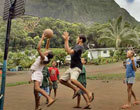
Every adult is in charge of instructing the children in at least one traditional skill, such as killing a wild animal or catching reef fish with throw nets. The children learn the Hawaiian language, memorizing names for plants and creatures, such as the reef triggerfish — the state fish — that Hawaiians call humuhumunukunuku apua'a.
As for Kanahele, his life changed along with the village. Not long after his group moved into the hills, he was convicted of harboring an activist who had refused to pay federal taxes. Kanahele spent four months in federal prison and emerged with an even greater reputation among hard-core activists.
The political establishment continued to warm up to him.
In 2002, then-Gov. Ben Cayetano granted Kanahele a full pardon for his prior convictions and hailed him as "a leader in the Hawaiian community." Kanahele thereafter vowed to avoid all violence, choosing instead a Gandhian path of "passive civil resistance" and "throwing spears of aloha" at his opponents.
With his three children grown and his wife of 28 years busy with her own projects, Kanahele spends his days cooped up in his office in the village. He cobbles together a living as a speaker and consultant on native issues, but his main work is here, on the phone, trying to figure out a way to spread the seeds of Pu'uhonua village.
His vision is to form similar villages throughout the islands.
Recently, the president of French Polynesia, Oscar Temaru, visited Kanahele. Temaru has long advocated independence from France. The two longtime friends compared notes. Kanahele showed Temaru the view from the highest point in the village.
"Let me show you what I showed him, brah," Kanahele said to a visitor.
Walking through several doorways, his hulking shoulders filling them as he passed, Kanahele stepped onto the village road and hiked a short distance to the top of a hill. From there, he gestured north toward Waimanalo and beyond, to a white-sand coastline and a slice of crystal blue ocean.
"This is what sovereignty is to me," he said. "Standing here on your land, not owing anything to anybody, not being afraid of anyone, knowing you fought the right fight with attitude — and looking out at that. This is the beginning, brah, just the beginning."
Copyright 2005 Los Angeles Times


http://www.hawaii-nation.org/rebuilding-kingdom.html
Subscribe to:
Posts (Atom)