3/31/11

OPERATION 8 - Trailer


On October 15, 2007 activists around New Zealand woke to guns in their faces. Black-clad police smashed down doors, dragging families out onto roads and detaining some without food or water. In the village of Ruatoki, helicopters hovered while locals were stopped at roadblocks. Operation 8 involved 18 months of invasive surveillance of Maori sovereignty and peace activists accused of attending terrorist training camps in the Urewera ranges -- homeland of the Tuhoe people. Operation 8 asks why and how the raids took place. How did the War on Terror become a global witch-hunt of political dissenters reaching even to the South Pacific?

Screening soon at The World Cinema Showcase


The Day the Raids Came

Stories of survival and resistance to the state terror raids


Book cover


On October 15th, 2007 an estimated 300 police raided houses all over Aotearoa New Zealand and arrested people based on warrants issued under the Terrorism Suppression Act. Lives were turned upside down as the police searched for evidence of ‘terrorism.’ This book is a collection of oral history interviews of people affected by those raids and the aftermath: defendants, friends, family, supporters and other people subject to the state’s coercive powers on that day.

The case is the first ever attempted use of the Terrorism Suppression Act, a piece of legislation enacted in response to the 9/11 events in New York and Washington DC. The terrorism charges were not brought, but the people arrested continue to face a long journey to freedom as the state seeks to punish political activists and to reinforce the status quo. http://www.rebelpress.org.nz/publications/day-raids-came


 http://www.october15thsolidarity.info/


3/30/11

Tainui supports privately managed prisons


What a bunch of Maori $ellouts. Serco are serial human rights abusers.  Clearly Tuku has no scruples or ethics going into business with dogs like Serco. This is NOT a gain for Maori, this is a money making opportunity for Serco & Tainui Inc. It ushers in the expansion of the prison industrial complex in Aotearoa.

Is it to much to ask Maori commentators & the Maori media need to stop being so sycophantic and start asking some hard questions and start giving some rigorous analysis like . I dont recall one article from a Maori journalist questioning the corporate iwi support for the privitisation of prisons, when the excesses and human rights abuses of the transnationals the want to go into joint partnership with is easy to find.

See Also :


SERCO Sharples Corporate Kupapa

As more and more Western governments use the services of Serco – the British multinational with an unhealthy hold on prisons and detention centres – it’s worth remembering the gross human rights abuses under its watch   http://antonyloewenstein.com/tag/serco/  


 Serco Rap Sheet:

• Serco staff bullied & inappropriately used excessive violence to restrain a mentally ill 14yo boy, lead to his suicide -- the youngest UK death in custody, in a Serco-run detention... facility

• Serco staff refused to address pleas for medical assistance of a meningitis-affected prisoner for four days, dismissing it saying he was “at it” again and “he was probably suffering from the flu and was only looking for tablets”, despite knowing the potential consequences of this in light of his medical history (he had previously slipped into a coma previously from the illness prior to his prison term). Guards told him to take Panadol, their inaction and stalling resulted in his death. He had previously lodged a complaint about his lack of access to medical care for his condition in the Serco centre

• Kilmarnock, the only privatised prison run by Serco in Scotland, has a higher than the national average number of deaths in custody

• High levels of self-harm & suicide in Serco-run centres. Australia’s detention facilities have seen a fourfold increase in self-harm rates in the past year, coinciding with the awarding of Serco’s contract to run Australia’s facilities. Self-harm behaviour has “spread among adolescents” according to Dr. Louise Newman, head of the Detention Health Advisory Group

• People in Serco facilities in the UK are sleeping in toilets to deal with overcrowding, with a “worrying” deterioration in access to GPs and health care and increases in violence and self-harm, following an unannounced visit by independent UK chief inspector of prisons, Anne Owers

• ‘Squalid’ conditions with ‘institutional meanness’ with Serco denying detainees pillows and toilet seats – Owers

• Suicide attempt and subsequent death of asylum seeker detained at Serco-run UK Colbrook Immigration Reception Centre. This followed obfuscation from Serco staff & the denial of help for his ongoing mental illness, including the removal of his anti-depressants upon his arrival in detention during a high at risk time for his mental stability

• Similarities between desperate protests in Serco-run immigration centres and prisons in UK and Australia. In the past six months in Australia, we have seen recurring hunger strikes at Darwin and Villawood IDC, public protests involving self-harm at Villawood, and regular breakouts at Darwin IDC.

• A death in custody at Serco-run Curtin IDC due to unspecified ‘health condition’ after being found unconscious, unofficially reported to be a heart attack from a congenital past condition. This raises questions as to the provision of health care at Curtin – if staff were aware of his apparent condition, what measures were taken to prevent an incident like this occurring? If they were taken, why did they not prevent his death?

• The suicide of detainee at Villawood IDC followed Serco staff dismissing attempts from refugee advocates becoming involved in dissuading the detainee from the roof. This included a Serco staff member hanging up on a phone call from a concerned friend. The detainee jumped to his death a short time later. Following his death, Serco staff cancelled a previously planned memorial service for the deceased by detainees at midnight the morning of the service. No reason was given for this.

• The next day, a group of asylum seekers took to the roof while a hunger strike continued inside Villawood. After they publicly self-harmed and were denied water and food until their return to the ground a day and a half later, a second group of detainees took to the roof. A member of this group also self-harmed, slipping into unconsciousness. Following their return to the ground, their advocate has said Serco staff have punished their protest with separation detention.

• Allegations of sexual abuse of children at Serco-run Leonora Alternative Place of Detention, with Serco staff unable to prevent the alleged abuse occurring.

• Disturbing sexualisation of children in UK Serco immigration detention centres: “One parent spontaneously complained that he had found his daughter in the [UK Yarl’s Wood Immigration Detention] centre without any clothes on. His child explained that she had been encouraged to undress and play “sex games” instigated by another detained child. This father felt that there was inadequate supervision of the children within the center and after this incident he no longer allowed his children to play with the other children. Another mother spontaneously commented on the sexualized behavior of children within the center.”

• Illness outbreaks of viruses and skin-based diseases affecting children in overcrowded UK Serco immigration detention centres

• Serco combines violent prisoner populations with asylum seekers, resulting in “dangerous” environments (Owers) at UK immigration detention centres

• Violent force from Serco staff ‘high’ (Owers) at UK’s Colnbrook IDC

• Serco use separation detention for long periods to manage difficult detainees in UK immigration detention, including separating mothers from children

• Quality and quantity for meaningful education and training for detainees ‘insufficient’ (Owers) for long periods in UK immigration detention facilities

• Excessive control & violent restraints used by Serco staff at UK Yarl’s Wood IDC on women and children. Generally aggressive and rude temperament of staff disrespectful of detainee human dignity

• Yarl’s Wood IDC women detainees have taken Serco to the High Court in March 2010, questioning their inhumane treatment from guards. Some have stripped naked to protest “being treated like animals”

• On 8 February 2010, their peaceful protest was met by attacks from Serco staff and forced confinement in a locked corridor without access to water, food or medication

• Detainee allegations of ongoing racist abuse from Serco staff in UK IDCs

• Requests for medical assistance and welfare of children ignored, denied and/or substantially delayed by Serco staff at Yarl’s Wood IDC

• Meetings between government agencies and Serco to consider the implications for women and children’s welfare of prolonged detention focused on public relations management and potential counter-legal concerns, instead of ongoing independent accountability for detainee health and dignity

• Serco continues to refuse to be interviewed on its activities in running Australia’s immigration detention facilities. Why?

References:

A. Owers, Her Majesty’s Inspectorate of Prisons, ‘COLNBROOK IMMIGRATION REMOVAL CENTRE – SIGNIFICANTLY LESS SAFE’, Press Release, November 2007, <http://www.justice.gov.uk/inspectorates/hmi-prisons/docs/colnbrook_pn-rps.pdf>

M. Wainwright, ‘Report into death of boy, 14, calls for reform of youth custody’, The Guardian, September 3, 2007, <http://www.guardian.co.uk/uk/2007/sep/03/ukcrime.prisonsandprobation/print>.

Associated Press, “New inquest ordered into teenage boy's death in custody”, The Guardian, 22 January 2009, <http://www.guardian.co.uk/society/2009/jan/22/youngpeople-deathsincustody/print>.

A. Lorek, K. Ehntholt, A. Nesbitt, E. Wey, C. Githinji, E. Rossor, R. Wickramasinghe, ‘The mental and physical health difficulties of children held within a British immigration detention center: A pilot study’, Child Abuse and Neglect, vol. 33, 2009, pp. 573-585 <http://www.childrenssociety.org.uk/resources/documents/Campaigns/19432_full.pdf>

K. Smith, “Inmate’s pleas for aid overlooked four days before death”, The Sunday Herald (Scotland), July 20, 2008, <http://www.sundayherald.com/news/heraldnews/display.var.2403695.0.inmates_pleas_for_aid_overlooked_four_days_before_death.php>S. Gaines, “Inmates sleep in toilets at overcrowded prison”, Sunday Guardian, July 22, 2008, <http://www.guardian.co.uk/society/2008/jul/22/doncaster.prison/print>Institute of Race Relations, “Kenny Peter's inquest points to asylum failures”, 5 October 2006, <http://www.irr.org.uk/2006/october/ha000013.html>E. Dugan, ‘Mothers detained in immigration centre hold 'naked' protest’, The Telegraph, April 11, 2008, <http://www.independent.co.uk/news/uk/home-news/mothers-detained-in-immigration-centre-hold-naked-protest-807802.html>Y. Narushima, ‘Self-harm rates increase fourfold’, The Age, October 4, 2010, <http://www.theage.com.au/national/selfharm-rates-increase-fourfold-20101003-162r8.html>L. Marshall, ‘Detained refugee dies in Perth hospital’, 31 August 2010, Independent Media Centre Australia, <http://indymedia.org.au/2010/08/31/detainee-dies-at-curtin-detention-centre>

3/28/11

Te Whanau Apanui Tukino! Stop deep-sea oil drilling


"This is a hugely important protest. It draws the links between the Crown Minerals Act, the Resource Management Act and the new Takutai Moana Act to show how devastating the confiscation of rights for Maori is by virtue of the Maori Party sell out."

3/26/11

Flotilla gathers for Petrobras protest


Te Whanau a Apanui has put out the call for a water-borne protest against Brazilian oil giant Petrobras's plans to prospect in the Raukumara basin.

Spokesperson Dayle Takitimu says vessels with links to the Nuclear Free Flotilla, Greenpeace, Forest and Bird, and Coromandel Watchdog are expected to be part of a flotilla leaving Auckland for Cape Runaway on Sunday in the hope of encountering Petrobras survey boats.

She says unlike some other iwi, Te Whanau a Apanui isn't interested in deals with miners.

“It's not about the money or greater ability to invest or joint venture with these companies. Whanau a Apanui just don’t want this activity occurring on our back doorstep when there is so much risk involved,” Ms Takitimu says.

She says all New Zealand is under-threat if there is an oil spill from the drilling.

Flotilla heeds iwi’s call to stop deep sea oil


Flotilla heeds iwi’s call to stop deep sea oil

Auckland, 23 March 2011: In response to a call to oppose deep sea oil drilling from East Cape iwi Te Whanau a Apanui, a flotilla of ships is to set sail from Auckland, for the East Cape, this Sunday.
Te Whanau a Apanui today redoubled their call for nation wide support in their opposition to deep sea oil exploration and drilling in the Raukumara Basin, East of their tribal lands off the spectacular East Cape of the North Island of New Zealand.

A number of groups have already committed to support the cause, including the Nuclear Free Flotilla, who intend to sail from Auckland this Sunday in protest.

Along with the Flotilla members, Greenpeace, Forest and Bird, anti-mining group Coromandel Watchdog, The Coal Action Network (CAN) and climate action group 350 Aotearoa have all promised their support. All are united in opposition to the Government’s current sell off of rights to drill for deep sea oil around New Zealand’s coast.

Te Whanau a Apanui spokeswoman Dayle Takitimu called on the whole country to support their stand, at a time when seismic surveying by Brazilian oil giant Petrobras is expected to begin off the Cape.
“We are resolute in our defence of our ancestral lands and waters from the destructive practice of deep sea oil drilling. This is an issue for all peoples of New Zealand and we call on those who support our opposition to stand with us in defence of what we all treasure,” she says.

As cheap, easily accessible oil supplies run out, the oil industry is opening up new frontiers in its global search for oil reserves. This includes the Arctic, and the areas of seabed the Government is selling off around New Zealand.

As BP’s Gulf of Mexico spill shows, deep sea oil drilling brings with it the very real risk of disaster. The Deepwater Horizon was working in 1500 metres of water. But depths in the Raukumara Basin, where Petrobras will be working, go as deep as 3000 metres.

“No one wants to see oil washing up on our beaches. A drastic spill would cost the New Zealand economy billions, and do enormous damage to our tourism and fishing industries, and our international reputation,” says Greenpeace Climate spokesman Steve Abel.

Daniel Mares, from the Nuclear-Free Flotilla, says: “Climate change, driven by fossil fuels like oil, is comparable to the nuclear threat in terms of its potential to drastically harm the quality and viability of life on Earth.”

Kevin Hackwell, from Forest & Bird, says: “We are very concerned at the potential damage to our marine wildlife of a Gulf of Mexico type oil spill, and this risk is all the more likely given that we do not have a robust regulatory framework around deep sea oil exploration and drilling.”

Aaron Packard of 350 Aotearoa commented that: “350 Aotearoa is clear that reducing emissions that result from fossil fuels, will not happen by drilling up more fossil fuels. Our continued ignoring of this will mean that the positive legacy we wish to leave will not be possible, and that our accruing carbon debt will continue to be passed onto our youngest citizens, and those yet to come."

The Government’s push to open up New Zealand to foreign oil companies was announced under the ‘Petroleum Action Plan’ in 2010, as part of a package of fossil fuel-based economic strategies that included removing ‘Schedule 4’ protection to parts of the conservation estate. Opposition to this culminated in a massive public demonstration in Auckland in May 2010, after which those plans were dropped.

A public send-off event will be held on the western side of Princes Wharf, downtown Auckland, to farewell the Stop Deep Sea Oil Flotilla on its journey to Cape Runaway (East Cape), on Sunday March 27, at 12.30 pm. Well wishers are invited to turn out in boats, or on foot, to support the send off at that time. All groups will meet at Cape Runaway on April the 2nd.

The public can also help ‘stop deep sea oil’ by going to: www.stopdeepseaoil.org.nz


3/24/11

Youth declaration a promise to fight on for the Takutai Moana


We object to the Political Party named “The Maori Party” within the New Zealand Government, voting in support of the legislation named “The Marine and Coastal Area (Takutaimoana) Bill.

This legislation violates and breaches Maori Rights embedded in the treaty named “Te Tiriti O Waitangi” and the Declaration named “He Whakaputanga o nga Rangatira o Niu Tireni”.

We also object to the Maori Party,s continuation of support to this legislation.

Therefore,we would like to state Maori Party’s vote of support for the Marine and Coastal Area Bill DOES NOT represent our support or tautoko.

We request that the Political Party named the Maori Party cease immediately their continuation of support of the “Marine and Coastal Area(Takutaimoana) Bill, as it continues to violate and breach “Te Tiriti O Waitangi”.

For the asaid reasons given above

We request that Assent is NOT GIVEN to the Marine and Coastal Area (Takutaimoana) Bill by the Governor General of New Zealand.

Petition Here

Marine and Coastal Area (Takutai Moana) Bill - Third Reading - Part 13

Marine and Coastal Area (Takutai Moana) Bill - Third Reading - Part 5

The Tall Man killed Mulrunji for a Song

3/23/11

Lake Tyers Mission - Blockade Benefit


Friday 25th March  at 7:30pm
Sahara Nights
124 Lygon St (near Glenlyon Rd)
 
Lake Tyers Aboriginal Mission is being TAKEN BACK by the people. No more government steamrolling. No more being dictated to by bureaucrats. No more racism.

This is a benefit for the struggle. Some of the women from the blockade will be in town and can fill you in on the situation on the ground. Won't read about it in the newspaper!

Sahara Nights is a beautiful, chill Egyptian restaurant with awesome food, a great sound system, and a stupidly large collection of shishas (hookahs). Up the top of Lygon St, near Glenlyon Road.

Come one, come all.


Musicians (so far...)

Justin Love - reggae/soul
Jake Hapeta from Kia Kaha
Zessie Lloyd
DJ Dustyn Tonks
DJ Pyro (Jeff Pyrotek)

What's going on:
19:30 - Dinner, Shishas, info and mingle
21:30 - Speakers from the Blockade
22:00 - Music starts
23:30 - Let's boogie
01:00 - Get outta here already!

Entry = $10. Includes first drink at the bar. 
 
 Brought 2 U by Lake Tyres Solidarity

Ka pu te ruha ka hao te rangatahi !


 _MG_8109

_MG_8111

_MG_8112


_MG_8114

pics thanks 2 tillnet

3/22/11

Ko nga rangatahi nga rangatira mo apopo


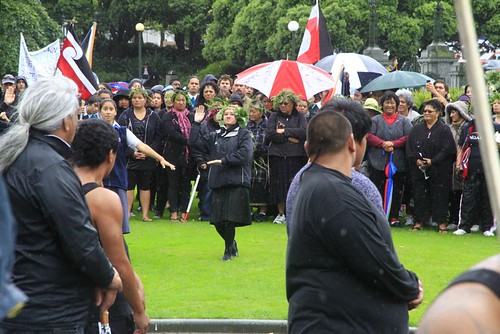
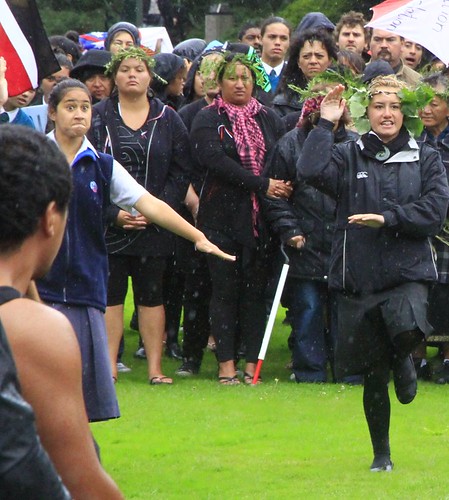
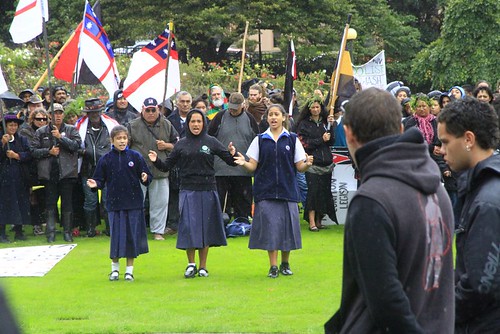
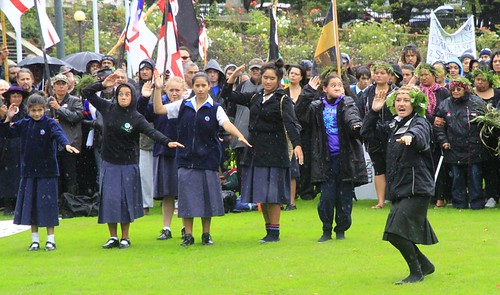
And our Rangatahi are those that lay down the instruments of theft... The New Zealand Flag, The Maori Party Flag, the Takutaimoana Act, the Marine and Coastal Area Bill. These Rangatahi have been on the march since it left Te Hapua. They have my greatest respect.  Annette Sykes

Dr Rawiri Taonui talks about the Taku Tai Moana Bill


‎"This is a modern day confiscation"

Kaipara and Auckland elders demand Maori Party return taonga

Gas 'fracking' alarm sounded


Climate Justice Taranaki organisers
CAMERON BURNELL/Taranaki Daily News
 
NOT IN OUR BACKYARD: Environmental activists and Climate Justice Taranaki organisers Emily Bailey and Urs Signer on farmland in coastal Taranaki which they believe is being surveyed for gas and oil exploration.
 
Click here to find out more!
Taranaki climate change activists are calling for residents to stand up against the region's growing oil and gas industry.

Parihaka residents Emily Bailey and Urs Signer have organised a public meeting in Okato tonight to discuss the issue.

The pair are part of the group Climate Justice Taranaki, which is concerned about the effect a new drilling technique called "fracking" is having on waterways and farmland.

An American documentary has suggested fracking involves injecting millions of gallons of water and sand, and hundreds of proprietary chemicals under high pressure into a well to allow gas to flow more freely.

Mr Signer said a survey company contracted by Todd Energy had started seismic surveying in recent weeks along the coast between Okato and Rahotu.

The Taranaki Daily News sought comment from Todd Energy on the issue but the firm had not responded last night.

"With 30 new oil and gas exploration permits for Taranaki, Maritime NZ says we now live in the most likely place for a major oil spill in NZ, threatening wildlife, kaimoana and our own beaches," Ms Bailey said.

She said some landowners were stopping the survey by blocking access to their land, and that the group hoped the meeting would encourage more people to do so.

"If we can stop the surveying now they may struggle to get drilling permits and we can stop the rigs being put up around us."

There were contradictory accounts from workers and the Government about what depths were being drilled at, she said.

"We're worried the oil companies are not releasing all the information about what chemicals they use, as well."

Mr Signer said that in the United States most of the research about the effects of the gas industry had been done by the companies themselves, and there seemed to have been little analysis completed in New Zealand.

"Most of what the Taranaki Regional Council has looked at is what is coming out, such as the drilling waste, but we're concerned with the chemicals that are going in with fracking. There's a mix of about 600 chemicals," he said.

He believes gas companies should give more information about what they are doing and what research they have completed.

The Climate Justice Taranaki public meeting is tonight at Hempton Hall in Okato at 7pm

Source