Showing posts with label Takutaimoana. Show all posts
Showing posts with label Takutaimoana. Show all posts


4/8/11
Haere Atu Petrobras
This Ngeri was written at the request of Ani Pahuru-Huriwai in protest of the PETROBRAS hui called at Hinerupe marae. It was completed on the 6th of April 2011. It focuses on the power of unity in challenging times and in times of hardship. It calls for all people to unite and together, overcome adversity.
Here are the kupu and whakapākeha.
Kekē-pōhatu... kekē tī kekē!
Kekē-pōhatu... kekē tī kekē!
Kekē tī Kekē-pōhatu hurihuri, hau-kauangaroa,
Katakata te Raukūmara ā haha!
Aha, Hiti tā-hiti... kekē tī kekē!
Hiti tā-hiti... kekē tī kekē!
Hi!!!
The stones rattle,
The stones rattle,
The stones rattle and turn, coming together to create crossings through vast waters
With a rumbling that echos through the Raukūmara
Build the stones high, let them rattle,
Build the stones high, let them rattle!
Na Robert Ruha i tito.
Callout for global support and solidarity : Maori communities face off with Petrobras over drilling permit
Source
Your support and solidarity is urgently needed!
Tino Rangatiratanga Flag : symbol of Maori self determination which embraces the spiritual link Māori have with Papatuanuku (Earthmother) and is a part of the international drive by indigenous people for self determination.
1. Contact media in your country, write a press release supporting the communities in New Zealand that are threatened by mining activities and supporting their efforts to defend themselves. International media coverage is needed to put pressure on Petrobras and the New Zealand government NOW.2. Use this information to alert your colleagues, networks and members of your organisation to what is happening in New Zealand through email lists, newsletters, magazines, bulletins etc.3. Send a message of global support and solidarity to nodrillnz@gmail.com. Let these communities know that they are not alone, and that they are a part of a global movement for climate justice.4. Consider taking action against Petrobras in your own country as a way of supporting what is happening here, and building links between your organisation or community fighting Petrobras [or other extractive companies] and the communities of Aotearoa threatened by fossil fuel exploration projects.PETROBRAS AND THE CO2LONISATION OF AOTEAROA
On the 1st June 2010, just 42 days after the BP Deepwater Horizon oil spill and 44 days before the well was capped, Brazilian company Petrobras was awarded by The New Zealand Government a five year exploratory license for oil and gas in the Raukumara Basin, situated in the East Cape / Bay of Plenty region of the North Island of Aotearoa (New Zealand). The license starts from a mere 4 kilometres offshore and goes out to 110 km. The granted permit area is 12,330 sq km. The New Zealand government sees just 6% of the profit Petrobras makes. If the project goes ahead, Petrobras will bring in their own workforce and maybe offer a few short term jobs.
The area for exploration is the traditional fishing grounds of indigenous peoples from the tribes and sub-tribes of Te Whānau-a-Apanui and Ngāti Porou. There was no prior consultation with these communities whatsoever.
The New Zealand National Party was elected in 2008 to lead a coalition government that has been committed to opening up the land and sea around the country for oil, gas and other minerals extraction in the interests of national economic development. A policy to mine pristine conservation lands was abandoned in 2010 when huge public opposition, supported by many environmental organisations, expressed widespread opposition to the plan, however, the areas remaining open to exploitation cover an area 42 times greater than that which is currently being mined, across most of Aotearoa.
A visit from a vessel contracted to Petrobras is expected to arrive off the East Cape on the weekend of the 2nd-3rd of April 2011. In response to a call to oppose deep sea oil drilling from East Cape iwi (tribe) Te Whanau a Apanui, a flotilla of ships is to set sail from Auckland, for the East Cape to confront the exploration vessel. People are being asked to light fires on the beaches and hui (meetings) are being called along the coast to mobilise the communities on land.
LOCAL IMPACTSBP Deepwater Horizon oil spill superimposed on to the Raukumera permit zone
The Raukumara Basin sits on a major and active fault line. In a high seismic activity area such as the Raukumara Basin there is an extremely high possibility that there would be damage to any sub-sea installations (wells, pipe lines) in the probable event of an earth quake. The exploration area regularly experiences +4 or +5 magnitude quakes and lies on the same faultline as the one that recently devastated the South Island city of Christchurch.
The massive oil and gas spill in the Gulf of Mexico, which took three months to cap and spilled millions of barrels of oil, was an exploratory drill. The depth of the exploratory drill
in the Gulf of Mexico was 1500 metres. In the Raukumara Basin proposed depths range from 1500 metres to 3000 metres, yet NZ has almost no capacity to deal with a major spill and has no adequate or enforceable means of compensation. It is entirely unknown what impacts the 240db sonic booms shot from the exploration vessel during the 2d seismic exploration phase will have on aquatic life, particularly regarding marine mammals. The area is at the heart of a well documented whale migration route.
The region’s history revolves around the moana (sea) and the Iwi (Maori tribes) have many stories that speak of the cultural and spiritual significance of the sea. It holds some of the most central and important history of the iwi threatened by Petrobras’s search for hydrocarbons and profit on behalf of its shareholders.
For as long as the Maori communities of the East Cape can remember, their daily lives, tikanga (customs) and whakapapa (ancestry) have been connected to the sea. “The sea is forever in our lives” says coastal community member Ora Barlow of Te Whānau-ā-Apanui.
PETROBRAS THE GIANTThe CO2lonisation of Aotearoa
Petrobras has recently become the third biggest petroleum company in the world after implementing the largest share offer in the history of capitalism, specifically to raise funds for offshore oil exploration at a time when the world stands on the brink of runaway climate change and global oil reserves are peaking. Increasingly dan
gerous extraction projects are becoming more commonplace in an industry desperate to maintain its grip on the world’s energy systems. As a result, communities most directly affected by the exploitation of fossil fuel reserves are facing unprecedented levels of risk as these companies target what they call ‘unconventional’ fossil fuel reserves.
The New Zealand government has given permission to a foreign company, with an abhorrent social and environmental record the permission to threaten these coastal communities without any prior consultation whatsoever. An oil spill will mean nothing less than cultural genocide for a region that has managed to maintain a great deal of its traditionally cared for land and traditional knowledge of environmental management against all odds. Toka Tū Moana is their renowned phrase (whakatauakii) that declares steadfastness and resilience, standing firm and unshakeable, despite adversity. A great deal of effort is made within these communities to maintain knowledge of traditional environmental management and many programmes are underway to transition these communities back towards states of true community resilience. “Our tipuna (ancestors) practised sustainable living, we can do it too, they relied on whanaungatanga (collective living), and so do we.” – Ani Pahuru-Huriwai, Ngati Porou
However, an oil spill, and climate change itself may well wipe out the entire coastal community’s ability to maintain whatever level of traditional food sovereignty and self sufficiency they have left.
COMMUNITY REACTION
When the government announced their awarding of this permit to Petrobras, local Maori symbolised their opposition to the plans of Petrobras and the New Zealand government by lighting fires along their coastline. Ms Pahuru-Huriwai of Ngati Porou (one of the closest communities to the permit area) said. “This is the way we all informed each other, signalled each other way back – through fire. In this case we’re saying that it’s Petrobras that we’re all against.”.“It’s a serious threat to us and our kapata kai (food cupboard). It’s not just a Maori thing either – we think every Kiwi (New Zealander) has an issue with it. Everyone who is scared of what’s happening, they need to be here.”
Several months later and with no sign of Petrobras or the New Zealand government changing their plans, a music festival under the banner of ‘Stop The Drilling!’ was held in Te Kaha, a region adjacent to the permit area. One and a half thousand people showed up to show their support, dwarfing the resident population of that particular tribal
area. Crowds shouted ‘Stop the Drilling!!’ and spoke of defending their community from attack by sea.
Petrobras have approached local runanga (tribal leaders) and have entered into a process of communication with them. The runanga have communicated to Petrobras the position of the communities that no consent will be given to Petrobras to follow through with the project. Preparations have been made by Iwi leadership to apply for a judicial review of the decision made to grant the permit, and for communication with the United Nations while local Maori have, with support from environmentalists, fishermen and others, established the Ahi Ka Action Group to campaign for a revocation of the permit and a decision not to explore the area.
The Ahi Ka Action Group have distributed 20,000 flyers to raise public awareness of the situation, they have established a basic website and have lobbied local authorities to throw their weight behind efforts to prevent exploration and extraction activities in the permit area. The group has been linking up with individuals and groups in other parts of Aotearoa and overseas who are under threat from mining in their area. A national networking and information sharing website is under development at: www.nodrilling.org.nz
Petrobras has contracted a vessel to undertake the first stage of seismic testing in the Raukumara permit area and this work is due to start in March 2011.
A MOVEMENT IS FORMING
With such a massive proportion of land and sea being opened up to mining companies, communities across the country are getting ready to defend themselves.
On the West coast of the North Island communities of Taranaki are also under attack from land and sea with 13 new onshore/coastal permits and 15 new offshore permits being handed out by the government. Parihaka, a settlement of huge cultural and historical significance which In the 1870s and 1880s became the centre of a major campaign of non-violent resistance to European occupation of confiscated land in the area is already surrounded by oil and gas exploration projects and is now facing even more. The company Greymouth Petroleum is focussing on northern to central Taranaki while companies Kea Petroleum, TAG Oil, Green Gate, L&M Energy and Todd Energy are targeting the rest of inland eastern and southern Taranaki. There is a great deal of concern surrounding the increased use of hydraulic fracturing to access oil and gas reserves in this area, a highly dangerous extraction process recently banned in some places in of the United States.
Down South, government-owned Solid Energy and other coal companies want to mine massive quantities of lignite, a low-quality brown coal, that lies under Southland farmland. They plan to turn it into briquettes, urea fertiliser, and synthetic diesel. At least 6.2 billion tonnes of lignite is technically and economically recoverable in 10 major deposits in Otago and Southland. The in-ground lignite resource is approximately 11 billion tonnes. A wide range of local and national groups are gearing up to stop these developments.
Up North, permits for a wide range of minerals, including gold are spurring communities into defensive action and communities are linking up with one another and a national level movement is coalescing to stop the drilling across the country.
CLIMATE JUSTICE
Of course, this isn’t exactly a new phenomenon, Petrobras and the fossil fuel industry in general has a long and bloody history of threatening the very existence of communities in order to access fossil fuel reserves. “it’s an international issue and we have to make sure our local support is strong and then globalise” – Ora Barlow, Te Whānau-ā-Apanui
While politicians fiddle around in flailing international negotiations to halt runaway climate change, their hands tied behind their backs by the most powerful consortium of companies the world has ever known, these communities, and others directly impacted by the root causes and impacts of the climate crisis are successfully standing together and defeating them in their own back yards.
“We must stand united with other hapu, other iwi, other New Zealanders who care about the environment. We must keep pressure on our government to wake up and show some long-term leadership, make Aotearoa a Renewable Energy Country, no longer reliant on Fossil Fuels like oil & gas, that the human race is quickly exhausting. We are a nuclear free country; we need to be a fossil fuel free country too!” – Ani Pahuru-Huriwai, Ngati Porou
“We must support those who carry this kaupapa for us to the international stage. We must unite with other indigenous peoples and learn from their experiences.” – Ani Pahuru-Huriwai, Ngati Porou
As the case of the BP oil spill and those lower income communities hit hardest by hurricane Katrina illustrates, the communities most vulnerable to environmental destruction are also those most
susceptible to the climate crises. Those hit first and worst are most often the least responsible for the crisis yet are actively leading the fight against major climate polluters. They require globalised support and solidarity in defending their answers to an ecological crisis which they have not caused or reaped untold profits from.
Te Whanau a Apanui spokeswoman Dayle Takutimu has called on the whole country to support their stand, at a time when seismic surveying by Brazilian oil giant Petrobras is expected to begin off the Cape.
“We are resolute in our defence of our ancestral lands and waters from the destructive practice of deep sea oil drilling. This is an issue for all peoples of New Zealand and we call on those who support our opposition to stand with us in defence of what we all treasure,” she says.
LinksContact : climatejusticeaotearoa@riseup.net for global climate justice movement related contact on the situation


3/24/11
Youth declaration a promise to fight on for the Takutai Moana
We object to the Political Party named “The Maori Party” within the New Zealand Government, voting in support of the legislation named “The Marine and Coastal Area (Takutaimoana) Bill.
This legislation violates and breaches Maori Rights embedded in the treaty named “Te Tiriti O Waitangi” and the Declaration named “He Whakaputanga o nga Rangatira o Niu Tireni”.
We also object to the Maori Party,s continuation of support to this legislation.
Therefore,we would like to state Maori Party’s vote of support for the Marine and Coastal Area Bill DOES NOT represent our support or tautoko.
We request that the Political Party named the Maori Party cease immediately their continuation of support of the “Marine and Coastal Area(Takutaimoana) Bill, as it continues to violate and breach “Te Tiriti O Waitangi”.
For the asaid reasons given above
We request that Assent is NOT GIVEN to the Marine and Coastal Area (Takutaimoana) Bill by the Governor General of New Zealand.
Petition Here
3/23/11


3/22/11
Ko nga rangatahi nga rangatira mo apopo

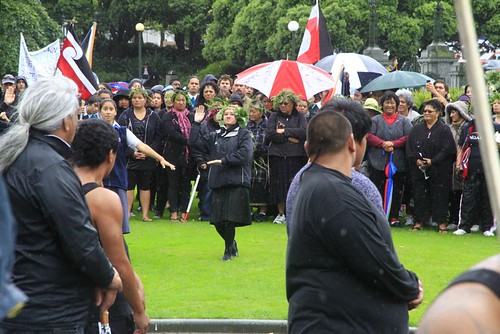
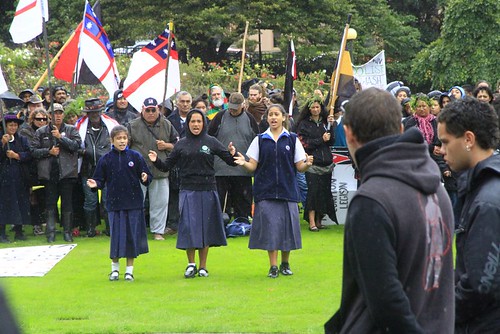
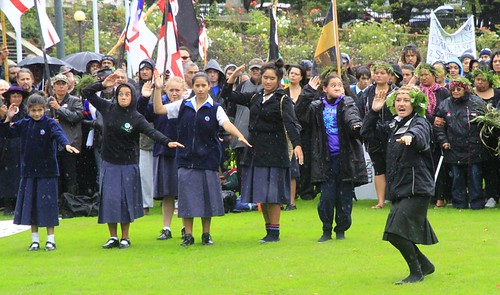
And our Rangatahi are those that lay down the instruments of theft... The New Zealand Flag, The Maori Party Flag, the Takutaimoana Act, the Marine and Coastal Area Bill. These Rangatahi have been on the march since it left Te Hapua. They have my greatest respect. Annette Sykes
3/19/11
3/14/11
MARCH TOWARDS TRUTH AND JUSTICE OPPOSE the Marine and Coastal Area Bill

The NZ Government is making changes to the Foreshore and Seabed Act and renamed it the new Marine and Coastal Area Bill.
- What is the Marine and Coastal Area Bill?
The place where we enjoy and spend time with our friends and family.
The place we teach our children how to swim or build their first sandcastle.
The place we enjoy a game of cricket or simply just throwing a rugby ball around.
The place we gather seafood for family or community occasions
The place we say I do as we celebrate our love for each other
The place we admire the sea views of nature’s beauty
The place we walk, we jog with our dogs, we skate, we run and scroll baby in pram along the seaside footpath feeling the sea breeze as we go about our daily lives.
- Who created this Marine and Coastal Area Bill?
- Why the Government wants to make this Bill legal is...?
Money cannot bring back our love ones
Money cannot buy us happiness
Money cannot build our nation
Money cannot provide us sea life resources
- What the NZ Government intend to use this Bill for?
- To mine on our beautiful beaches, simply means to dig out all our natural resources out of our ocean.
- To oil drill in our harbours, simply means more pollution and no more fish.
- To privatise our shorelines and sell it off to overstate buyers, simply means no public access to our beaches.
- What are the dangers of this Bill?
The NZ Government want to make this Bill legal in the next couple of days, so I am going to MARCH AGAINST THIS BILL, starting 6am from Cape Reinga 14th Monday March 2011, going through to Wellington arriving at Parliament Buildings in due time. If you have great love for our ocean, our environment, our country, our people, our future, you are most welcome to join me on this journey as we March together TO OPPOSE THIS MARINE AND COASTAL AREA BILL
If you want to know more on this issue or want to know where we will be in the next couple of days, you can txt me directly on my phone 0211778111
‘Bring your shoes, placards, banners, flags and most of all your love and support’
COMING TO A TOWN NEAR YOU!

2/16/11
Hikoi to oppose the marine and coastal bill


OPPOSE THE MARINE & COASTAL BILL
HIKOI 2011
TAUTOKO MAI TE KAUPAPA
LED BY:WIKATANA POPATA, AND TE ROOPU MARANGA AKE
WHEN:THURSDAY 24th FEBRUARY, 2011
STARTING FROM: TE RERENGA WAIRUA HIKOI THROUGH TO WELLINGTON
TIME: KARAKIA @ 6am
BRING YOUR WALKING SHOES, FLAGS, PLACARDS, BANNERS
Wikatana Popata Contact details:
021 134 0586, Email/maorilise@hotmail.com
9/8/10
Moana Jackson PRIMER ON THE FORESHORE AND SEABED
‘I once spoke of our people who have their mana attacked being like a beached whale struggling to live…what I say now is to remember how often the sea casts the whale on the shore’.
- Te Ataria, 1889.
‘The question that must always be asked of legislation is not whether it is a legislative compromise or even whether it is practical, but whether it is just’.
- Justice Thurgood Marshall, U.S. Supreme Court, 1970.
This Primer is part of material produced for hui within Ngāti Kahungunu on the foreshore and seabed that began with the original proposals put forward on the issue by the last government in 2003.
It addresses some of the main parts of the new Marine and Coastal Area (Takutai Moana) Bill and asks questions about the new regime it establishes for the foreshore and seabed.
It tries to provide some context for the Bill by considering the grounds that have compelled Māori to so forcefully and consistently voice concern about the issue over the last several years - it considers the attempts the people have made to avoid being ‘beached’ by the various Crown proposals since 2003.
It also tries to apply the test for legislative legitimacy outlined by Justice Marshall and assesses whether the Bill is just.
It regrettably concludes that it is not.
It further concludes that the proposed Bill simply consolidates the main inequities of the 2004 Seabed and Foreshore Act that the Waitangi Tribunal found to be problematic in terms of Te Tiriti o Waitangi and the United Nations Committee on the Elimination of Racial Discrimination held to be racially discriminatory.
In that context the Prime Minister’s statement that the Bill will be a full and final settlement of the issue is simply inaccurate because rather than removing the injustice it actually compounds it.
- Moana Jackson.
There were three main grounds of opposition.
1. The Act was a confiscation of Iwi and Hapū rights to the foreshore and seabed because it removed title and vested it in the Crown on behalf of ‘all New Zealanders’.
- The act was discriminatory because it required Iwi and Hapū to allow access over areas of foreshore they had an interest in but did not place the same responsibility on Pākehā. It created a basic inequality of obligation.
- The Act was also discriminatory because it denied Māori access to the Courts to seek clarification of rights. It created a basic inequality of legal opportunity.
What did Iwi and Hapū seek?
Repeal of the Act and a replacement piece of legislation that
(a) removed the possibility of confiscation and
(b) was non-discriminatory.
Does the Marine and Coastal Area (Takutai Moana) Bill Repeal the 2004 Act?
Yes.
There has been a lot of work done by the Māori Party and others, including the Ministerial Review Panel chaired by Justice Edward Durie and countless submissions by Iwi and Hapū to ensure its repeal.
Does the new Bill remove the inequities in the 2004 Act?
No.
Indeed in many ways it simply enshrines them in new language.
How does the new Bill address the issue of confiscation?
The Bill does remove the idea of vesting the foreshore and seabed in the Crown.
However it still takes Iwi and Hapū interests off Māori and vests them in a new construct called a ‘common space’ in the marine and coastal area.
It remains a confiscation because it is still a taking from Iwi and Hapū. The only difference is that the final destination of the confiscated land is given a new name.
What does the ‘common space’ mean?
It is a legal fiction denoting an area that nobody owns and within which no-one is allowed to have new private title.
Does the ‘common space’ apply to all the foreshore and seabed around the coast?
No.
It effectively only applies to area in which Māori might have an interest and specifically excludes the large majority of foreshore currently held by others under private title.
Does the new Bill have rules around the ‘common space’?
Yes, which is why it is a legal fiction.
For example on one hand it says it is a common space no-one owns and on the other it outlines in great detail the authority and control the Crown has over it.
It thus has specific provisions for absolute Crown ownership of certain minerals in the ‘common space’ with the associated power to grant licenses for those minerals. It asserts Crown ownership rights over an area that no-one is supposed to own.
How does it address the issues of discrimination?
It doesn’t really.
The continued confiscation is itself discriminatory because areas held by others are not subject to the same taking and subsequent vesting in the ‘common space’. Only Māori are discriminated against in this way.
The Attorney General Chris Finlayson has nevertheless stated that ‘the Bill, unlike the Foreshore and Seabed Act 2004 which it replaces, treats all New Zealanders, including Māori, without discrimination’.
Yet the Bill clearly discriminates between Māori and other New Zealanders in all sorts of other quite specific ways.
For example while our people have always been willing to allow access we have always asked that Pākehā in similar situations be required to do the same. Under the Bill they do not have to do so, which thus maintains the basic inequality of obligation.
Does the Bill restore the right of access to the Courts?
Yes.
It establishes a new ‘customary title’ in the ‘common space’ that Iwi and Hapū may seek to have recognised in court.
However to establish the title Iwi and Hapū have to prove continuous use of the relevant area since 1840. Because the ability of most of our people to use the foreshore since 1840 has been taken away or limited by actions of the Crown it is going to be almost impossible for most Iwi and Hapū to meet the test.
Indeed research conducted into the previous regime suggested that at least 98% of Iwi and Hapū have been denied undisturbed possession since 1840.
The acceptance by the Prime Minister that the threshold was so high most wouldn’t meet it is both an accurate assessment of the test and a perhaps unwitting acknowledgement of its basic discriminatory nature.
Due process is restored but in a way that maintains the basic inequality of access.
Are there other provisions regarding due process?
Yes.
The newest provision sets a time frame of six years for Māori to prove their so-called ‘customary title’.
This is a particularly odious provision as it introduces something new into the whole discourse of civil and human rights, namely that a right or interest can only exist if people can establish it within a certain time limit.
It is rather like saying for example that the basic right to freedom of speech can only exist if you can prove you have it in six years. Rights are meant to be universal and their universality depends upon them being free of time constraints.
It simply introduces another discriminatory process applicable only to Māori.
Can Iwi and Hapū negotiate ‘customary title’ in the ‘common space’?
Yes, direct negotiations can be held with the Crown but will in practice only be available those few Iwi and Hapū that can meet the relevant test.
It excludes most Māori and will therefore be divisive and create further inequalities.
What is the nature of the ‘customary title’?
It is a new form of title that is neither the customary title recognised in Māori law nor even that recognised in the Pākehā law of aboriginal title.
It is also quite specifically defined as being less than freehold title.
It is therefore a discriminatory title in that others may have freehold in their land contiguous to the moana but Iwi and Hapū can’t – it is a subordinate title predicated on a notion of essentially subordinate Māori rights.
These few issues alone make the Bill discriminatory, unjust, and in continuing breach of Te Tiriti and other relevant international Human Rights Conventions.
Is there a period for submissions?
Yes, although the dates and times have yet to be announced.
4/7/10
Moana Jackson: A PRIMER ON THE GOVERNMENT CONSULTATION DOCUMENT ‘REVIEWING THE FORESHORE AND SEABED ACT 2004’.
‘The test of whether any rights regime for Indigenous Peoples is just or unjust is quite simple – does it recognise an equality of rights and restore what has been taken, or does it assert something else?’
- Kawaipuna Prejean, Hawaiian intervention at the 1991 sitting of the United Nations Working Group on the Rights of Indigenous Peoples.
This Primer has been prepared as part of the ongoing discussion in Ngāti Kahungunu about the foreshore and seabed issue, and in particular the Crown consultation document on the repeal of the 2004 Foreshore and Seabed Act.
It is hoped that it might be of value to others who wish to engage in the discussions and participate in the consultation process with the Crown.
It canvasses some of the main points in the Crown proposals and attempts to relate them to the issues Māori have raised on the subject since 2003.
The Iwi Leaders’ Group has released a detailed commentary on the Crown document and this Primer necessarily addresses some similar issues. However it also focuses on others to determine whether they in fact recognise an equality of rights for Māori and restore what has been taken, or whether they assert something else.
It acknowledges that the document does have positive features in accepting that the current situation in regard to the foreshore and seabed has been both unacceptable and inequitable to Māori. However whether it is a ‘sophisticated’ or ‘elegant’ solution as the government claims is another question because ‘elegance’ is rarely the same as ‘fair’ or ‘just’.
On that basis there are several areas in the Crown proposals which need some ‘improvement’ as the Iwi Leaders’ Group has stated, and several which need to be elaborated upon further.
However of perhaps more importance is the fact that the Crown’s preferred option for resolving the issue is conceptually flawed – it is based on certain presumptions, both political and legal, which limit the chance for substantive improvement and therefore also limit the possibility that any resolution will actually promote an equality of rights.
It is obvious that the issue is an intensely political one but politics or political expediency should never preclude justice. Neither should they damage the relationship between the Crown and Iwi and Hapu that was envisaged in Te Tiriti o Waitangi. The 2004 legislation did both.
This Primer is based on the belief that there is no need to repeat those mistakes.
- Moana Jackson.
It clearly commits to three main changes –
1. The repeal of the 2004 Foreshore and Seabed Act.
2. The restoration of rights which that Act tried to remove.
3. The restoration of due process. That is restoring the right of those who wish to go to court on this matter to do so.
Does it suggest anything to replace the 2004 Act once it is repealed?
Yes.
It suggests four possible options to regulate the use and protection of the Foreshore and Seabed.
It also suggests in some detail the sort of ‘customary rights and title’ Maori might be entitled to under its preferred option.
What are these options?
1. To fully vest the Foreshore and Seabed in the Crown.
2. To create a radical title for the Crown in the Foreshore and Seabed – that is, the right to regulate subject to Iwi and Hapu rights.
3. To vest full ownership of the Foreshore and Seabed in Maori.
4. To create a ‘No ownership’ regime based on a public domain or takiwa iwi whanui.
What is the Crown’s preferred option?
The ‘No ownership’ regime.
What does this mean?
It is not clear what the notion of public domain would entail but the concept of ‘No ownership’ poses real conceptual difficulties, the most important of which are –
1. In tikanga terms whenua has to belong to somebody just as tangata whenua have to belong to the whenua. The notion of not belonging (or not being ‘owned’ in the document’s language) is a diminishment of the relationship Iwi and Hapu have with the whenua and therefore of whakapapa itself.
2. In terms of Pākehā law it appears to revive the discredited colonising legal doctrine of terra nullius or ‘the empty land’ which once allowed colonisers to take indigenous lands simply by saying there were no people there.
The difficulties were recently highlighted when a leading barrister commented, not entirely jokingly, that if no-one owned the foreshore it was technically ‘empty’ and someone else could come along and take it, just as colonisers have always done.
Are there any other difficulties with the ‘No ownership’ regime?
The idea is also problematic if not deceitful because while the Crown suggests no owner it actually retains for itself a right to control and manage the Foreshore and Seabed that in reality amounts to ownership.
Indeed the document makes no reference to repealing the many statutes which have already been passed to vest ownership in the Crown.
The government has made it clear for example that it will continue to control whatever ‘nationalised minerals’ might exist in the Foreshore and Seabed. Those minerals are petroleum, gold, silver, and uranium. The document makes no clear reference to other ‘non-nationalised’ minerals.
The ‘No ownership’ concept is problematic in another way because it essentially gives the Crown the right to determine whatever Maori ‘customary rights’ might flow from the regime because they will necessarily be subject to, or have to be exercised in relation to existing statutory authorities. Indeed that right to define is akin to the right of an owner to decide what may or may not happen on a particular piece of land.
Are these ‘customary rights’ the rights Iwi and Hapu define according to tikanga?
No.
They are rights which Maori may have used since ‘time immemorial’ but they are actually constrained within the colonising doctrine of aboriginal rights or title. They are therefore a ‘burden’ on whatever authority the colonising power has assumed but they are also able to be extinguished or removed if the Crown decides to do so through legislation or some other means.
The document specifically retains this right of extinguishment. For example it notes that if a customary right has not been exercised because it has been extinguished by the Crown, even in breach of ‘Treaty principles,’ it stays extinguished unless the Waitangi Tribunal recommends otherwise.
The result is that the ‘customary rights and title’ are lesser rights than those enjoyed by others. They are not tikanga-defined or controlled but are rights that one famous Court case described as ‘diminished’ and ‘necessarily dependent’ on the whim of the Crown.
How then would the rights be established if the ‘No ownership’ proposal goes ahead?
The Consultation Document says there are different territorial or title rights and non-territorial or use rights.
They may be recognised either through a court case (the restoration of due process) or through direct negotiation between the Crown and a particular Iwi or Hapu.
As a general rule Iwi and Hapu will have to establish the rights by proving –
1. They have been continuously exercised without interruption since 1840
2. They apply to foreshore continuously occupied without interruption since 1840.
3. They have not been extinguished.
Are these requirements any different to the 2004 Act?
Not really.
They effectively retain what may be called a ‘Crown wins’ test because most Iwi and Hapu have been prevented from continuously exercising them by Crown actions since 1840.
The only possible difference is a suggestion that the Crown may decide it has to prove it extinguished the right rather than Iwi and Hapu having to prove it wasn’t removed, but no firm commitment has been made in that regard.
What ‘customary rights or title’ are then available?
Very few.
They include such things as
- Protection of certain ‘customary activities’.
- Ability to prepare a ‘Planning document’ to be considered by local bodies in their District Plans and applications under the Resource Management Act.
- Ability to grant or withhold permission under ‘customary title’ for activities requiring a resource consent from a local body.
Do Iwi or Hapu with these titles have to guarantee public access?
Yes, and Maori have always of course agreed to do so.
However there is a fundamental inequality in this requirement because others with freehold title to land on the foreshore do not need to grant access. It is only Maori with a ‘diminished’ title over a tiny piece of the foreshore who have to do so while those who control over 80% of it do not.
Can the other options be considered?
Technically yes, although the government is clear about its preferred option. Indeed it has said if Maori do not accept it the 2004 Act will remain in place.
That seems an unfair threat and hardly a good basis for a proper Treaty-based resolution.
Yet there are other possibilities that will address the concerns many people have while allowing a resolution for Maori that will recognise an equality of rights and restore what has been taken rather than assert something else as the current option does.
8/2/08
Race is on for minerals
The race for minerals in the seabed in the Pacific including Fiji is well underway. Leading the race in Fiji is Nautilus company an Australian-dominated but listed on the Toronto Stock Exchange and now leading the charge in the Pacific.
The Nautilus official website confirms that it holds more than 370,000 square km of licences and exploration applications in Papua New Guinea, Fiji, Tonga, the Solomon Islands and New Zealand along the western Pacific Ocean's Rim of Fire.
However surfacing in the debate or race for minerals is the United Nations law of the sea convention regarding boundaries for three countries and the fact that Fiji, Tonga and New Zealand share Minerva Reef to the South of Fiji as a common boundary mark.
continues here
See Also: Thanks to Mines and Communities
Report Minerals Group Wins Pioneering Award 29-11-2005
Statement In bed with Placer 29-11-2005
Statement In bed with Placer 29-11-2005
Statement India Update 10-12-2005
Statement India Update 10-12-2005
Statement Australian miner looks to sea floor 19-01-2006
Report Riches Calling From Deep Under The Ocean 24-05-2006
Statement The imperative to ban seabed mining 25-05-2006
Statement The Imperative To Ban Seabed Mining 25-05-2006
Statement Ecosystems threatened by deep-sea mining: report 18-05-2007
Report Tribal Villagers Demand Stop to Deep Sea Mining in Pacific Papua New Guinea a Testing Ground for Con 03-07-2007
Statement Getting in too deep? 19-07-2007
Report Nautilus gets more licences 19-07-2007
Statement Getting in too deep? 19-07-2007
Statement Seafloor copper-gold could be mined in 2010 31-10-2007
Report The Devil in the Deep Blue Sea 14-07-2008
Subscribe to:
Posts (Atom)