Showing posts with label First Nations. Show all posts
Showing posts with label First Nations. Show all posts
10/14/08
Police attack Algonquin families
Police attack Algonquin families at peaceful blockade of highway 117 in northern Quebec from Barriere Lake Solidarity on Vimeo.


9/12/08
Native Americans neglected after Gustav
More than a week after Hurricane Gustav spared the city of New Orleans, some gulf coast communities are still dealing with the storm's destruction.
One Native American community has received no government assistance despite being devastated by Gustav.
Aljazeera's Mike Kirsch reports.
Anyone know how to contact these folks?
One Native American community has received no government assistance despite being devastated by Gustav.
Aljazeera's Mike Kirsch reports.
Why doesn't this surprise me? The oil company wants the land, so they want the Indians to leave, therefore the government will take its good old time to help them. How sad.
They have screwed the Native Americans since they stepped foot on this continent and they are still screwing them.
This would be a good cause if anyone can help these people in any way possible. It's tough times for everyone, but even tougher for them.
Anyone know how to contact these folks?
10/2/07
7/3/07
Indigenous activists face police at roadblock
MEDIA ADVISORY
for immediate release
July 2, 2:45 pm
Indigenous activists face police at roadblock
First Nations activists are continuing the days of action with a
blockade in Saanichton at this hour. Around 30 people are risking
arrest on West Saanich Road between Stelly's Road and Mt. Newton Cross
Road. (See map link below).
Members of the Tsartlip Band, other First Nations and their supporters
are preventing traffic from passing as they protest injustice against
native people.
"This is an action in solidarity with other First Nations across
Canada," Victoria activist Rose Henry said by phone at 2:30 pm Monday.
"We are tired of the poor living standards, tired of poverty, tired of
having no housing, and tired of the treaty process."
"The police are here now. More police are arriving," Henry said. She
requests supporters bring friends to help and bear witness, water,
banners, and other supplies for the protest. Henry said the protest
will go on until 5:30 pm today, assuming police don't move to break it
up before then.
Contact: Rose Henry 250-812-0199 cell
Map:*
tinyurl.com/ywcjbv*
ZoeBlunt (at) gmail.com
earth_first (at) resist.ca
250.361.1876
for immediate release
July 2, 2:45 pm
Indigenous activists face police at roadblock
First Nations activists are continuing the days of action with a
blockade in Saanichton at this hour. Around 30 people are risking
arrest on West Saanich Road between Stelly's Road and Mt. Newton Cross
Road. (See map link below).
Members of the Tsartlip Band, other First Nations and their supporters
are preventing traffic from passing as they protest injustice against
native people.
"This is an action in solidarity with other First Nations across
Canada," Victoria activist Rose Henry said by phone at 2:30 pm Monday.
"We are tired of the poor living standards, tired of poverty, tired of
having no housing, and tired of the treaty process."
"The police are here now. More police are arriving," Henry said. She
requests supporters bring friends to help and bear witness, water,
banners, and other supplies for the protest. Henry said the protest
will go on until 5:30 pm today, assuming police don't move to break it
up before then.
Contact: Rose Henry 250-812-0199 cell
Map:*
tinyurl.com/ywcjbv*
ZoeBlunt (at) gmail.com
earth_first (at) resist.ca
250.361.1876
6/15/07
WASÁSE CALLS ON AFN TO GO BEYOND “NATIONAL DAY OF ACTION” AND SUPPORT SUSTAINED WASÁSE CALLS ON AFN TO GO BEYOND “NATIONAL DAY OF ACTION” AND SUPPORT

COMMUNIQUÉ - FOR IMMEDIATE RELEASE
(WSANEC Territory, Victoria, BC) - June 14, 2007
The chiefs of the Assembly of First Nations (AFN) have encouraged people to organize and participate in a “National Day of Action” to draw attention to and educate Canadians on First Nations issues. In solidarity with those who will be taking action on June 29th, the Wasáse Movement challenges the AFN to go further than this one-day national day of rhetoric and symbolic protest. We challenge the chiefs of the AFN to truly respect their people and to engage in a real strategy of action to improve the quality of life for Indigenous people in this country.
The AFN’s motives for calling this single and limited National Day of Action are questionable. The Assembly’s May 23rd call to action references the removal of the current funding cap on band councils as a focal point for concern, and it is clear that the primary motive behind the National Day of Action is to pressure the federal government to increase funding for the band council system. The Conservative government recent response to the AFN's call for increased funding, in its "Specific Claims Action Plan", and National Chief Phil Fontaine's immediate support for the this deft and distracting move, is an indication that there is no serious intent behind the AFN's position.
More funding for band councils and tribunal for specific claims will not make a difference in the way our people are affected by land-loss, racism, and poverty. We believe creating a better life for our people means fighting for the respect of our inherent rights and the return of our lands through a sustained campaign of political confrontation and direct non-violent action. Wasáse calls on the Assembly of First Nations to go further in responding to the hearts and minds of all the people who engage in the National Day of Action by:
1. Redirecting the agenda and efforts of the AFN inward to strengthen our communities; and,
2. Supporting a strategy of sustained political action and confrontation going beyond June 29th.
“Some of us believe in reconciliation, forgetting that the monster has a genocidal appetite, a taste for our blood, and would sooner tear us apart than lick our hands… We need to stand against history and against those who would submit to it, and with the warriors who want to beat the beast into bloody submission and teach it to behave.” – Wasáse.
6/13/07
NATIONAL DAY OF ACTION & RESISTANCE ANTI- KKKANADA DAY JULY 1st, 2007

The Real National Day of Action & Resistance ANTI-CANADA DAY July 1st
2007!
While the collaborator chiefs of the Assembly of First Nations plan to
march, acquire corporate donations and access government funds on June
29th
, other groups are calling on
Indigenous people and their allies to take grassroots ACTION on Canada
day - the day that symbolizes epic state atrocities and oppression
against Indigenous people, including: genocide, land theft and
occupation, brutality, violence and abuse, and mass child apprehension
and deaths.
Today, Canada continues its program of assault on Indigenous people.
The state imprisonment and death of Elder and Warrior Harriet Nahanee
is oneof many examples of the state's vile mistreatment of Indigenous
people, in particular those who expose and dissent Canada's illegal
theft and occupation of Indigenous lands. Harriet was a 72-year old
Pacheedaht grandmother, married into the Skwxwu7mesh Nation, who was
arrested and imprisoned for protecting the Eagle Ridge Bluff site that
is slated to be destroyed in the expansion of the Sea-to-Sky Highway
for the 2010 Olympics.
Despite her frail health, Harriet was sentenced to fourteen days at
the Surrey Pretrial center; a men's prison and notorious hell hole.
While in jail, where she was inflicted with abuse, and not given
proper medical care in a cell with tens of other inmates subject to
racist treatment, Harriet Nahanee contracted pneumonia. After one week
of release from custody, she was hospitalized and passed away within a
week. Harriet represents hundreds of other Indigenous people who are
criminalized and abused by the Canadian state when they choose to
stand up against and not assimilate into Canadian capitalist society.
Harriet was well known for her use of the Royal Proclamation to
explain how unceded Indigenous lands are illegally occupied and
governed by the Canadian government. The Canadian and provincial
governments continue to attempt to extinguish Aboriginal title and
rights (through litigation and the BC treaty process), dispossess
Indigenous people from their lands, and destroy traditional
territories through mega-development projects.
There are over 500 murdered and missing Aboriginal women in Canada,
yet Canada does not acknowledge this as a 'Justice file,' or as the
responsibility of the justice system. Instead, the unjust deaths are
treated as 'cultural,' and put under a 'Canadian Heritage file.' Where
do the AFN collaborator chiefs stand on this issue? Where were they at
the Pickton trial? Why do they not mention Aboriginal women on their
Day of Action?
Today, there has been more Indigenous children in foster and state
(MCFD) care today then there ever was in residential school (tens of
thousands of Indigenous people who were forced in residential school
are now filing legal cases against the church and state of Canada).
This should be alarming as the number of Indigenous people in abusive
and assimilating residential schools (which instituted cultural
genocide and slave labor) was immense. Children continue to die and be
sexually and physically abused in MCFD care today, as well as
suffering further isolation from their cultural roots.
Everyday in Canada, hundreds of incidents of police brutality
against Indigenous people, namely youth, take place. Police and RCMP
in Prince George and other areas have sexually assaulted Indigenous
girls, police and RCMP have run Indigenous youth over with their cars
in northern communities and other areas, and police and RCMP have
murdered many Indigenous people all over Canada (starlight tours,
deaths in custody, shooting to death, tazering to death, beating to
death, etc.).
Canada remains one of the only countries that does NOT have an
independent body to investigate police and RCMP brutality, murders and
hate crimes. Instead they investigate themselves, and as a result many
police and RCMP literally get away with murder. When Pivot Legal
Society announced the completion of its report, including affidavits
documenting police brutality and violence, the police chief (Jamie
Graham) just simply "retired."
Vancouver BC's hosting of the 2010 Olympics has already aggravated
Canada's abject poverty and homelessness that Indigenous people are
overrepresented with. The estimated number of homeless persons in
Canada ranges from 100,000 to 250,000, 25-30% which are Indigenous
people. Due to skyrocketing housing prices and a lack of affordable
housing and social housing (more focus is made on accommodating hungry
visitors (tourists)), the number of homeless people will surely rise
during the lead up to the 2010 games.
Canada's Dirty History is Repeating Itself...
REFUSE TO ACCEPT YOUR OPPRESSION!
ANTI-CANADA DAY
JULY 1st, 2007
THE REAL NATIONAL DAY OF ACTION & RESISTANCE
Refuse to Accept:
*The unjust state death of Elder and Warrior Harriet Nahanee *Over 500
murdered and missing Indigenous women *Theft and occupation of Indigenous
lands *Child apprehension of Indigenous children *Police, state and
military
violence and brutality *Abject poverty with thousands Homeless
*Criminalization of dissent
Meet at Grandview Park (at Commercial Drive) at 1pm, March to follow For
more information contact: anti.canada.day@gmail.com
Take Action in your own communities!
Let the AFN collaborator chiefs know they don't represent you!
Let Canada know you reject their program of assault!
Native People rise up and take back the land!
5/8/07
Incident At Oglala - The Leonard Peltier Story
Silence, they say, is the voice of complicity.
But silence is impossible.
Silence screams.
Silence is a message,
just as doing nothing is an act.
Let who you are ring out & resonate
in every word & every deed.
Yes, become who you are.
There's no sidestepping your own being
or your own responsibility.
What you do is who you are.
You are your own comeuppance.
You become your own message.
You are the message.
In the Spirit of Crazy Horse
Leonard Peltier
http://www.leonardpeltier.net/
This youtube is a clip, for the entire video go to:
Part one:
http://video.google.com/videoplay?docid=5790917753412875220
Part two:
http://video.google.com/videoplay?docid=-8089944787131579351
4/28/07
Winona LaDuke speaks on Genetic Engineering, Biodiversity and Decentralization
Winona LaDuke speaks on Genetic Engineering, Biodiversity and Decentralization: A view from the Native American. 2003
"Across the continent, on the shores of small tributaries, in the shadows of sacred mountains, on the vast expanse of the prairies, or in the safety of the woods, prayers are being repeated, as they have for thousands of years, and common people with uncommon courage and the whispers of their ancestors in their ears continue their struggles to protect the land and water and trees on which their very existence is based. And like small tributaries joining together to form a mighty river, their force and power grows. This river will not be dammed."
--"Like Tributaries to a River"
Voices from the Gaps http://voices.cla.umn.edu/vg/Bios/entries/laduke_winona.html
During her talk, Winona speaks about the following issues and organizations:
Honor The Earth: a voice for the earth... a voice for those not heard www.honorearth.org
California Interfaith Power and Light: Our faith, our planet, our responsibility - a religious response to global warming www.interfaithpower.org
Save Wild Rice: Protecting Wild Rice from Genetic Engineering www.savewildrice.org
NativeEnergy: Supporting and building new renewable energy projects www.nativeenergy.com
White Earth Land Recovery Project www.nativeharvest.com
Black Mesa Trust www.blackmesatrust.org
Black Mesa Indigenous Support www.blackmesais.org
Black Mesa Water Coalition www.blackmesawatercoalition.org
The Gwich'in Steering Committee: Formed in 1988 in response to increasing threats to open the coastal plain of the Arctic National Wildlife Refuge to leasing for oil. www.gwichinsteeringcommittee.org
Glen Canyon Institute: Dedicated to restoring a healthy Colorado River through Glen Canyon www.glencanyon.org
National Resources Defense Council: The Earth's Best Defense www.nrdc.org
Related videos and websites:
Peabody Coal/Cortez Gold: The Ongoing Rape of Indigenous Land, Water and Air
http://video.google.com/videoplay?docid=4677532421130427782
Sacred Species
http://video.google.com/videoplay?docid=-8679732113106497385
Sacred Land Film Project
www.sacredland.org «
A RADICAL BLACKFOOT TEACHES THE ECONOMICS OF GLOBALIZATION
Jim M. Craven (Omahkohkiaayo i'poyi), Professor of Economics and Business Division Chair at Clark College/Vancouver, speaks at the Globalization of Homelessness and Poverty Community Lecture Series, Washington State University/Vancouver. January 27th, 2005
From the website: www.aradicalblackfoot.blogspot.com
Peabody Coal/Cortez Gold: The Ongoing Rape of Indigenous Land, Water and Air
Peabody Energy/Cortez Gold Mines Barrick/Kennecott Joint Venture: The Ongoing Rape of Indigenous Land, Water, Air and Culture.
Honoring ... all » Our Indigenous Women Activists Tour 2006 Portland, Oregon June 11th, 2006
Carrie Dann Western Shoshone Nation
Louise Benally Dineh (Navaho) Nation
Julie Fischel, attorney Western Shoshone Defense Project
WESTERN SHOSHONE DEFENSE PROJECT www.wsdp.org
"Mission: To affirm Newe (Western Shoshone) jurisdiction over Newe Sogobia (Western Shoshone homelands) by protecting, preserving, and restoring Newe rights and lands for present and future generations based on cultural and spiritual traditions."
"We are who we are because our nation survived here. It is written on our earth." Bernice Lalo, Western Shoshone
"The destruction of these sacred places represents a continued genocide against the Western Shoshone."
http://www.wsdp.org/alerts.htm
NO DIRTY GOLD CAMPAIGN
http://nodirtygold.org/western_shoshone_nation_usa.cfm
BLACK MESA INDIGENOUS SUPPORT www.blackmesais.org
"Relocation is Genocide"
"Entering Sovereign Dine Nation. All people who respect the land, life and laws of the Dine are welcome."
Senate bill SB1003: The Navajo faced with relocation oppose the bill and say relocation would strip them of their indigenous way of life. Since 1974 over 15,000 Navajo and 100 Hopi have been displaced from their ancestral homes in Arizona. Opponents say that the Navajo are being moved off their land so coal companies can mine it. The Bureau of Indian Affairs estimates that less than a few hundred Navajo remain on Black Mesa and John McCain's Senate Bill 1003 would require their imminent removal by 2008. But the remaining Navajo REFUSE TO BE MOVED.
Sacred Land Film Project http://www.sacredland.org/endangered_sites_pages/black_mesa.html
4/24/07
Identity, Justice and Respect: An Honourable Vision for A New Australia

We the peoples, whose voices have been silenced,
We the peoples, of First Nations, of many nations,
We the peoples, the marginalised and privileged children of terra nullius, the asylum children of poverty and war,
We the peoples of Australia seek a better way, a better life and a better nation.
As it stands, Australia is a divided nation, built on invasion and mourning, wealth and poverty.
As it stands, Australia is the bastard child of the British Empire,
So what does Australia stand for?
How can we be a mature nation when the First Nations are denied self-determination, human rights, land justice and voice?
How can we be a mature nation when those seeking the safety of our shores are demonised and imprisoned.
How can we be a mature nation when there is such disparity of wealth and access to services.
How can we be a mature nation when our aspirations are about our hip-pockets and not our values and vision.
As it stands, we are a nation suffering from arrested development – lacking in honour and moral fibre.
A nation’s identity comes from a compassionate inclusion of all of its cultures.
A nation’s identity comes from a willingness to face the truth of the past, the challenges of the present and a willingness to create justice for the future.
Your Voice is a movement/party for the future.
Your Voice stands against policies of exclusion and denial.
Your Voice stands with those who want to create a nation built on justice for the First Nations, treasuring the diversity of our many cultures and respect for the lands and waters of the creator spirits.
Your Voice stands with those who want fairness and rights for all peoples and all individuals.
We therefore put the following policies before the nation based on our themes of identity, justice and honour.
http://www.yourvoice.org.au/
Native flashpoints simmering as backlog of stalled land claims grows
This is pure KKKanda propaganda, and sounds if they are going to steamroll their process through irregardless of the wishes of First Nations.Calling broad based social movements militant when the truth is that are led by Elder women & men, just gives them justification to use all of the states resources to repress these communities standing up for their ancestral rights for their grand children's, grandchildren.
at 17:37 on April 23, 2007, EST.
OTTAWA (CP) - Anger over decades of federal stalling on native land claims is set to erupt in flashpoints across Canada, says former Ontario premier David Peterson.
After mediating several cases, he warns of "a new militancy" among First Nations who've felt ignored for too long. Ottawa must move faster on legitimate claims before growing frustration turns deadly, he said in an interview.
"There's a lot of potentially explosive situations out there."
Peterson says more confrontations are on the way.
"There is hardly a rail line, a road, a pipeline, a hydro line that doesn't somewhere go across disputed property.
"But one of the great frustrations for the aboriginal community is no one has sat down and seriously engaged in discussion about this."
A stack of dusty studies, including a recent Senate report, has slammed the slow pace of settlements.
Native leaders complain that Ottawa acts as both judge and jury - when it acts at all.
Indian Affairs Minister Jim Prentice himself says the system is broken. The number of backlogged claims has soared to about 800 from 250 since 1993.
Prentice said he will soon ask cabinet to approve an action plan. The question is whether he can sway the Conservative government to make potentially costly changes.
The price of not acting may be much higher, observers say.
A new generation of native activists - increasingly youthful, restless and often unemployed - has lost patience, says Peter Russell, a constitutional expert at University of Toronto.
"We're going to have more and more of these flashpoint events. It's an urgent, urgent matter.
"It divides us all. It's very costly and it's unnecessary.
"We have to scream: Government, move! Please!"
Growing tensions flared over the weekend as a splinter group of Mohawks of the Bay of Quinte paralyzed freight and passenger rail traffic with a blockade on a busy Toronto-Montreal line near Deseronto, Ont.
Protest leader Shawn Brant blamed the slow pace of talks around use by developers of a quarry on disputed land. He also said the protest that ended early Saturday is just one in a planned campaign of economic disruption.
On Monday, affiliated demonstrators dumped what they called "toxic waste" from that site on the steps of the Ontario legislature in Toronto.
People inconvenienced by the weekend chaos were understandably angry, Russell says.
"But we're the culprits as much as the First Nations people. We, and our governments, have not been willing to get a process in place that's fair and expeditious. Until we do so, we're going to have more of this - and it'll be miserable."
It's not unusual for legitimate claims to be stalled for decades, as small armies of lawyers and negotiators get rich with little incentive to speed things up, Peterson said.
"I've seen trivial things take 10 years to do. There are professional negotiators who go on forever doing this because there's a lot of people making a lot of money off it."
Peterson has intervened in many cases, including a series of ugly scuffles between native demonstrators and town residents last year over a housing development in Caledonia, Ont.
"It was the worst mass riot going on. People were confronting each other. And the worry was that somebody would be shot."
Good negotiators who understand the sometimes "intense frustration" of dealing with native consensus methods are crucial, he says.
Tensions will only grow between native and non-native communities until Ottawa "rolls up its sleeves" and revamps its policies.
Police who respond to the often super-charged Catch-22 of a native blockade must weigh law enforcement against the potential for all-out mayhem.
Some critics say police and the courts must crack down.
"We know these situations have to be dealt with very carefully," says Sgt. Kristine Rae of the Ontario Provincial Police. "And it has to be done in association with all of the involved parties.
"The main goal for each and every one that does occur is a peaceful resolution."
Power rests with Ottawa to settle the land claims that fuel most incidents, she said.
"'If things are sped up and it helps prevent the demonstrations, I think that's only a good thing for not just the police, but all the communities as well as demonstrators."
4/20/07
From Eagle Ridge to Sutikalh

Harriet resisted the development that threatned her land at Eagle Ridge Bluff. But she also visited other land reclamations and supported her Indigenous allies in their efforts to resist the exploitation on their lands. And as we know the corporation's, government's and VANCOC's appetite and thirst for mega development has not been satisfied yet. They want to carve up the province at an abominal rate, making sure the land is "accomadating" for the hungry visitors that will come in 2010.
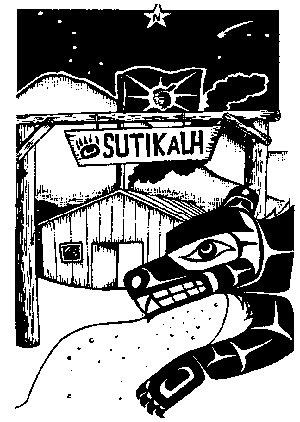
On May 2, 2000, members of the St'at'imc nation and their allies established a permanent camp near Melvin Creek, located off Highway 99 between Mt. Currie/Pemberton and Lillooet, in the southern Interior region of BC.
Known as Sutikalh, the St'at'imc winter spirit of the area, the camp was set up to stop government and corporate plans to build a $500 million all-season ski and recreation resort in an untouched Alpine mountain area.
Part of the Cayoosh Moutain Range, the region is a transition zone from the coast to the Interior. It is habitat to Grizzly bears, cougar, bobcat, wolverine, deer, hawks, owls and many other small animals. It also contains one of the largest herds of Mountain Goats now remaining in North America.
The area has been occupied and used by the St'at'imc for as long as 10,000 years, following the retreat of the last glacial period which carved out the steep-sided valleys and jagged mountain tops.
Along with food gathering, the area was also used by shamans, who went to the mountains for purification, spiritual renewal and training. These traditions continue to be practised today at Sutikalh, where people come to gather foods, medicines, pure fresh water, and to participate in cultural and spiritual activities.
To this day the area remains unceded, unsurrendered St'at'imc territory, in which neither Canada nor BC have legal or moral authority to govern, claim territory or even carry out business.
That both levels of government continue to impose their authority is a violation of Canada's own laws and its highest courts (i.e., the 1763 Royal Proclamation and, to a lesser extent, the 1997 Delgamuukw Supreme Court Decision).
Ugly people wreck havoc on other peoples lives, Beautiful people resist.
Ski resorts and shopping malls are morgues.
Resist the opprssion, resist the atrocities this May:
Sutikalh 7 Year Anniversary Gathering
Come to Sutikalh camp on Saturday May 5, 2007 to celebrate 7 years
of resistance & sovereignty against a proposed ski resort in
St'at'imc territory.
Camp is located off Hwy. 99 midway between Mt. Currie & Lillooet.
Bring
camping gear if you plan on staying weekend (sleeping bag, tent if you
have
it, etc.)
http://harrietspirit.blogspot.com/
For more info contact:
Rosalin Sam 604-894-2400 sutikalh2003@telus.net
Ramona Joe 604-894-2462
4/17/07
Band occupies Manitoba hydro station
Members of a northern Manitoba First Nation have occupied a hydroelectric generating station and say they will not leave until provincial officials agree to meet with them.
The Pimicikamak Cree Nation from Cross Lake has had band members camped out at the nearby Jenpeg generating station since last Thursday.
Band members are protesting against a long delay in implementing the Northern Flood Agreement, an agreement among the federal and provincial governments, Manitoba Hydro and five First Nations affected by flooding caused by hydroelectric projects on the Nelson and Churchill rivers.
Four of the five First Nations have settled their compensation under the agreement, but the process is still ongoing with the Pimicikamak Cree Nation.
Band official Mervin Garrick told CBC the band will stay on the site as long it takes to get a meeting with the government parties involved.
"We've been very, very patient, but with 30 years of waiting and nothing really concrete happening, then people have to take action," he said.
"We have to try and make the government responsible and get them to recognize and implement the agreements that were signed with the First Nations."
Manitoba Hydro officials had agreed to a meeting in Winnipeg today, but Garrick says it's pointless to get together with only one party.
The band will block Highway 6 if progress is not made soon, Garrick said. The highway is the main link between southern Manitoba and the city of Thompson and other points north.
The premier's office was not immediately available for comment.
http://www.cbc.ca/canada/manitoba/story/2007/04/16/jenpeg-protest.html4/13/07
"Ultimate hypocrisy": Indigenous poverty – now and then
| |||
Making a Stand at Desert Rock
On December 12th, 2006 community members in Burnham, New Mexico established a blockade to prevent preliminary work for the proposed Desert Rock coal-fired power plant. More info:
www.desert-rock-blog.com
http://www.indigenousaction.org/
4/12/07
Sutikalh settlement area
Press Release
(April 11, 2007, St’át’imc Territory, Lillooet BC) On April 4, 2007, during the St’át’imc Chiefs Council’s monthly meeting, the final approval for the formalization of a settlement area in Sútikalh (Melvin Creek Cayoosh Creek range) was provided.
This area has received much public attention since an application was put forth by Nancy and Al Raine (NGR Consultants Ltd) for the development of a large-scale ski resort in the area. The ensuing authorization for the ski resort development by the provincial government was extremely controversial.
On August 17, 2000, the St’át’imc Chiefs provided correspondence to Al Raine and the provincial government reconfirming their unified opposition to the planned development based upon the continuing existence of St’át’imc title throughout the territory including the area chosen for the proposed ski resort.
Following direction from St’át’imc people, the St’át’imc Chiefs Council has enabled the development of the Nxekmenlhkálha Lti Tmícwa (land use plan) which is accompanied by the Land and Resource Application Process. These two documents which outline the procedures for land use decision-making form the basis for the formal decision to establish Sútikalh as a settlement area under the authority of the St’át’imc.
When the provincial government began its unilateral considerations and decision-making processes on the Cayoosh ski resort application, several St’át’imc people were concerned to the point of moving into the area to protect it from the proposed development project. Grand Chief Saul Terry, Chairperson of the St’át’imc Chiefs Council states, “St’át’imc people have been living in the Sútikalh area for seven years now and going through this process of establishing the area as a settlement area is more of a formality in order to ensure that the area is protected”.
During his recently completed term as the St’át’imc Chiefs Council Chairperson, Chief Garry John was very instrumental in supporting the on-the-ground efforts to protect the Sútikalh area. Chief John states, “Our people have extensive ties to this entire area and the evidence is there to support our title. The St’át’imc people have provided consistent and unanimous direction regarding the protection of the Sútikalh area.”
The land use decision-making authority being exercised by the St’át’imc Chiefs Council and St’át’imc people is based upon existing St’át’imc title. The process utilizes the values and principles within traditional ecological knowledge systems and this, in turn, provides the model used for the formal establishment of a settlement area by the St’át’imc Chiefs Council.
For further information, please contact:
Grand Chief Saul Terry, SCC spokesperson Chief Garry John
Office: (250) 256-7523 Office: (250) 259-8227
http://sutikalh.resist.ca/index.html
4/7/07
Manitoba chiefs hint at civil unrest
By Alexandra Paul
| |
Manitoba’s aboriginal chiefs laid out a timetable of civil acts this spring leading up to a national day of protest June 29.
The campaign is an effort to focus attention on frustrations over grinding poverty and political inaction on century-old treaty promises for land and resources, Assembly of Manitoba Chiefs leader Ron Evans said Thursday.
If demonstrations and marches don’t work then aboriginal leaders will take more drastic measures, possibly including roving blockades of rail lines, he and other chiefs told reporters.
“We are hoping we don’t have to go there,” Evans said.
Evans outlined the strategy following an emergency meeting of chiefs from many of the 63 first nations in Manitoba who are angry over rising tensions with Ottawa. Winnipeg, with 70,000 aboriginal people, is often called the aboriginal capital of Canada. Another 75,000 live on province’s First Nation communities.
On April 25, there will be a rally of aboriginal people from every corner of the province at the legislature.
In May, First Nation chief will invite federal Indian Affairs Minister Jim Prentice to the province to discuss aboriginal grievances.
If all that fails, then First Nations will stop co-operating on development projects across the province, from proposed hydro dams to logging and mining enterprises.
“Many projects that this province needs to build the economy require the support of First Nations,” said Evans, listing corridors for hydro lines and pipe lines. “They run through First Nations lands and to make those projects success, they need our support,” Evans said.
Tension are rising between aboriginal people and the federal government everywhere in Canada but the escalation appears more pronounced in Manitoba.
“The spotlight is on Manitoba, and with the country watching we will take the lead,” Evans said.
Last weekend, a draft Canadian military manual on counter-insurgents named radical aboriginal groups as potential terrorists.
Last week, Dakota Ojibway Treaty Council and the 35-member Southern Chief Organizations called an emergency meeting to consider roving rail blockades this summer without bothering with demonstrations.
In March, Indian Affairs Minister Jim Prentice threatened funding cuts to native organizations that took part in blockades. Evans threatened to pull first nations out of development projects around the province, effectively halting talks to build hydro dams, power transmission corridors and pipelines, a warning he made again Thursday.
Chiefs say they all agree the problem is grinding poverty and a sense of economic despair — but action to fix it has polarized them.
Some, led by former national Chief Ovide Mercredi, want to use peaceful means of dissent such as demonstrations to draw public support for the aboriginal plight.
A younger generation of leaders like Dakota Ojibway Treaty Council chair Chief Terrance Nelson say only drastic measures, like rail blockades, will satisfy the level of anger among aboriginal youth that only needs a spark to explode.
Leaders say they will start talking to aboriginal people from remote northern communities to urban ghettoes to get out the vote for select candidates in federal and provincial elections widely anticipated this year.
http://www.winnipegfreepress.com/local/story/3936246p-4547988c.html
Subscribe to:
Posts (Atom)